
SOMETIMES a nation’s moral temperature is not taken in Parliament or courtrooms, but on a crowded street, in front of a small shop, during an ordinary quarrel that suddenly becomes a test of conscience.
In a small town in Uttara-khand, India, a Hindu gym owner stepped in to defend an elderly Muslim shopkeeper being harassed over the name of his store. What should have been a forgettable local spat instead became a mirror held up to the country.
The man who intervened, Deepak Kumar, did not carry a banner or a manifesto. He did not arrive as an activist or a leader.
He acted because he saw an older man being humiliated and decided that silence would make him complicit. His now-famous introduction “My name is Mohammad Deepak” – blending identities that are usually kept apart – was not a clever slogan so much as a reminder of a simpler truth: citizenship is not a favour granted by a majority, and dignity is not conditional on faith.
As reported, on Jan 26, Deepak was at a friend’s shop next to a clothing store called Baba School Dress and Matching Centre when a group of activists from Bajrang Dal, a hardline Hindu group, mobbed store owner Vakeel Ahmed, demanding he drop “Baba” from his 30-year-old shop’s name.
They insisted that “Baba” in Kotdwar could only refer to Siddhabali Baba, a local temple to Hindu god Hanuman, so a Muslim had no right to use it in his shop’s name.
A video recording of the incident that had gone viral showed Deepak confronting the Bajrang Dal activists with the question: “Are Muslims not citizens of India?” before introducing himself with the combined Hindu and Muslim names.
Taken aback, the vigilantes retreated. However, a few days later, they returned with more than 150 Bajrang Dal supporters, this time to protest outside Deepak’s gym.
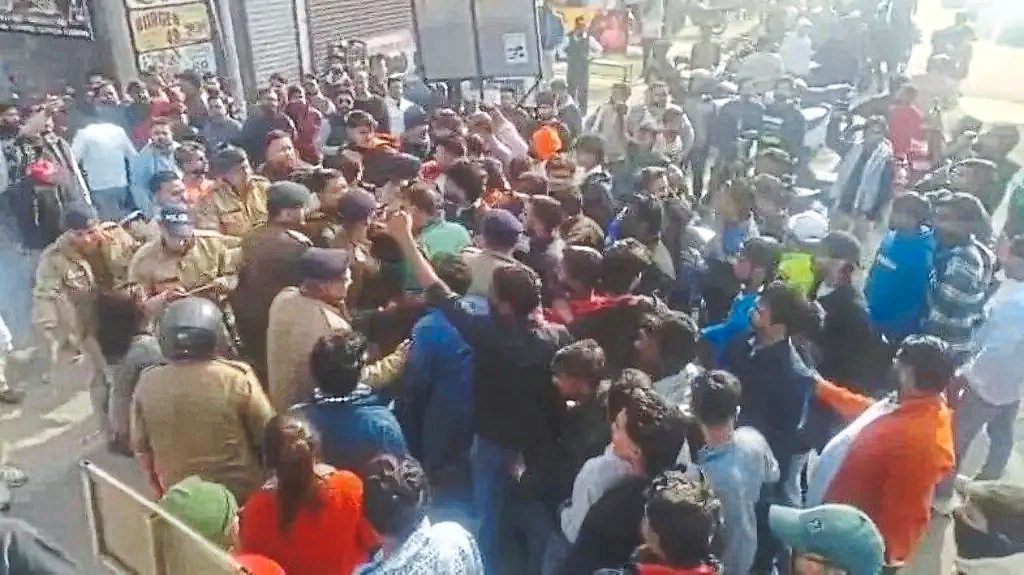
The intensity of the backlash that followed is the more troubling part of the story. That a brief, non-violent intervention could invite protests, police complaints, threats, and economic punishment tells us something uncomfortable about the times we live in. We often speak as if intolerance is only about loud mobs or extreme speeches.
But intolerance also shows up in the way fear is allowed to do the work of discipline – emptying a man’s workplace, unsettling his family, and sending a message to others who might think of speaking up next time.
Equally revealing is the speed with which the episode was turned into a spectacle of heroes and villains. There is a growing gap between symbolic approval and real-world protection. We seem comfortable applauding courage as long as someone else bears the cost of it. And yet, the story is not only bleak.
The quiet gestures of support – from strangers offering solidarity in practical ways – suggest that the social ground is more complicated than the noise suggests.
Beneath the theatre of outrage and intimidation, there remains a large, uneasy middle that does not quite agree with public bullying, even if it does not always know how to resist it. This is why the incident matters beyond its immediate details. It forces a question that goes deeper than any single dispute: What kind of everyday behaviour do we want to normalise?
A society does not drift into intolerance only through big ideological shifts.
It gets there through small, repeated acts of looking away, and it resists through equally small acts of refusal. The man at the centre of this episode did not try to become a symbol. He simply chose not to be silent.
As he had told BBC Hindi, “By identifying myself as Mohammad Deepak, I wanted to tell them that I’m an Indian. That this is India and everyone has the right to stay here, regardless of their religion”.
Choosing to speak up is the real issue here; will such choices remain rare and costly in India or will we be able to build a public culture where basic decency no longer requires unusual bravery?
The answer to that will shape not just headlines, but the texture of daily life itself. — The Statesman/Asia News Network