
YUSUF Omar used to believe that online hate was largely the result of fringe ideas and influences, at least in Malaysia.
But recently, the 25-year-old software developer has realised that it can emerge from many issues, shaped by different groups’ interpretations of events and amplified by technological advances.
“I have seen people going all out debating or arguing over whether VIPs should be allowed to enter restaurants without reservations.
“Or whether those living in the so-called ‘kayangan’ (lofty status) should experience the same traffic jams we endure daily, instead of relying on police escorts funded by taxpayers to clear the way just for them.”
He says such arguments tend to spiral out of control when narratives about “disloyalty to the country” or “disrespect” towards certain figures or groups begin to surface.
“When that happens, I just switch to other social media platforms. It has become a headache looking at things online today.”
Observers warn that such seemingly mundane disputes can become entry points for polarising narratives that escalate into extremist rhetoric when amplified by algorithms and group dynamics online.
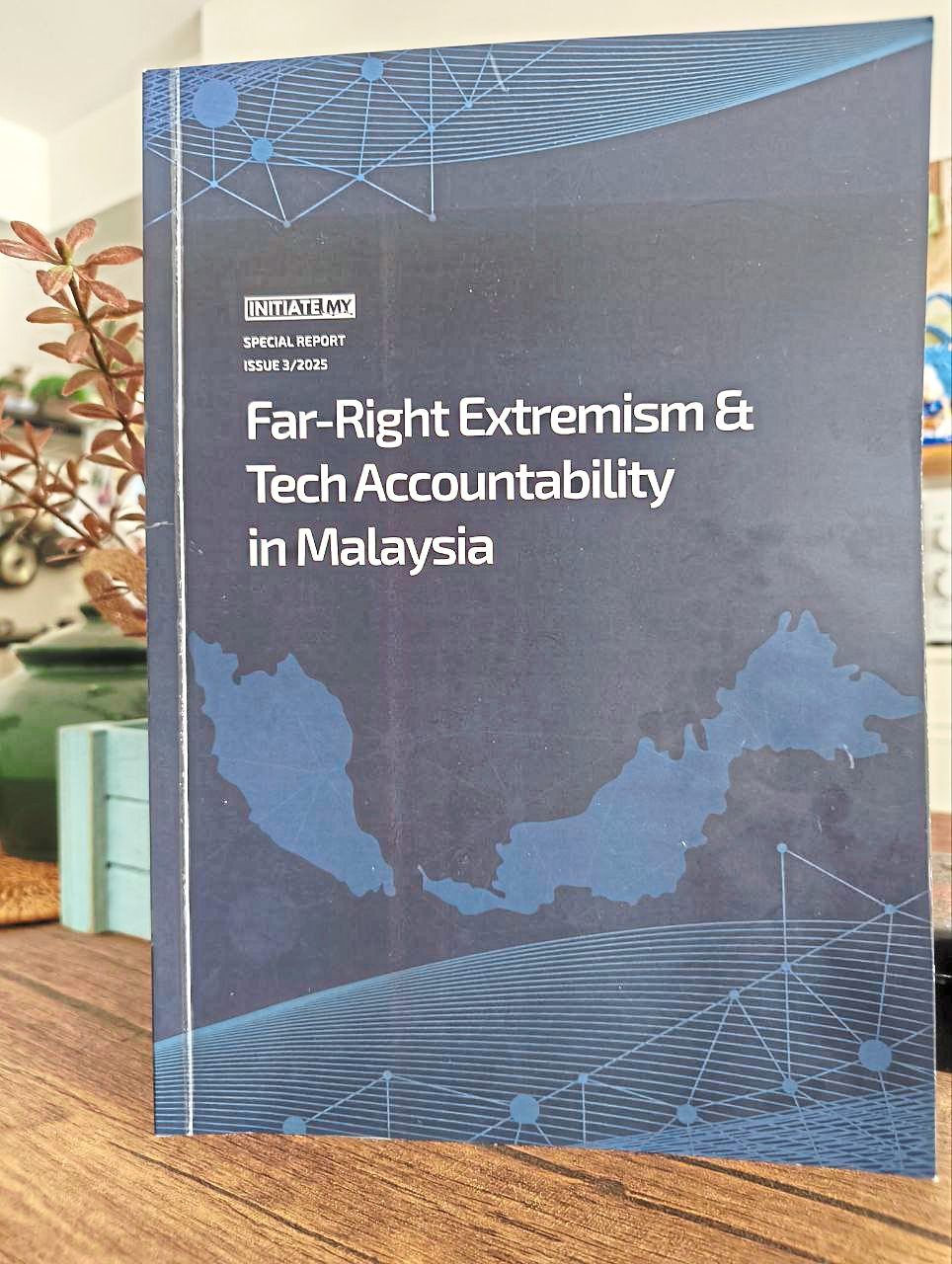
Yusuf’s experience reflects the latest findings by think tank Initiate.my on the amplification of extremist narratives by digital platforms in the absence of effective safeguards. In its special report, “Far-Right Extremism and Tech Accountability in Malaysia”, the organisation warns that this phenomenon threatens national security as well as societal and democratic institutional integrity.
“This threat manifests online and spills into the offline sphere. Analysis of recent case studies shows that up to 86% of online commentary was negative, reflecting a highly polarised and hostile discourse.
“Engagement-driven platform design, weak local moderation and opaque governance systems enable such content to spread rapidly, normalise hostility and escalate online outrage into real-world harm, even when the underlying grievances predate social media.”
Citing the dangers of far-right extremism (FRE), the report notes that online hostility towards Rohingya communities in Penang and Kuala Lumpur following certain incidents, for example, contributed to digital and physical vigilantism, harassment and forced displacement.
“This demonstrates that extremist content on platforms is not merely online rhetoric, but poses tangible threats to public safety.”
Dangerous narratives and AI
The report says FRE trends in Malaysia – and their online-to-offline risks – mirror patterns seen in the United Kingdom and Europe.
In the months leading up to the 2016 Brexit referendum in the UK, for example, far-right groups and nationalist influencers amplified anti-immigrant rhetoric online, followed by a rise in hate crimes offline.
“Globally, FRE seeks to defend a perceived ‘pure’ and dominant majority against political, economic and demographic change. It typically rejects liberal democracy, advances discriminatory and exclusionary rhetoric, intolerance and pseudoscientific conspiracy theories that dismiss evidence and portray governments and international institutions as hostile or corrupt elites.
“In Malaysia, these dynamics take a distinct local form. FRE actors mobilise exclusionary ethnoreligious nationalism that undermines social cohesion and erodes trust in state institutions, including the federal system, law enforcement and the judiciary,” the report states.
It also highlights periods when such narratives are most aggressively deployed.
“Politically aligned far-right actors often weaponise these narratives during high-salience periods, including elections, communal flashpoints and geopolitical crises. The impacts extend beyond rhetoric, manifesting in extremist attitudes and behaviours ranging from dehumanising hate and intergroup hostility to distrust between communities and the state, intolerance and, in some cases, violence.”
As technology advances, these actors increasingly use artificial intelligence (AI) to amplify their messaging. The report says a core tactic involves exploiting digital platforms and AI-enabled tools – including image generators – to spread hate, disinformation and misinformation through algorithm-driven echo chambers, weak moderation and visually compelling content.
“While digital connectivity brings economic and social benefits, it also increases exposure to online radicalisation, harassment and exploitation.
“As of January 2024, Internet penetration in Malaysia reached 97.4%, with 33.59 million users, while social media usage stood at 28.68 million users, or 83.1% of the population.”
Eroding trust
The report also highlights gaps in big tech companies’ policies that govern social media platforms, which can undermine online safety.
“Big tech companies increasingly function as de facto rule- setters of public discourse. Rollbacks in trust-and-safety safeguards, opaque policy shifts, the reinstatement of high-risk accounts and weaker enforcement of community standards can normalise divisive content and reward coordinated inauthentic behaviour.
“The growing reliance on automated moderation at the expense of human oversight widens the gap between policy and practice at scale.”
At the same time, far-right narratives systematically erode trust in public institutions by amplifying perceptions of bias, weakness or complicity. The report cites examples such as the controversy surrounding Global Ikhwan Services & Business Holdings Sdn Bhd (GISB), linked to the banned Al-Arqam movement, and the dispute between Penang and Kedah, in which Kedah Mentri Besar Datuk Seri Muhammad Sanusi Md Nor asserted that Penang “belongs” to Kedah.
“In the GISB case, online commentary accused authorities of selective enforcement, framing the crackdown as politically or religiously motivated. Distrust grew when leaders were released or charges dropped.
“Likewise, in the Kedah-Penang dispute, far right narratives amplified claims that federal authorities were failing to defend what commentators framed as ‘Malay interests’, portraying the government as politically biased and undermining institutional credibility.
“Rapidly spreading online claims and slow official responses further compound polarisation and normalise hostility toward institutions, increasing the risk of spillover into real-world conflict.”
Policy recommendations
The report calls for measures to mitigate these threats through a whole-of-government and whole-of-society approach that balances security with fundamental human rights.
It emphasises the need to address the damage FRE inflicts on institutional trust and social cohesion, and to recognise it as a domestic extremist threat. This includes integrating it into the Malaysia Action Plan on Preventing and Countering Violent Extremism (MyPCVE), with early-warning monitoring, targeted prevention and educational interventions to counter radicalisation.
The report also recommends investing in efforts to combat tech-facilitated hate and violence by mobilising funding from Asean, philanthropic bodies, the private sector, and civil society organisations and platforms to support proactive mitigation.
Highlighting limitations in big tech moderation and governance, it urges stronger content moderation tailored to local contexts. This includes combining AI-powered tools with human oversight to detect coded, multilingual and rapidly evolving harmful content, particularly during high-stakes periods such as elections, high-profile arrests and communal flashpoints.
Protecting personal data and preventing doxxing are also emphasised, with calls to strengthen enforcement of the Personal Data Protection Act 2010, implement systems to detect and remove sensitive information, and establish rapid takedown mechanisms alongside victim-support channels.
The report further advocates multi-stakeholder oversight, treating online safety as a public- good obligation. It calls for greater transparency in content ranking, recommendations and monetisation, and for moderation systems to be co-designed with diverse stakeholders.

Initiate.my executive director Aizat Shamsuddin points out that radicalisation is now faster and more decentralised, often occurring online without formal recruitment structures.
“While STEM [Science, Technology, Engineering, and Mathematics] and AI are critical to national competitiveness, they alone cannot address the underlying social fractures in inter-ethnic and interreligious relations. Sustainable economic and social progress depends on peaceful human-to-human engagement.”

Research director Suyin Chia says deeper risks lie within the structural design of big tech platforms, particularly how content is amplified, monetised and allowed to spread at scale.
“Meaningful tech accountability requires upstream interventions and fixes to the incentives and design choices that consistently reward harm.
“This is not something platforms and regulators should solve alone. Effective and equitable risk mitigation will depend on sustained multistakeholder engagement bringing together government, tech companies, civil society, researchers and affected communities to ensure responses are locally grounded, rights-respecting and suited to our social and political context.”