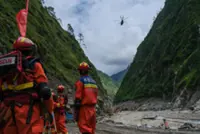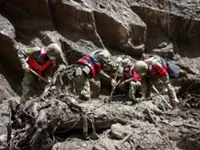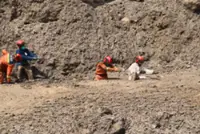
THE ice of the Himalayas is vanishing.
Glacier-clad slopes are turning bare, and the ground atop the range – which stretches across five Asian countries – is slumping as the ice that once held it together disappears.
Meltwater is pooling in valleys, forming deep, unstable lakes.
The pace of loss is alarming.
At Everest’s base camp in Nepal, perched on a melting glacier, the ice has dropped almost 70m since the 1980s. And the danger is often sudden.
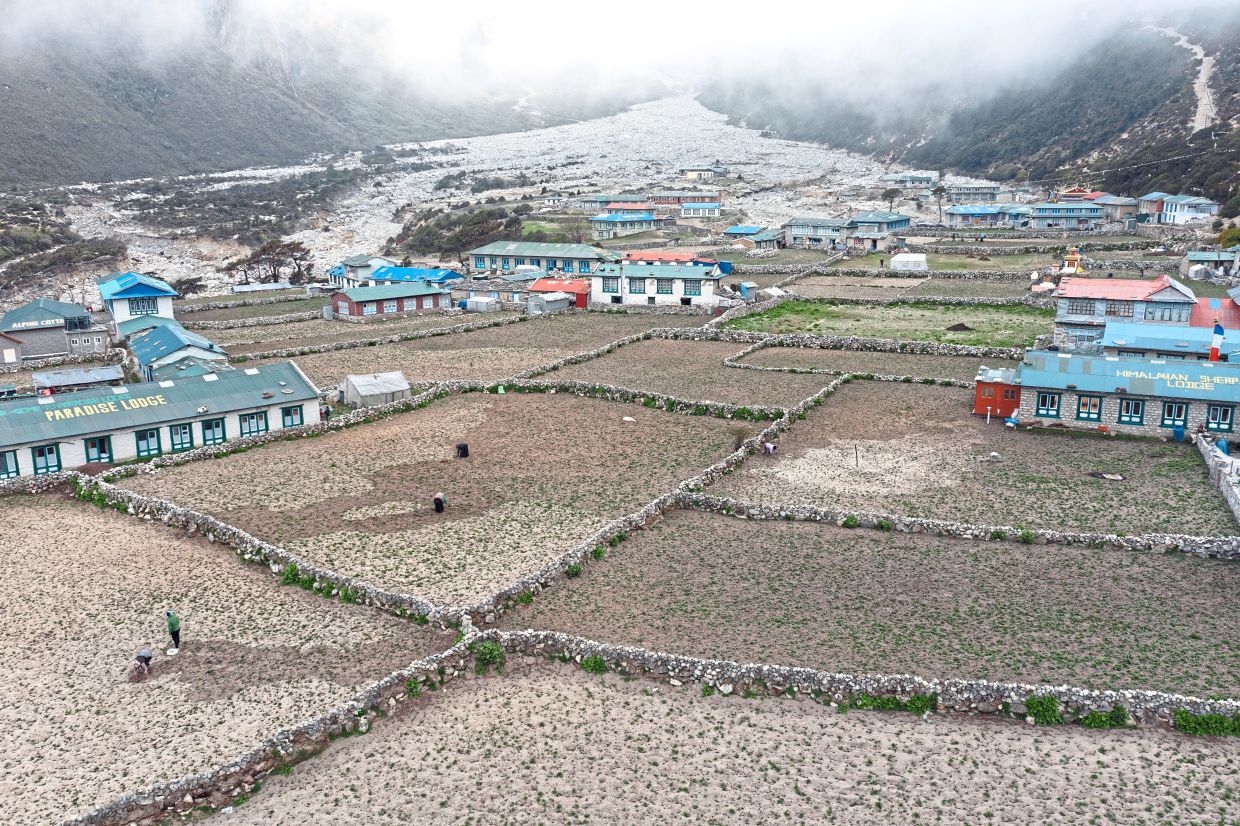
On Aug 16, 2024, in the secluded village of Thame, 370 people were reminded of just how swiftly nature can strike.
A high-altitude lake above the valley, fed by glacial melt for over a decade, had gone largely unnoticed – until rocks tumbled hundreds of metres into it.
The displacement sent millions of litres of water rushing downstream.
Villagers heard a growing roar. By the time the surge reached Thame, it had destroyed the medical clinic and school, flattened two dozen homes and trekking lodges, and washed away entire potato fields.
Glaciologist Scott Watson of the University of Leeds later retraced the flood’s path to the unnamed lake.
Across the fast-warming Himalayas, thousands of similar lakes are forming, each one a potential trigger for sudden avalanches or glacial floods.
“When falling rocks or snow land on a frozen glacier, nothing much happens,” Watson said.
“But as the ice melts and forms a lake, those falling objects can set off a flood that menaces villages, lodges, hydropower plants and anything else in its path.”
Predicting which lakes will burst is difficult. The Thame flood came from a small lake, not even on official hazard lists.
Headmaster Om Prasad Bhattarai, preparing the school’s 32 students for lunch that day, saw the surge charging down the valley.
He urged the children to run. They reached higher ground just as water slammed into the building.
The flood carved a 13m-deep gash through the village, swallowing structures and fields.
Proliferating threats
Glaciers are no longer pristine.
On the Ngozumpa, Nepal’s longest glacier, Watson’s team found rivers of dirt, boulders and milky-grey water.
Ice remains beneath the debris, but meltwater is forming puddles, ponds and increasingly, lakes.
Over time, these join to create ribbon-like waterways across the mountains.
Some lakes are astonishingly deep. Watson measured one at 50m, rising to 67m minutes later.
Dig Tsho, refilled after a catastrophic 1985 flood, reached 80m.
Ice melting releases rocks and boulders, ready to crash into the water and trigger destructive flows.
Daniel Shugar, a glacial-flood expert at the University of Calgary, likens it to cannonballing into an above ground pool – only here, the pool wall is blown out.
Water barrels down valleys, picking up sand, silt, gravel and boulders, forming a slurry that can destroy homes, crops and infrastructure.
Watson’s team trekked 210km over three weeks, surveying 26 lakes, using sonar, drones and GPS to gather crucial data.
“We hope this data will help officials better comprehend the risks they face,” he said.
‘We don’t feel peace’
Thame was lucky. The daytime flood allowed villagers to escape.
Elsewhere, the toll is higher. In July, a glacial lake in Tibet burst overnight, killing at least 11 people. Months earlier, it had been a cluster of small ponds that merged into a 60ha lake before bursting.
“Nobody knew these lakes were forming,” said Sonam Futi Sherpa, an earth scientist at the University of Utah.
Satellites can track large lakes, but smaller, high-altitude lakes often evade detection behind clouds or in shadowed valleys.
One way to mitigate the hazard is to drain lakes.
A US$36mil grant from the UN’s Green Climate Fund will help Nepal construct drainage channels at four high-risk lakes.
Previous efforts at Tsho Rolpa and Imja lowered water levels by several metres, but meltwater continues to refill the lakes.
Residents remain alert. Nawang Doma Sherpa, 65, recently moved to Chukhung, 3km downstream of Imja, to raise yaks.
One night, she and her husband awoke to the rumble of rushing water. “In summertime, we don’t feel peace,” she said.
The Himalayas’ dying glaciers are more than a receding spectacle.
Each melt lake is a potential flood waiting to happen, a reminder that disappearing ice is itself a threat – sudden, unpredictable and devastating. — ©2026 The New York Times Company
This article originally appeared in The New York Times
Already a subscriber? Log in
Get 20% OFF The Star Digital Access
Cancel anytime. Ad-free. Unlimited access with perks.