
BEFORE President Donald Trump returned to the White House, tech titans tried hard to win him over with inauguration donations and Mar-a-Lago visits.
Yet once in office, Trump vowed to take on the industry, threatening to break up Meta, imposing tariffs on Apple’s supply chains and restricting AI chip exports.
Now, however, the biggest tech companies are reaping almost everything they wanted.
Since last summer, Trump has rolled back limits on AI chip exports, fast-tracked domestic data centres and signed legislation giving government approval to a certain type of cryptocurrency.
Last month, he signed an executive order overriding state AI restrictions and green-lit sales of powerful Nvidia chips to China.
“The onservative party stands for the free market and not picking winners and losers,” said Isabel Sunderland, a technology policy expert. “Yet what we’ve seen is an administration that has picked the tech industry to win, contrary to its own base.”
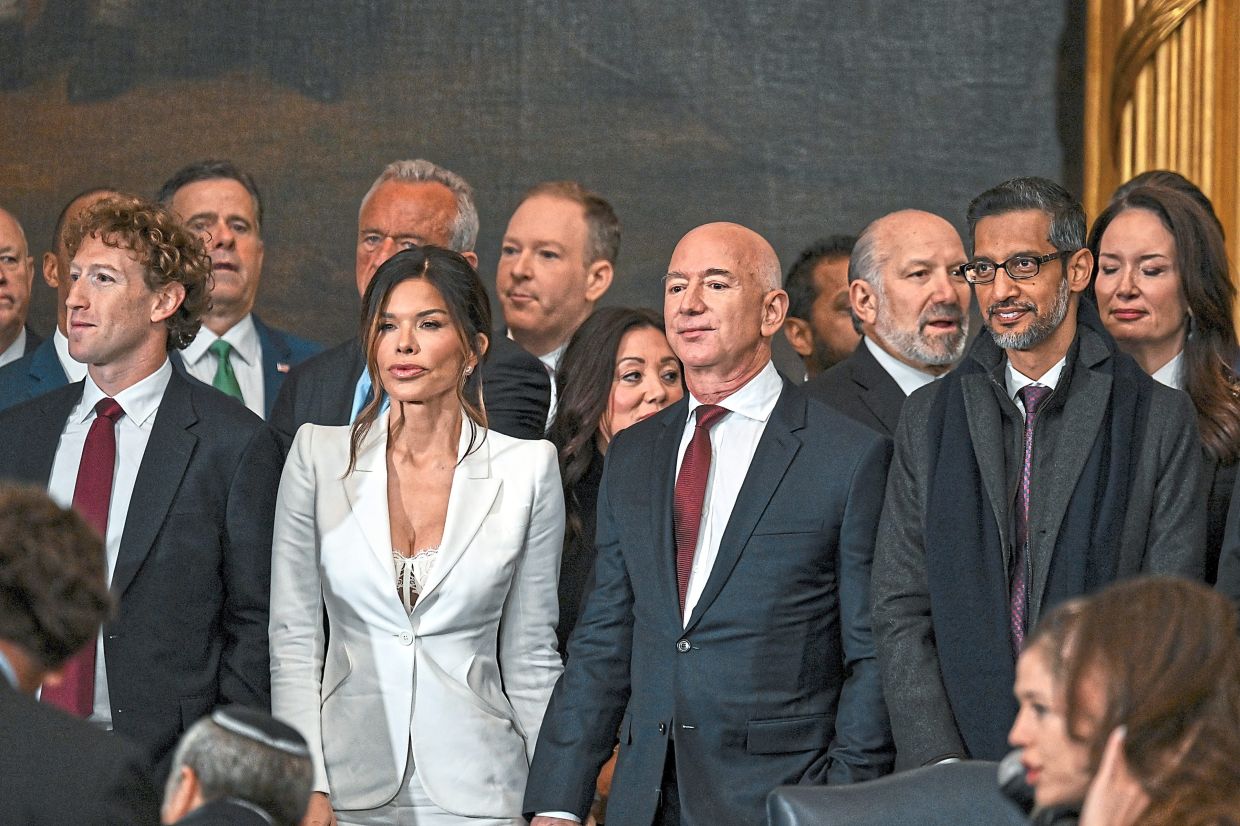
Courted assiduously by tech executives, Trump has cemented a mutually beneficial alliance with Silicon Valley.
While the duration of this entente is unclear, it has major implications for AI, cryptocurrency and other fast-growing technologies, and is already shaping the political debate ahead of midterm elections.
Trump has leveraged tech support to push his “America First” agenda while advancing US leadership in AI and crypto.
Amazon, Apple, Google, Meta, Nvidia, OpenAI, and Oracle have announced a combined US$1.4 trillion in spending on domestic data centres and manufacturing projects.
For Silicon Valley, the outcome has been a bonanza: fewer restrictions, soaring shares and largely unfettered AI development. Bitcoin has also hit record highs.
But the relationship has divided the right.
Republican lawmakers, conservative think tanks and populist figures such as Steve Bannon have criticised Trump for enabling tech billionaires to consolidate power while leaving other Americans behind.
“Big Tech is not a natural ally to our coalition,” said Wes Hodges of the Heritage Foundation. “Our work is to remember Big Tech’s concentration of power that threatens conservatives.”
White House spokesman Liz Huston defended the alliance, saying, “President Trump is leveraging his close relationships with private-sector titans to cement American technological dominance for the rest of the 21st century.”
Tech companies’ lobbying has been relentless.
After Elon Musk left his advisory role in May, other executives, including Nvidia’s Jensen Huang, gained direct access to the president.
Amazon, Meta, Google, Palantir and Coinbase have all thrown support behind White House projects, donating to refurbish the East Wing.
“We’re seeing an industry that knows how to work the president,” said Jessica Gonzalez, co-CEO of Free Press, a media advocacy group.
The relationship was on full display at a White House dinner in September, where Trump praised tech leaders as “leading a revolution in business”.
OpenAI CEO Sam Altman thanked him for being “pro-business”, Sundar Pichai of Google commended his AI leadership and Apple’s Tim Cook applauded his support for domestic manufacturing.
Some Republicans, however, are uneasy. They worry about AI safety, jobs and the environmental toll of sprawling data centres.
In July, lawmakers voted against a provision that would have let states impose their own AI regulations – a measure backed by Republican Senator Ted Cruz and White House AI adviser David Sacks, later incorporated into Trump’s executive order.
Florida Governor Ron DeSantis criticised the move, insisting states should retain the right to regulate AI, and Representative Marjorie Taylor Greene echoed those concerns.
Polls suggest widespread unease. A survey by the Institute for Family Studies found 57% of Americans – including 43% of Trump supporters – oppose federal overrides of state AI laws.
Construction of massive data centres has also sparked controversy.
Amazon, Meta, and Microsoft have been expanding facilities that consume huge amounts of energy and water, pushing up utility costs.
In Georgia, two Democrats won seats on the state’s Public Service Commission, campaigning on affordability.
Safety concerns extend to AI itself. OpenAI and other companies face lawsuits from parents whose children formed unhealthy attachments to AI chatbots.
“It should not be at odds to say we are pro-American AI and also need to protect kids,” said Evan Swarztrauber, a former FCC adviser.
Parents lobbying for stricter social media and AI safety laws highlight a growing tension within the Republican base.
Lori Schott of Colorado, a lifelong Republican, said, “Grassroots Republicans are struggling to reconcile the Trump administration’s friendliness with tech executives. Our votes will reflect a party that puts kids’ safety first.” — ©2026 The New York Times Company
This article originally appeared in The New York Times