
THE claimed capture by paramilitary forces of El-Fasher, a city in Sudan’s Darfur, could mark a turning point in the country’s two-year war and stoke fears that the country could again be split a decade after losing South Sudan in 2011, analysts warn.
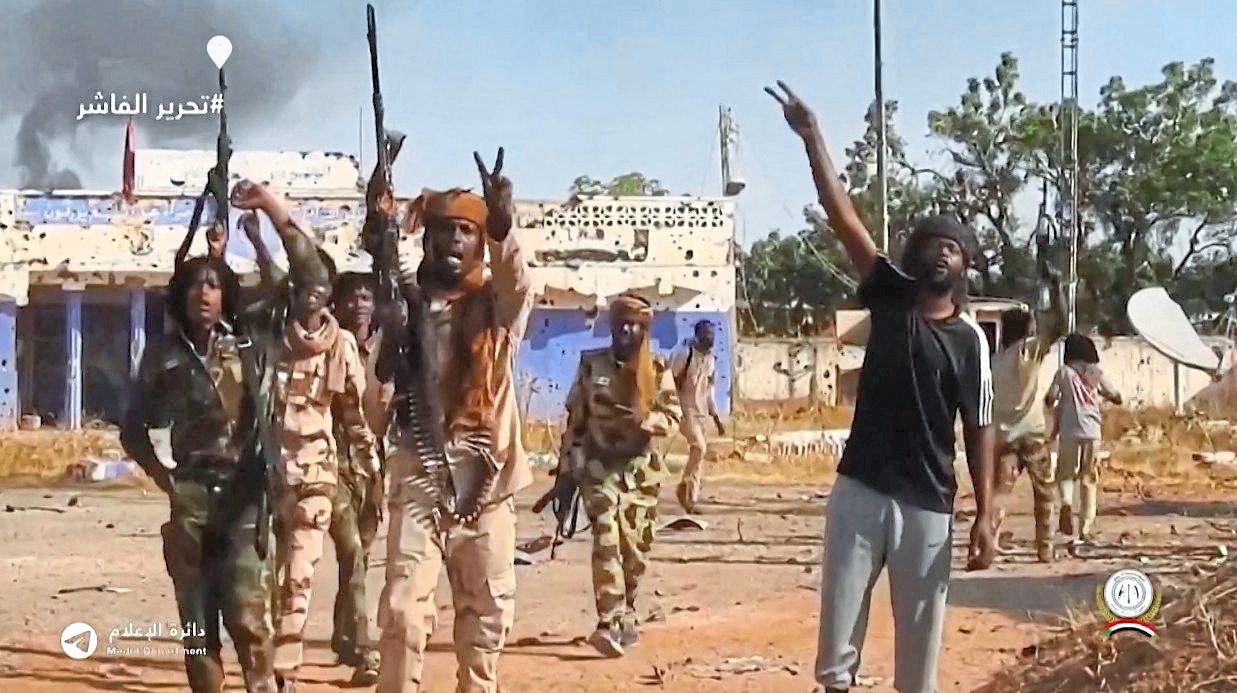
The paramilitary Rapid Support Forces, at war with the army since April 2023, claimed full control on Oct 26 over the city they have besieged for nearly 18 months.
If confirmed, the army’s loss of its last stronghold in Darfur would hand the RSF full control of the western region, ousting the army from nearly a third of Sudan’s territory.
El-Fasher’s capture would leave the army under Abdel Fattah al-Burhan entrenched along the Nile and Red Sea in the north, east and centre and the RSF under his former ally Mohamed Hamdan Daglo dominating the western plains.
“This is the moment many feared would lead to Sudan’s clear partition,” said Alan Boswell, project director for the Horn of Africa at the International Crisis Group.
“Whether or not that scenario plays out, Sudan is now de facto partitioned.
“The longer this war drags on, this division will likely only grow more concrete and harder to unwind.”
For over two years, Sudan has been devastated by a brutal war that has killed tens of thousands and displaced nearly 12 million people.
Following the army’s early 2025 offensive in central Sudan and the recapture of capital Khartoum, the western regions of Darfur and Kordofan have seen the war’s fiercest battles.
While El-Fasher came under relentless attack, the army has escalated airstrikes on Nyala, the de facto RSF capital in the west, where the paramilitaries recently established a parallel government.
A war-monitoring group has reported widespread massacres in oil-rich Kordofan, including in North Kordofan’s Bara after the RSF claimed to have regained control of the strategic city on a key crossroads to Darfur.
Pro-democracy activists said El-Fasher residents have endured “the worst forms of violence and ethnic cleansing” since the RSF claimed control.
Those accusations revived the spectre of ethnic violence against non-Arab communities that first drew the world’s eyes to Darfur two decades ago.
It also echoes 2023’s RSF massacre in West Darfur capital El-Geneina, where up to 15,000 civilians – mostly from non-Arab groups – were killed.
About 260,000 civilians remain trapped in El-Fasher, with many forced to eat animal fodder to survive.
The RSF has built a 56km earthen berm encircling the city – sealing it off from humanitarian aid and, for many, from escape.
“Hell has already begun,” said Mohaned al-Nour, a Sudanese human rights lawyer and analyst. “This violence is embedded in the militia’s very DNA.”
The RSF originated from the Janjaweed, Arab militias accused of carrying out genocidal campaigns in early-2000s Darfur that killed 300,000 and displaced millions, prompting war crimes charges against then-president Omar al-Bashir.
Bashir formalised them as the RSF under Daglo, a former camel trader.
Over time, the group became a powerful, well-funded paramilitary force, enriched by Sudan’s gold trade and backed by foreign sponsors, notably the UAE.
Last month, the International Criminal Court convicted Sudanese militia chief Ali Muhammad Ali Abd-Al-Rahman of war crimes and crimes against humanity for the 2003-2004 Darfur attacks.
He was a leading member of Sudan’s infamous Janjaweed militia, who participated “actively” in multiple war crimes, according to the ICC.
The UN called the verdict a “reminder to today’s perpetrators that there can be no impunity for mass crimes against civilians”.
Both the RSF and army have been accused of atrocities since the beginning of the war.
Earlier this year, the RSF established a parallel government in western Sudan, opposing the army-led administration in the east on the Red Sea coast.
Cameron Hudson of the Washington-based Centre for Strategic and International Studies (CSIS) said territorial control in Darfur would bolster RSF claims of legitimacy as a government.
With both sides resupplied and emboldened by outside backers, peace efforts led by Washington and regional powers have repeatedly collapsed.
The RSF has received weapons and drones from the UAE, according to UN reports – allegations that Abu Dhabi denies.
Meanwhile, the army has drawn on support from Egypt, Saudi Arabia, Iran and Turkey.
Despite talks in Washington last month involving the US, Egypt, Saudi Arabia and the UAE, no progress has been made.
Boswell said the fall of El-Fasher would give the RSF more leverage in peace talks.
“Militarily, it will also allow them to deploy more resources and manpower to the front lines,” he added. — AFP