A charred electricity pole standing among burnt trees following a wildfire in Neos Voutzas, near Athens. — Reuters
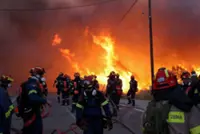
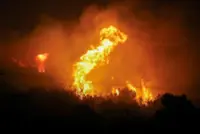
WHEN Greek firefighters investigated the cause of a deadly wildfire near the Athens Riviera in August, they found a familiar culprit: a loose power cable whose sparks were blown across a field of dry grass in a windstorm.
The investigators’ report said the cable near the town of Keratea showed signs of oxidation and improper maintenance.
Within hours, the blaze had killed one person and burned 16sq km of land abutting tourist beaches south of the capital.
“It was rapid,” said Keratea resident Manolis Palaiolougkas, pointing to an area of charred earth just outside town where the fire started.
Faulty power lines were the leading cause of major wildfires this summer, overshadowing arson and negligence, preliminary fire brigade data shows.
Of 41 major Greek blazes investigated by the brigade, 15 were likely caused by the electricity network, charring 20,640ha of land.
That’s up from last year, the data shows, and comes after years of underinvestment in the power grid during Greece’s 2009-2018 debt crisis.
It adds to the risks posed by climate change, which has made summers hotter and drier and wildfires more destructive, costing the state billions of euros.
“For many years, I and other colleagues have raised this issue with flares caused by energy transmission networks,” said Palaiologos Palaiologou, assistant professor at the Agricultural University of Athens. “We must not hide the issue under the carpet.”
A second fire brigade report showed that in 2024, nine major fires were likely caused by the electricity network, including one that barrelled north of Athens and torched 10,000 hectares – an area the size of Paris.
In Greece, details on what triggers the wildfires are generally not published.
Fire brigade spokesman Vassilis Vathrakogiannis declined to comment on the data because it was not public.
Public power distributor HEDNO said it carries out regular maintenance and hiked maintenance expenditure to €165mil in 2024 from €122mil in 2019.
Its efforts include deforestation, pruning and safety inspections, and it has prioritised laying cables underground to reduce fire risk, HEDNO said.
It has been found guilty in just three cases related to wildfires since 2012, out of around 122,000 fires recorded, it added.
The government blames the problem on a lack of investment during the debt crisis before it came to power in 2019.
That “cumulatively left a huge gap that we have to fill now,” Deputy Energy Minister Nikos Tsafos told parliament last month.
Meanwhile, local authorities are losing patience.
Dimitris Papachristou, the mayor of coastal towns hit by the August fire, said he would sue HEDNO for negligence over at least two major blazes caused by cables this summer.
“We witness the same story every year, across Greece,” said Papachristou. “We have reached our limits.”
HEDNO said it found no link between the August fire and the power grid. It carried out maintenance in Keratera on May 14 and had cleared a four-metre circle around the pole, per Greek law.
The challenge to overhaul the ageing grid is immense, with some of the country’s 4.5 million poles in forested areas that are now fire hot spots.
Near-empty villages across rural areas are still served by countless lines.
Myriad cables crisscross Keratea, some sagging so low that residents joke about using them as a clothesline.
To reduce the danger, cables should be moved from high-risk areas, renewed or buried underground in areas where it is possible, Palaiologou said.
Tsafos told parliament about 1,800km of cables are placed underground annually.
At that rate, it could take the task decades to complete.
“There is still a very long way to go,” he said. — Reuters