FILE — The Vineyard Wind Farm in the Atlantic Ocean off the coast of Martha’s Vineyard in Massachusetts, Sept. 10, 2024. The Trump administration is halting wind projects that had been approved, financed and under way — while providing little to no justification. The actions are putting thousands of jobs and billions of dollars of investments at risk.. (Randi Baird/The New York Times)
WHEN the Trump administration ordered construction to stop at Revolution Wind, a giant offshore wind farm near Rhode Island that was nearly finished, it vaguely cited “national security concerns” but offered no further explanation.
It was the third time since April that the administration had revoked permits or halted wind projects already approved, following actions against sites in New York and Idaho.
Legal experts say there is little basis for blocking projects that had secured permits.
The administration has also signalled in a court filing that it plans to rescind approval for the Maryland Offshore Wind Project, which would involve up to 114 turbines off Ocean City.
These extraordinary moves are creating a crisis for the wind industry, putting thousands of jobs and billions of dollars of investment at risk.
Even if developers win legal challenges, delays drive up costs and inject uncertainty that could kill projects.
“The rationale is shockingly thin,” said Michael Gerrard, director of the Sabin Centre for Climate Change Law at Columbia University. “If you’ve got all your permits and spent billions, and they can still pull the plug, who is going to want to invest?”
The US$6.2bil Revolution Wind project was 80% complete. Its 65 turbines were set to power more than 350,000 homes in Rhode Island and Connecticut by next spring.
In an Aug 22 letter to Orsted, the Danish developer, the Bureau of Ocean Energy Management said it was seeking to protect US national security interests and ordered work to stop.
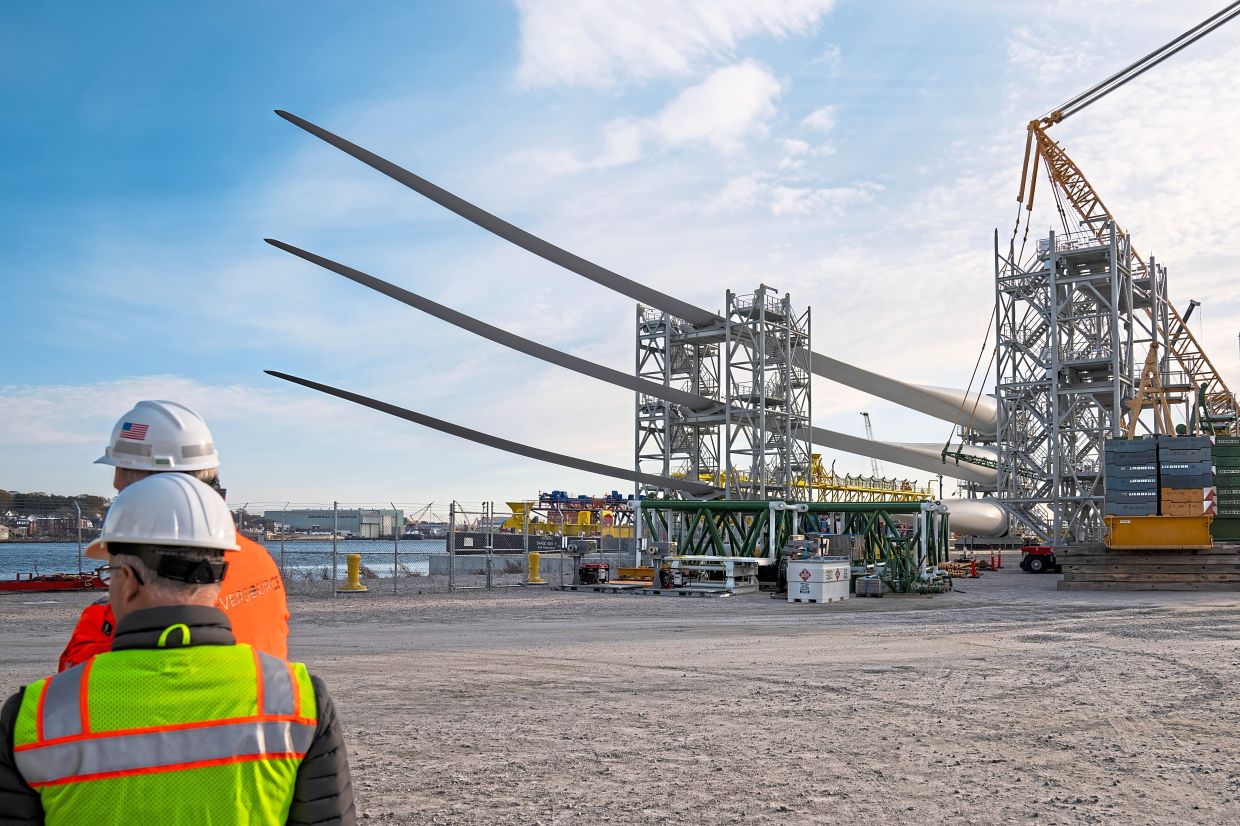 Wind turbine blades stacked for transport at a pier in New London, Connecticut. — Joe Buglewicz/The New York Times The Vineyard Wind Farm in the Atlantic Ocean off the coast of Martha’s Vineyard in Massachusetts. — Randi Baird/The New York Times
Governors and senators from Rhode Island and Connecticut denounced the move.
“They say there are national security interests here. Come clean, reveal them,” said Democratic Senator Richard Blumenthal of Connecticut.
“They have offered no facts to justify this lawless, reckless decision.”
Blumenthal warned that prolonged legal battles would still damage consumers.
“The administration will lose if challenged but, in the meantime, consumers will lose.”
The Interior Department declined to elaborate on security concerns, instead echoing Trump’s long-standing hostility to wind power.
“Americans deserve energy that is affordable, reliable and built to last – not experimental and expensive wind projects that are proven failures,” said department spokesman Aubrie Spady.
Wind turbines already supply more than 10% of US electricity and are key power sources in states like Iowa, Oklahoma and Texas. Union leaders say more than 1,200 jobs could be affected if Revolution Wind is halted. New England’s grid operator also warned of supply risks.
“Should this project be interrupted, we will have an elevated risk of rolling blackouts,” said Katie Dykes, commissioner of Connecticut’s Department of Energy and Environmental Protection.
Trump has long been a vocal opponent of wind power, and on his first day in office he issued a moratorium on new offshore projects. Former President Joe Biden encouraged offshore wind as part of his climate strategy. Many assumed projects with federal permits were safe.
But in April, the Interior Department abruptly ordered work to stop at Empire Wind, a US$5bil project off Long Island.
Officials claimed the approval process was rushed and flawed, but released reports were almost entirely redacted.
The project was later allowed to continue, though officials suggested it was only after New York Governor Kathy Hochul agreed to approve new gas pipelines. Hochul denied any such deal.
In July, the administration reversed approval for Idaho’s Lava Ridge Wind Project, citing unspecified “legal deficiencies”.
Meanwhile, Environmental Protection Agency chief Lee Zeldin openly contradicted the “national security” narrative, telling Fox News: “The President is not a fan of wind – the economic impacts, the environmental impacts to fisheries. He believes the nation needs more fossil fuels.”
Orsted has said it is “evaluating all options”, including legal action, but still hopes to complete Revolution Wind.
Officials in Connecticut and Rhode Island vowed to push ahead but admitted they were in the dark.
“I think there’s a deal to be had, and I’ve got to see what the ask is,” said Connecticut Governor Ned Lamont. “I have no idea what the ask is.” — ©2025 The New York Times Company
This article originally appeared in The New York Times