THE clock is ticking on an international police force sent to restore order in Haiti. Money is running out and bodies are piling up.
The Multinational Security Support mission, a force of mostly Kenyan police officers known as the MSS, arrived in Haiti one year ago, intent on pulling Haiti out of the clutches of gang chaos.
Its United Nations mandate expires in October and its funding runs out in September, but the Trump administration has yet to say whether it plans to continue providing financial support to the force.
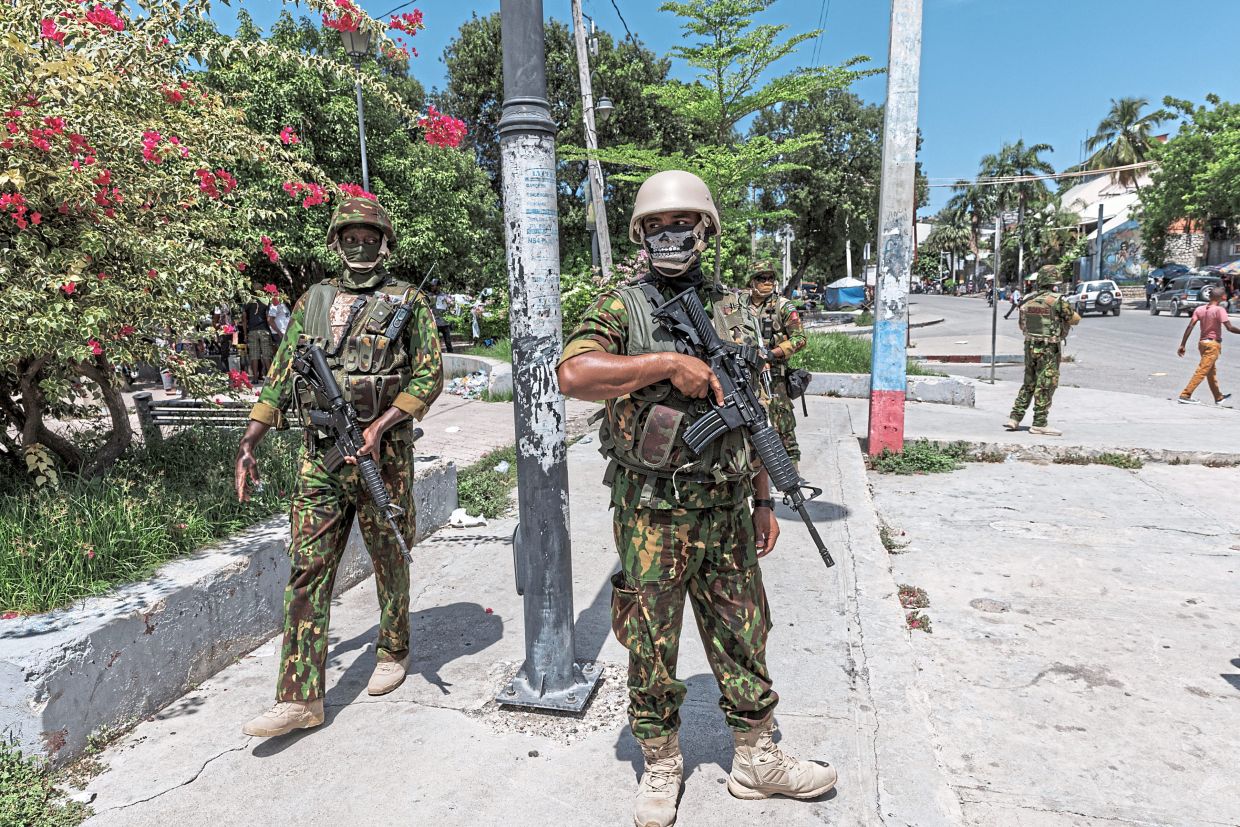
The approaching deadlines loom large over Haiti, where gangs still control most of the capital, Port-au-Prince, and have spread to areas outside the city, displacing 1.3 million people. More than 5,600 people were killed last year.
Experts say increasing the size and funding of the international force is Haiti’s only hope, and its slow progress tackling violence is a direct result of the international community’s failure to step up and provide more help.
The Trump administration’s wavering underscores an administration occupied by crises in different parts of the world, where Haiti seems to be a low priority.
“Haiti is falling apart,” said Nathalye Cotrino, a senior researcher for Human Rights Watch. “I don’t know what more they want to happen in Haiti.”
A coalition of gangs attacked Port-au-Prince last year, launching a coordinated offensive on prisons, hospitals and police stations. The airport has been closed to international flights since November, after gangs fired on passing aircraft.
Unwilling to send its own forces, the United States proposed the international mission, which was staffed mostly by Kenyans but with contributions from other countries.
It took months for the force to reach its current staffing level of about 1,000 officers. It was supposed to be 2,500.
“It lacks sufficient equipment and technology, and countries have not contributed as planned,” said Gedeon Jean, executive director of Centre for Analysis and Research in Human Rights in Haiti.
Asked whether it planned to renew the mission’s funding, the US State Department released a statement that did not answer the question.
“The United States continues to provide lifesaving medevac, critical equipment, training, transportation and logistical support to the MSS mission and the Haitian police,” the statement said.
The United States has been the mission’s single-largest contributor, providing US$835mil in financial and in-kind support, including US$150mil in foreign assistance for logistics support and equipment, US$60mil worth of material and services, and up to US$625mil to sustain the mission’s compound, the statement said.
“The mission as currently constructed will not be enough,” US Secretary of State Marco Rubio said earlier this year.
Rubio has said that the Organisation of American States should take a more active role leading a military-style mission, but that group had no such proposal on the agenda when it met recently.
Albert Ramdin, the secretary-general of the Organisation of American States, said it would soon present a robust plan to address Haiti’s security, humanitarian and economic crisis.
“Abandoning Haiti is not acceptable,” he said in a statement.
The MSS mission commander, Godfrey Otunge, referred questions to his spokesman, who did not respond to requests for comment.
In an interview last fall, Otunge stressed the team’s accomplishments, such as clearing gangs from the airport and Port-au-Prince’s seaport.
Three of its officers have died in battle, and the force played a key role working with the Haitian National Police to stop the gang offensive in Kenscoff, a community outside Petion-Ville, near the capital, said William O’Neill, the United Nations’ expert on human rights for Haiti.
“The MSS has been fighting with one hand tied behind its back,” O’Neill said. “It lacks key equipment like helicopters, surveillance drones and vehicles appropriate for Haiti’s terrain.”
The MSS has been credited with isolated advances, but it has struggled to retain them.
It has never managed to retake any community controlled by gangs and no gang leaders have been captured or killed, according to an analysis by the International Crisis Group, a Belgium-based think tank.
At least four massacres have taken place since October, claiming around 500 lives, the United Nations‘ panel of experts on Haiti noted in a recent memo to the Security Council.
Haiti’s government and the MSS, it said, had “failed to respond effectively” and the international force’s limited presence on the street has allowed vigilantism to grow.
A proposal for a full UN peacekeeping mission failed, because Russia and China, which have veto power on the Security Council, objected.
The UN secretary-general had proposed that the UN should beef up the MSS funding, but no vote has taken place.
“Until the United States makes up its mind, there isn’t going to be a vote,” said Renata Segura, a programme director at the International Crisis Group.
“It’s hard to say if the MSS was a success or failure, because we’ve not given them a proper chance.” — ©2025 The New York Times Company
This article originally appeared in The New York Times
Already a subscriber? Log in
Get 20% OFF The Star Digital Access
Cancel anytime. Ad-free. Unlimited access with perks.