
A member of the Pereiaslav volunteer air-defence unit setting up a gun during a recent Russian drone attack on the Kyiv region. — Photos: Constant Meheut/The New York Times
CLAD in khaki fatigues, the Ukrainian volunteers lounged on a concrete terrace as dusk swallowed the surrounding fields.
Music trickled from a phone, mingling with bursts of laughter – a fleeting ease before what they had been warned would be a “hot night”.
They were part of a civilian unit stationed in Pereiaslav, a town 80km southeast of Kyiv, tasked with guarding the skies against incoming Russian drones.
Their weapons? Ageing machine guns supplied by the Ukrainian army. Their mission? Shoot down whatever they could.
As usual, the crew – made up of university professors, builders, salespeople – stood ready waiting for the signal.
At 11.35pm, Mykhailo’s phone rang. He picked up, then shouted, “Let’s go!”
The chase was on.
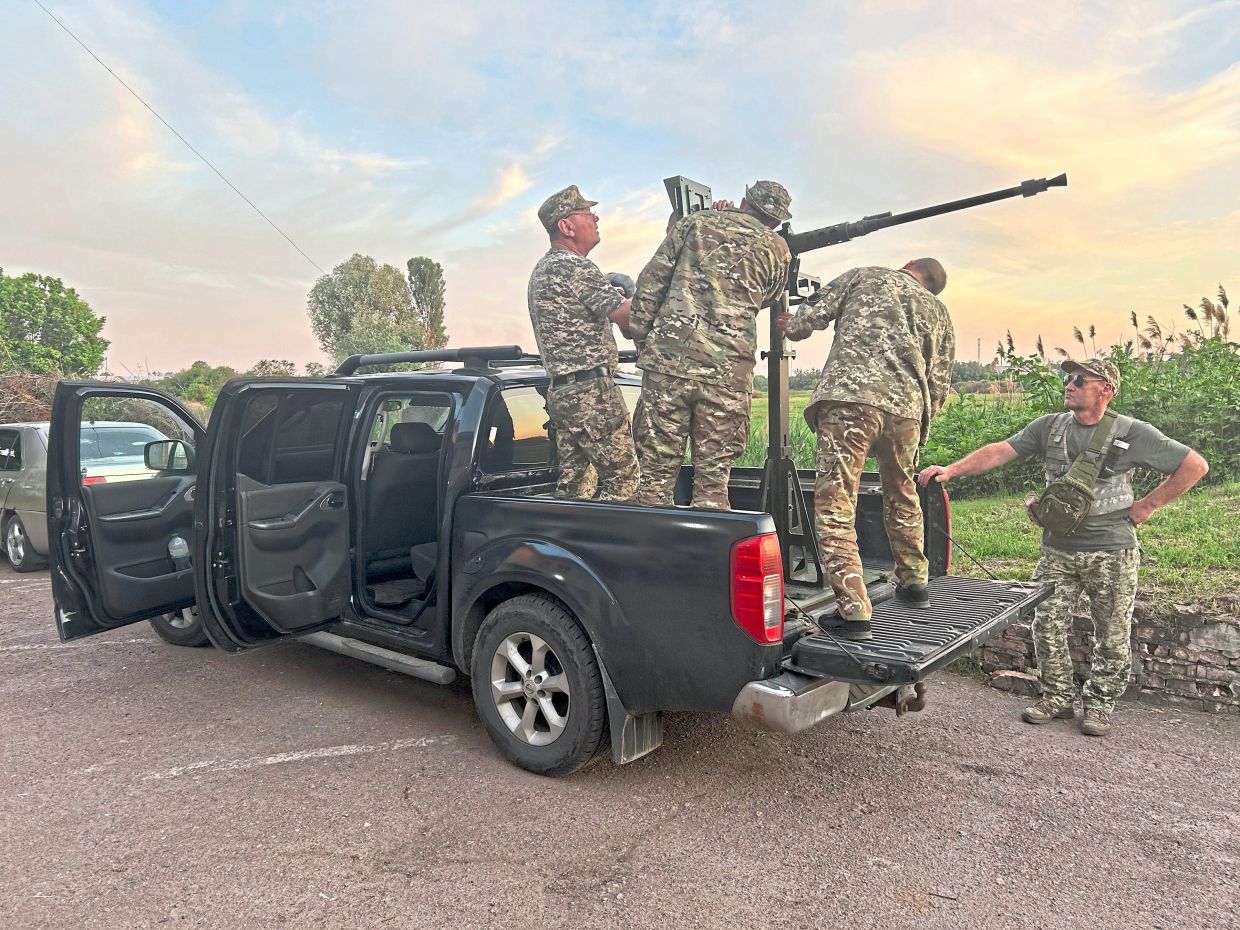 Members of a Ukrainian volunteer air-defence unit checking out a newly-received Browning machine gun near Pereiaslav. — Constant Meheut/The New York Times
Mykhailo and two others leapt into a grey pickup truck and sped off through narrow roads into the countryside.
Minutes later, they reached an open field, jumped out and began setting up.
Two tripods were quickly readied for machine guns. A third held night-vision binoculars and a laser.
Mykhailo – like others, identified only by his first name for security reasons – glanced at a tablet on the truck’s bonnet. Its screen was lit with a swarm of red triangles sweeping across Ukraine: Russian drones, several dozen kilometres away.
“Three heading our way,” said Mykhailo, a trade union representative by day. “Let’s wait.”
As Russia intensifies its drone assaults on Ukraine, volunteer crews like this one are spending sleepless nights trying to push them back.
That same night, Russia launched a record-breaking 472 drones and decoys, followed by another wave of over 400, as well as 40 cruise missiles and six ballistic missiles, according to the Ukrainian air force – one of the war’s largest barrages so far.
Analysts say the tactic is deliberate: wear down Ukrainian air defences with drones, then follow up with missiles that are harder to intercept.
The drones themselves have evolved. They now fly higher – out of reach of older weapons – and change routes often, using decoys to confuse defenders.
To counter this, Ukraine uses a patchwork of solutions – everything from Second World War-era machine guns to cutting-edge Western systems, and electronic jamming to disrupt navigation.
Kyiv, frequently targeted, has been largely protected by powerful US-made Patriot systems. But the city’s dependence on unpaid, lightly equipped volunteers highlights just how stretched Ukraine’s defences have become.
The unit in Pereiaslav, a town of 20,000 on the Dnieper river, was formed in mid-2023.
Sofia, a former journalist now working full time with the crew, said locals began noticing drones skimming low over the river to avoid radar.
“We saw them, heard them and understood we needed to do something,” she said. “All we needed was guns and ammo.”
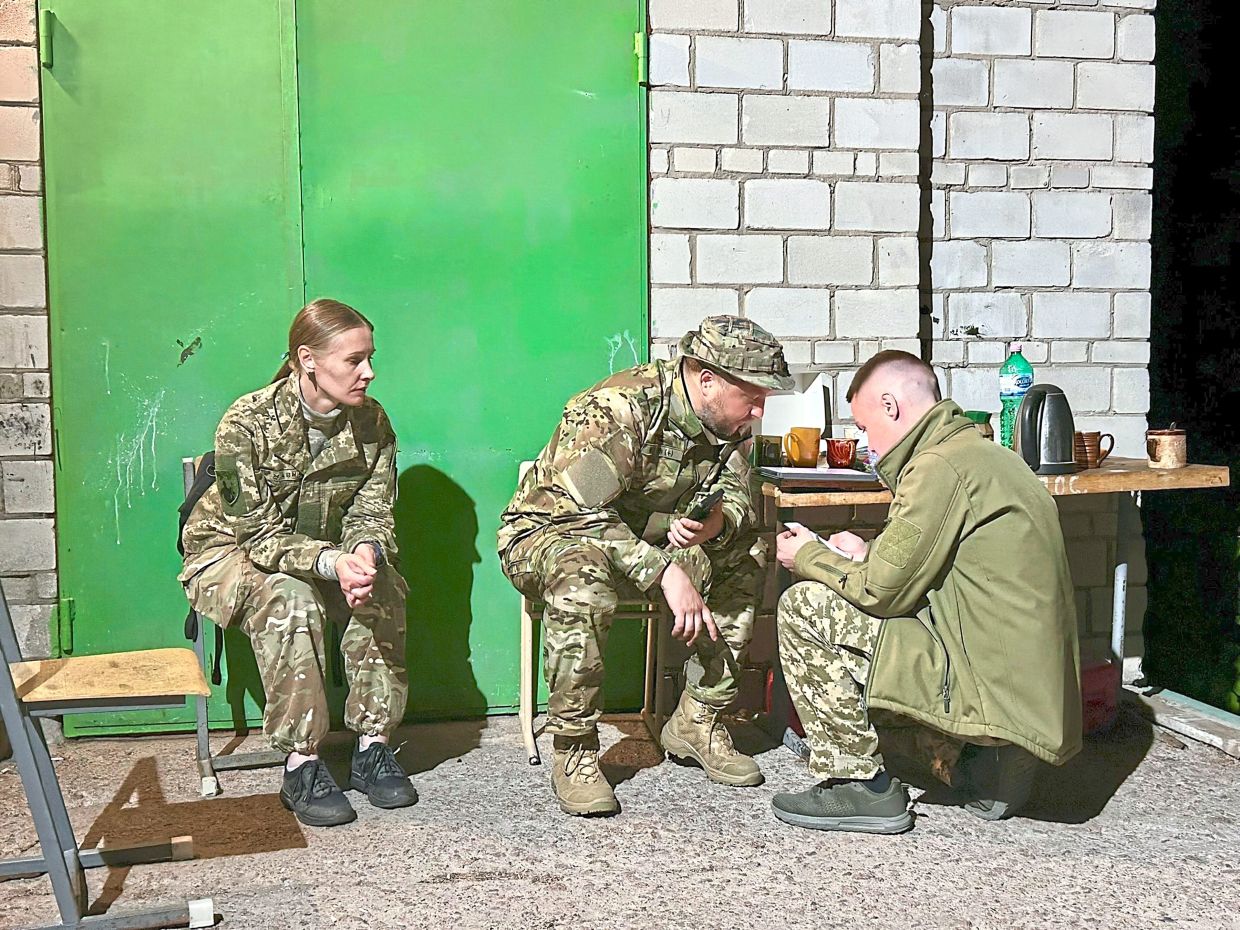 Sofia, left, a former journalist, now works full time with the Pereiaslav air-defense unit, which was formed in summer 2023.
The army sent some old weapons and gave basic training. Everything else – uniforms, fuel, food, first-aid kits – was provided by the volunteers themselves.
For two years, they’ve balanced day jobs with 12-hour night shifts. Caffeine, they say, is their most reliable ally.
Oleh Voroshylovskyi, the unit commander, explained that Kyiv’s air defence is structured in three concentric rings. His unit covers about 32km of the outermost layer – intercepting drones early and alerting the inner rings.
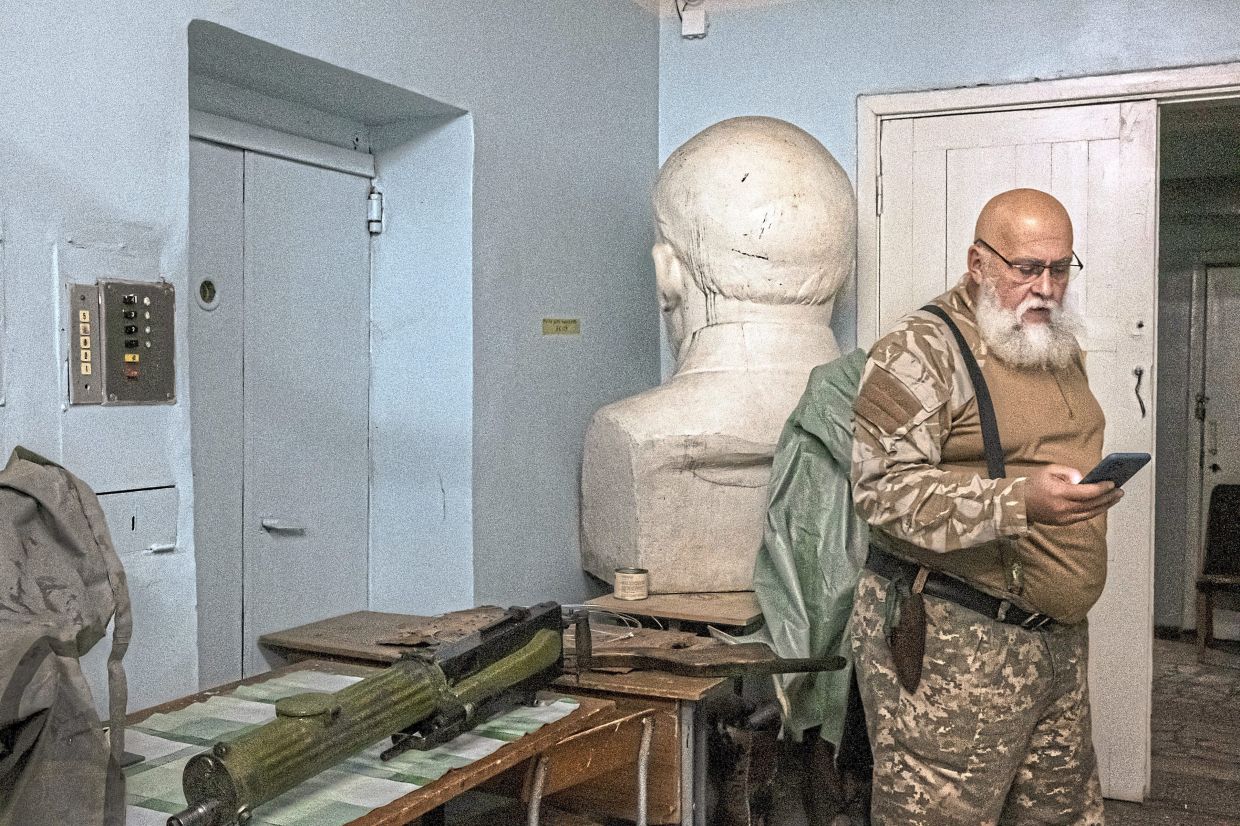
Since forming, the unit has relied on WWII-era Maxim machine guns and 1950s-era Czechoslovakian Uk vz. 59s.
“They may be old, but they’re effective,” said Voroshylovskyi, standing near downed drones displayed at their base – a building still marked by Ukraine’s Soviet past, including a bust of Lenin turned to face the wall.
“The Maxim was once used to shoot down small planes. How is a drone different?” he asked.
After downing some 30 drones, the team recently received a more powerful US-designed Browning machine gun, mounted on a truck. Training is ongoing.
“We had been dreaming of it,” said Sofia, watching as the team tested the weapon.
Until it’s ready, Mykhailo’s crew makes do with what they have.
That night, after setting up, they waited in the pitch-black silence under a crescent moon. The stillness was broken only by croaking toads and hooting owls – and then, distant gunfire.
“Look! It’s getting busy over there,” Mykhailo said, pointing to the north, where red tracer rounds streaked the sky and spotlights swept overhead.
Soon after, a low mechanical buzz – like a lawnmower – hummed in the air. A Russian drone.
Their radar didn’t register it, but the sound was unmistakable.
“It’s coming!” shouted Yaroslav, another crew member.
They scrambled behind their mounted guns. Yaroslav rotated the binoculars, scanning the sky on a grainy black-and-white feed.
The drone veered west, circling. They couldn’t see it, so they held fire – unwilling to waste ammunition.
“Russian drones used to fly at about a thousand metres – we could hit that,” said Yaroslav. “Now they’re often flying at 2,000m. Our weapons can’t reach that.”
The crew relayed the drone’s location to other units and stayed ready.
Yaroslav, an IT professor who had served on an exam jury earlier that day, said their role often involves observing more than shooting – and increasingly, it’s become dangerous work.
Russian drones, he said, are now targeting air-defence teams.
As the hours passed, they fell into a familiar rhythm – tracking swarms within a 190km radius, moving into position, and watching red tracers light up the sky.
By sunrise, they hadn’t fired a shot.
But the results of what slipped through were visible online – explosions in Kyiv, buildings ablaze, civilians wounded.
“A classic night,” Yaroslav said, his eyes bloodshot from fatigue. — ©2025 The New York Times Company
This article originally appeared in The New York Times.