
HUMANS live in a plankton world. These minuscule organisms blanket the oceans, covering nearly three-quarters of the planet, and are among the most abundant forms of life on Earth.
But as the world warms, plankton populations are shifting, with consequences that ripple through the entire marine food chain.
A year ago, Nasa launched a satellite to provide the most detailed view yet of the diversity and distribution of phytoplankton. Its insights could help scientists understand the changing dynamics of life in the ocean.
“Do you like breathing? Do you like eating? If your answer is yes for either of them, then you care about phytoplankton,” said Jeremy Werdell, the lead scientist for the satellite programme, called PACE – short for Plankton, Aerosol, Cloud, Ocean Ecosystem.
Historically, ship-based research has offered only brief snapshots of the ever-changing oceans. Satellites provided a broader perspective, but their limited colour range was akin to looking at a garden through green-tinted glasses.
“You know it’s a garden, you know it’s pretty, you know it’s plants, but you don’t know which plants,” explained Nasa oceanographer Ivona Cetinic.
The PACE satellite removes that filter, finally revealing all the colours of the ocean’s “flowers” – phytoplankton, tiny algae and bacteria that photosynthesise, harnessing energy from the sun.
These organisms are the foundation of the marine food chain, sustaining zooplankton, which in turn feed fish and larger creatures.
Now, climate change is shaking that foundation.
A shifting ocean
Phytoplankton in the open ocean appear to be dwindling.
In the early 2000s, scientists detected that vast oceanic regions with fewer nutrients and sparser phytoplankton – known as ocean deserts – were expanding.
At the same time, coastal phytoplankton blooms, especially at higher latitudes, have increased in frequency, according to a 2023 study.
Warmer sea temperatures are fuelling this growth, with blooms appearing earlier in the year, disrupting fisheries and livelihoods.
And while marine life depends on phytoplankton, some blooms can be harmful.
When they grow too large and decay, they deplete oxygen in the surrounding water, creating “dead zones” where nothing else can survive.
Certain species also produce toxins that can sicken or kill fish, birds and even humans.
Researchers estimate that harmful blooms cost the US economy around $50mil annually through damage to public health, fisheries and coastal recreation.
In the winter of 2021, millions of oysters off the Louisiana coast suddenly died, dealing a heavy economic blow to local fishermen.
Investigators traced the event to a toxic phytoplankton bloom triggered by a storm, said Bingqing Liu, an oceanographer at the University of Louisiana, Lafayette.
Liu is part of PACE’s “early adopter” group, working to integrate the satellite’s data into predictive models. The goal is to give people advance warning of toxic blooms, so they can mitigate economic and environmental losses.
A closer look
While satellites give oceanographers a broad view, other researchers are zooming in, collecting and studying plankton under microscopes.
These scientists aren’t just observing the “garden” Cetinic described – they’re stepping inside, studying its plants and animals in fine detail.
Some of the most intriguing creatures lurk below the surface, beyond the reach of satellites.
Across the North Atlantic in winter, an extraordinary phenomenon unfolds.
Stretching from the US and Canada to Europe, quadrillions of tiny creatures are suspended in the ocean’s twilight zone, hibernating.
These are Calanus finmarchicus, a type of zooplankton that drifts with the ocean’s currents. They play a crucial role in funnelling energy from phytoplankton to larger animals like fish, whales and birds.
“You can think of Calanus as little batteries floating in the ocean,” said Jeffrey Runge, a zooplankton ecologist recently retired from the University of Maine.
As winter sets in, Calanus descend into deeper waters, hiding from predators in the dim light. But warming oceans may be disrupting this cycle.
Plankton hunting
In November, David Fields, a zooplankton ecologist at the Bigelow Laboratory for Ocean Sciences, set out on a research trip in the Gulf of Maine.
He and his team were hunting for Calanus to study how they are responding to rising temperatures and shifting currents.
“It’s really hard to get these kinds of signals,” Fields said. “Because of the lack of data, of sampling.”
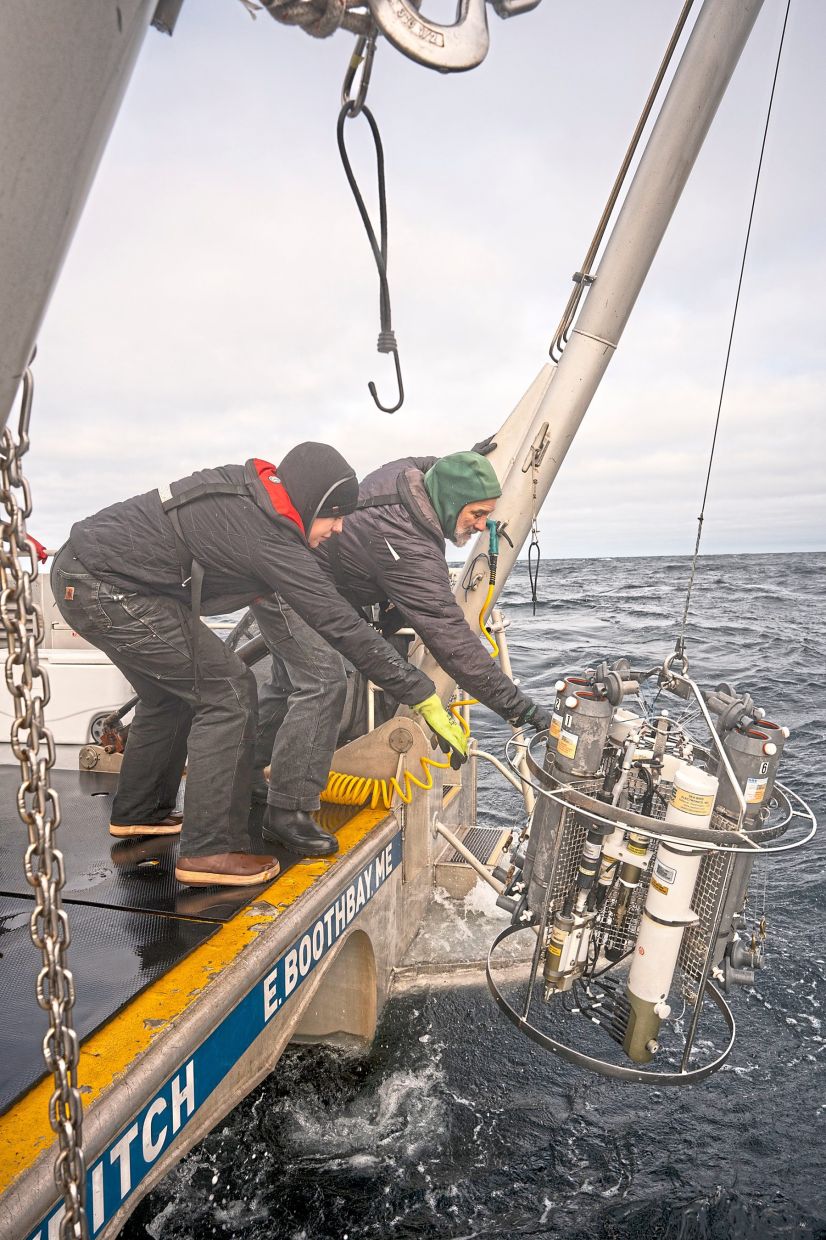
That’s why, before dawn on a freezing November morning, he and a team of local scientists boarded a 15m catamaran from the Bigelow dock in East Boothbay, Maine.
Throughout the day, they rinsed nets into buckets, carefully collecting plankton samples while getting drenched in icy seawater and battling seasickness as the boat lurched over the waves.
Back at the lab, under a microscope, the Calanus specimens revealed their most valuable feature: large oil sacs packed with calorie-rich lipids, a crucial food source for fish and whales.
Experimental studies show that as ocean temperatures rise, Calanus are getting smaller and storing less fat.
Fields calls the layer of hibernating Calanus the “ocean’s fat layer” – a vital resource for the entire ecosystem.
“That’s the whole reason the Gulf of Maine runs the way it does, because of that beautiful fat layer,” he said.
A ripple effect
Among the researchers on Fields’ November trip was Amy Wyeth, a zooplankton ecologist starting a new plankton monitoring programme for the Maine Department of Marine Resources.
The goal, she said, is to give the state “a little more predictive power” – particularly to track the movements of endangered right whales and help prevent their entanglement in lobster fishing gear.
With only about 370 North Atlantic right whales left, these animals depend on Calanus, sometimes consuming hundreds of millions of the tiny creatures per day.
The Gulf of Maine was once a rich summer feeding ground for right whales. But in 2010, a marine heatwave began shifting the ecosystem.
By 2012, New England saw record-high air temperatures, further compounding the effects.
Larger, fat-rich Calanus became scarcer in late summer and autumn. As a result, right whales have been forced to travel farther north to the Gulf of St Lawrence – where they face threats from busy shipping lanes and commercial fishing operations.
“One can make the link between relentless CO2 increase and what’s happening to right whales and Calanus,” Runge said. “It’s one of these complex mechanisms showing how warming is reshaping ecosystems.”
Keeping watch
In January, a group of European researchers called for continued funding for long-term plankton monitoring.
Since the 1930s, commercial ships have been towing continuous plankton recorders, collecting plankton samples on long nets that roll up like scrolls.
These methods have remained largely unchanged, allowing scientists to track shifts in plankton populations over time.
In the United States, NOAA has conducted plankton surveys since the 1960s, providing crucial data for fisheries management.
NOAA’s latest report for New England documented a record-high phytoplankton bloom in 2023 and noted an increase in smaller, less energy-rich zooplankton species – a sign of ecosystem restructuring.
But long-term monitoring isn’t glamorous science, said Michael Parsons, a biological oceanographer at Florida Gulf Coast University.
“It’s hard to keep consistent funding in place to routinely be out there collecting samples and looking at what’s there,” he said.
With plankton populations in flux, keeping an eye on these tiny creatures may prove more important than ever. — ©2025 The New York Times Company
Already a subscriber? Log in
Get 20% OFF The Star Digital Access
Cancel anytime. Ad-free. Unlimited access with perks.