



IN 2022, Ferdinand “Bongbong” Marcos Jr won the Philippines presidential election and became its 17th president. His win was celebrated despite the fact his father, Ferdinand Marcos Sr, was overthrown by the People Power Revolution in 1986 after 20 years of dictatorship.
The Marcos family’s return to power was strongly attributed to a well-crafted social media campaign that focused on changing the historical narrative of the Marcos regime. Marcos Jr targeted younger voters who never experienced his father’s martial law, focusing on whitewashing his father’s crimes and reframing many of his oppressive policies as being beneficial to the public.
Philippines media outlet Rappler took extraordinary steps to highlight Marcos’s sophisticated social media campaign. While it was unsuccessful in preventing his win, the new administration was not happy with Rappler. The media outlet is still under scrutiny after the previous Duterte regime tried to ban it. But early this year, the Philippine courts acquitted the media outlet of tax evasion.
The Marcos campaign is an example of “digital astroturfing”, a campaign technique that’s becoming more commonplace in politics around the world. It involves the rich and powerful manipulating the algorithms of social media to present whatever narrative they desire. It is a strategy used by established, politically-motivated groups (such as corporations, interest groups, and politicians) to impersonate grassroots activist movements for political gain.
The Rappler case shows that media outlets are in the perfect position to properly monitor and investigate such schemes.
A similar astroturfing campaign was launched by former Malaysian prime minister Datuk Seri Najib Razak, who lost the 2018 general elections as a result of the 1MDB scandal. Many expected him to fade into obscurity as corruption charges started to mount against him.
But in 2019, he started an ingenious campaign to rewrite his public image called “Malu Apa Bossku” (Why the shame, boss?).
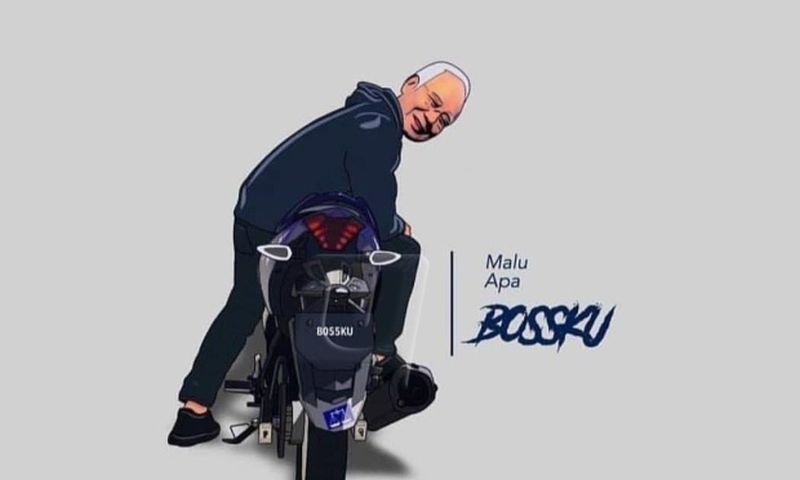

The start of the campaign was also engineered with a social media campaign that mimicked grassroots support that eventually translated into reality as he began to command large crowds at any public event that he attended.
On a larger scale, this kind of information operation is also used by political parties and their affiliates to influence public perspectives and opinions on various issues. This is done through a coordinated use of fake social media accounts and content farms. The content farms manufacture disinformation or political propaganda that is then distributed, disseminated, and propagated through their network of inauthentic accounts. The goal behind this is to distort public opinion on social media as they can artificially boost support for specific political figures, campaigns, and rhetoric.
With people being more connected through social media, their worldviews are easily influenced by what they see online. Social media and its AI-powered algorithms curate each person’s feeds, and these systems are easily manipulated (which was first exposed in the Cambridge Analytica scandal in 2018). The naturalistic and targeted nature of social media feeds often give people the false impression that social media is representative of “popular” public opinion.

In most situations, digital astroturfing efforts are seen as antagonistic actions; trolls who attack political opponents through insults or disinformation. But there have been instances in the region where more positive and less direct actions are used, such as the Indonesian buzzers.
Buzzers are a form of astroturfing but they are used in a seemingly more “positive” and less controversial fashion. Buzzers promote political issues positively and seek to control public opinion by overwhelming public discourse with mainly positive and supportive perspectives on a topic. Their use of misinformation or other more negative forms of influence is more limited as their focus is on offering political insider perspectives. Buzzers can easily argue that they are expressing personal opinions and are not antagonising their opponents and thus are seen as “clean” and acceptable.
There is no standardised formal method to fight back against digital astroturfing efforts. As many of these efforts can be veiled as individuals exercising their freedom of speech to engage in political discussions online (even using fake accounts), regulation of these activities can be challenging for fear of regulatory overreach.
It is the actions of regular people that are most effective in putting a stop to astroturfing. If any such cybertrooper is identified, mass reporting by people is an effective way to stop these accounts (especially if they engage in spreading misinformation, which is usually a violation of most public social media platforms).
But that is often specific to certain platforms but not for others, and again it also depends on the level of engagement of the community in doing this sort of citizen policing. The press has not been part of this discourse as trust in the media is at an all-time low. Trust in the media has been declining for decades now as people have started to rely more on social media for their daily news consumption. With declining readership and revenue from a very crowded news space, media outlets are fighting for their survival as they endure an identity crisis. Pushing back against digital astroturfing would be one such duty that contemporary media should undertake.
With a general election happening soon in Cambodia – and hopefully in Myanmar and Pakistan – digital astroturfing is expected to play a more prominent role in deciding who will win. The media can step up to engage in countering these efforts so it can restore people’s trust in media and establish good boundaries to rally people back to quality media standards.
It is a huge challenge for already cash-strapped media outlets, but this is the new battleground for information, and if the media wants to remain relevant in the social media age, it needs to be more involved in countering misinformation. – 360info
Benjamin YH Loh is a senior lecturer at the School of Media and Communication, Taylor’s University, and an associate with the Asia Centre in Bangkok. He is a media scholar who employs digital ethnography in studying emergent cultures and the digital public sphere. Originally published under Creative Commons by 360info™.
Already a subscriber? Log in
Get 20% OFF The Star Digital Access
Cancel anytime. Ad-free. Unlimited access with perks.
