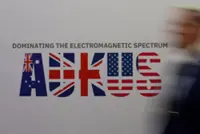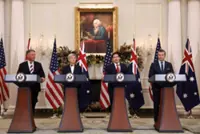
THE 2021 announcement of Aukus shocked many South-East Asian countries, China and even France.
The trilateral security pact between Australia, the United Kingdom and the United States aims to establish legal order and counterbalance China’s hegemony in the Indo-Pacific.
The pact also demonstrated Washington and London’s confidence in providing Canberra with access to nuclear-powered submarines.
Some Asean countries have expressed their concern about a possible arms race in the region. Australia will have access to build and operate the next generation of Collins-class submarines that will adopt Virginia-class or Astute-class submarine technology, according to The Strategist, but run on enriched uranium that only needs to refuel after 20-30 years. Enriched uranium, however, can be turned into a nuclear weapon.
Asean has been divided in its response to Aukus. The Philippines, Singapore and Vietnam seem to have warmly welcomed the security pact, saying it could maintain maritime security and stability in the disputed South China Sea.
Meanwhile, Indonesia and Malaysia have expressed concern about the access and presence of Australia’s nuclear submarines in the region, which they say will escalate tensions in the region and could even lead to nuclear war.
China has also strongly condemned the formation of Aukus in a joint statement with Russia. It has been reported that China has also moved its Jin class nuclear submarines from a naval base in Qingdao to one in Longposan, Hainan, which faces the South China Sea and South-East Asia.
The stationing of Jin class submarines has put the area equally at risk, considering they fall under the category of ballistic missile submarines (denoted as SSBNs).
According to the United States Department of Defense’s 2019 annual report on Chinese military capabilities, China’s navy operates four SSBNs and six nuclear-powered attack submarines (SSNs). In the past 15 years, China has built 12 nuclear submarines.

Despite the different reactions to the formation of Aukus and China’s nuclear submarine programme, Asean has maintained a shared spirit in preventing nuclear catastrophes in the region through the 1971 Declaration of Zone of Peace, Freedom and Neutrality (Zopfan) and the South-East Asia Nuclear Weapon-Free Zone (SEANWFZ) in 1995. Nevertheless, both instruments have been ineffective. Zopfan was declared to avoid any “external” intervention in the region. The 1995 declaration was intended to prevent any Asean member state from developing nuclear weapons and pushed five nuclear weapon states to accede to this instrument.
None of the nuclear weapon states are signatories to SEANWFZ, partly because the declaration’s original concept was not expanded to cover the exclusive economic zones of Asean states. Further-more, Australia is not among the nuclear weapon states, and nuclear-powered submarines are not classified as nuclear weapons.
The common misconception about nuclear-powered submarines is that they are like mobile atomic bombs because they have nuclear reactors. But the reactor on a nuclear submarine cannot explode like an atomic bomb, it can only meltdown.
Apart from security concerns, the environmental impact of nuclear-powered submarines need to be emphasised. Since these submarines carry nuclear reactors and nuclear fuel, they are categorised as environmental hazards in the event of an accident, such as nuclear leaks that could easily spread and contaminate the ocean with radioactive material.
Considering that some of the world’s busiest sea-lanes are located in South-East Asia – the Strait of Malacca, the South China Sea, Indonesia’s three archipelagic sea-lanes in the Sunda Strait, the Sulawesi Strait and the Banda Sea – and the fact that the region is home to 10%-12% of global fish stocks and is rich in biodiversity, any nuclear accident there will be devastating.
The US nuclear submarine USS Connecticut struck an undersea mountain in the South China Sea on Oct 2, 2021, according to the Navy Times. The collision immediately sparked concerns over the safety of nuclear submarines passing through South-East Asian waters, as it could lead to a radioactive catastrophe.
From the security perspective, Asean can hardly avoid the regional passage of nuclear submarines belonging to Aukus and China, since neither the 1982 United Nations Convention on the Law of the Sea nor other international or regional instruments prohibit such activities. But from the environmental perspective, Asean, China and Aukus should be aware that any damage to the region’s marine environment as a result of nuclear activities would lead to a major catastrophe and security crisis.
Joint declarations or more robust instruments are desperately needed to protect the environment in the region.
Indonesian President Joko Widodo’s “blitz” meetings with Russian President Vladimir Putin and Ukrainian President Volody-myr Zelenskyy to restore peace should be replicated in the region. Successfully maintaining peace and stability in the South China Sea, at least in and beneath the sea, will allow Asean states to shift their focus to reducing tensions in the air, including the potential plan of some states to enact an air defence identification zone above Indonesia’s archipelagic sealanes. – The Jakarta Post/Asia News Network
Taufik Rachmat Nugraha is a research fellow at the Indonesian Center for the Law of the Sea at Padjadjaran University. Ridha Aditya Nugraha teaches air and space law in the international business law programme of Prasetiya Mulya University.
Already a subscriber? Log in
Get 20% OFF The Star Digital Access
Cancel anytime. Ad-free. Unlimited access with perks.