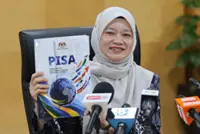
What lies beneath the Programme for International Student Assessment (Pisa) 2025 results is more troubling than the scores (see infographic).
Only 54% of Malaysian students reached at least basic proficiency in science, 44% in reading and just 35% in mathematics.
Pisa asks whether a 15-year-old can use knowledge to solve unfamiliar problems, interpret evidence and think independently. Our concern, therefore, should not be, “How do we raise Pisa scores?” but rather, “What kind of learners are our schools producing?”
There are encouraging signs. Malaysian students performed better than expected in computational problem-solving, and reported strong teacher support. These are assets we should build on. Here are some suggestions:
> “Problem of the week”
Challenge students with a Malaysian problem such as flood mitigation, household budgeting, food waste or public transport, and require them to use mathematics, reading and science together to propose solutions. This can be done weekly across all subjects.
> Reading beyond textbooks
Allocate 15 minutes a few times a week for students to read news reports, graphs, instructions, opinion pieces and digital sources. Ask them what the information really means.
> Learning to reason
The way we teach mathematics needs to change. Lessons should require students to explain why an answer works, compare two solutions or identify an error. Reasoning must become visible.
> Use artificial intelligence (AI) differently
With 56% of Malaysian students reporting weekly AI chatbot use for learning, schools should teach students to challenge AI answers, detect weak evidence and correct inaccurate responses. AI literacy should mean verification, not dependency.
> Exam grades and more
School-level learning indicators such as reading stamina, problem-solving, student questioning and knowledge application must also be tracked.
Pisa should be a mirror, not a scoreboard. If we build a generation that can read deeply, reason mathematically, question intelligently and solve problems confidently, good Pisa results will follow.
ASSOCIATE PROFESSORS DR MUHAMMAD NOOR ABDUL AZIZ and DR PARAMJIT KAUR
School of Education
Universiti Utara Malaysia