MALAYSIAN students have shown strong resilience and curiosity, ranking among the world’s top performers in these areas in the Programme for International Student Assessment (Pisa) 2025.
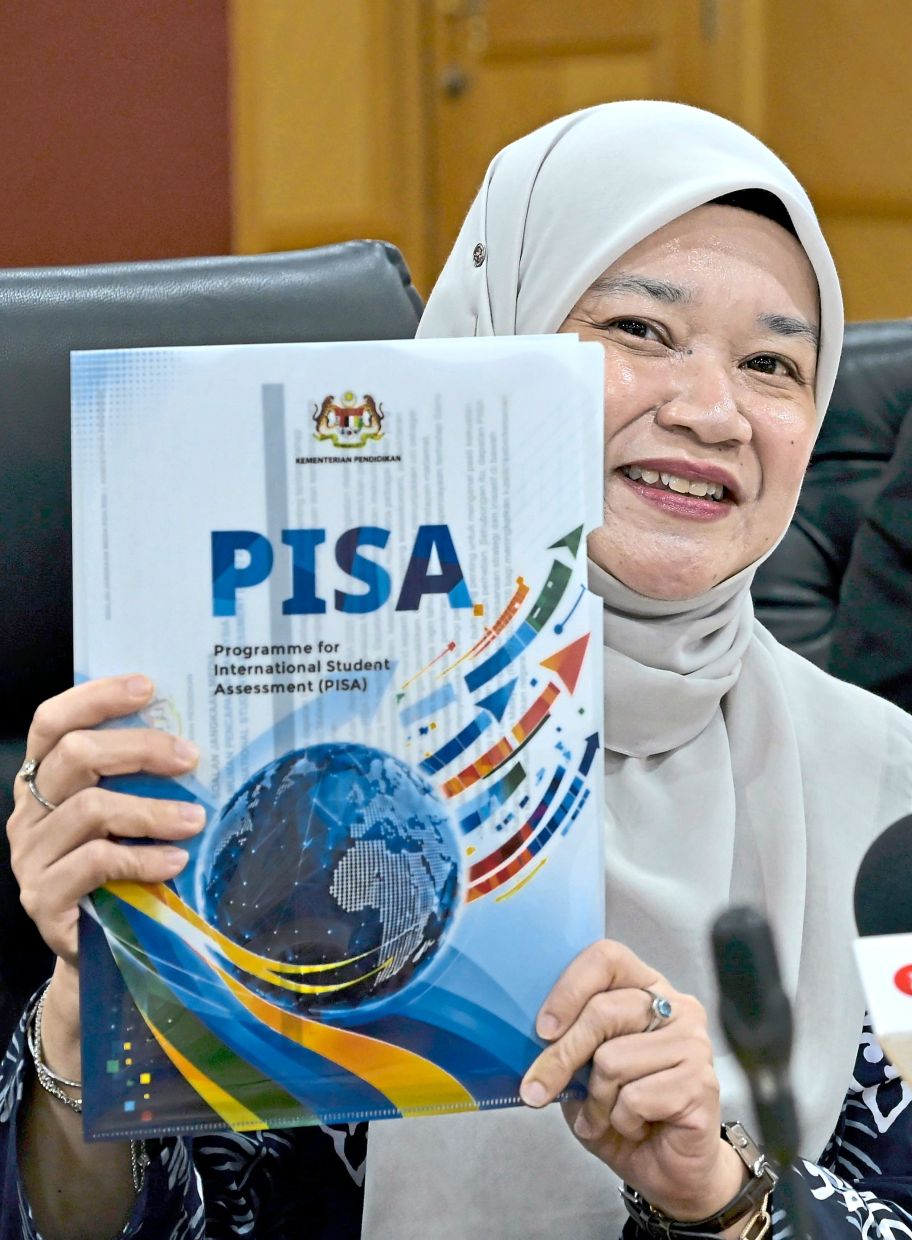
Education Minister Datuk Seri Fadhlina Sidek (pic) said Malaysian students ranked highest globally for their willingness to seek help, while their resilience in learning ranked third highest in the assessment conducted by the Organisation for Economic Co-operation and Development (OECD) among 15-year-olds.
“Malaysian children also have a high level of curiosity. They are competent, persistent, resilient, and are increasingly able to manage their own learning.
“When given problems, they show a good ability to find patterns, use logic, test possibilities and find solutions,” she said when announcing the Pisa 2025 results at the Education Ministry in Putrajaya on Sept 8.
The achievement was also highlighted by OECD director for education and skills Dr Andreas Schleicher in a video message.
He said Malaysian 15-year-olds stood out for their perseverance and were becoming more self-directed learners, performing better than the majority of countries taking part in the assessment.
“That matters a lot because in the world into which these young people are growing up, knowledge will remain important, but the capacity to keep learning, to keep growing will be even more important.
“Artificial intelligence can put the accumulated knowledge of humanity into our pockets but no technology can substitute for curiosity,” he said.
Pisa is administered every three years to 15-year-olds in both OECD and non-OECD countries. Each round covers three core domains – reading, mathematics and science – with one given greater emphasis by rotation. Science was the major domain in 2025.
The assessment also gathers information on students’ attitudes, as well as their school and learning experiences.
A total of 7,624 Malaysian students from 157 learning institutions took part in Pisa 2025, which involved 91 countries and economies, up from 81 in 2022.
Malaysia’s performance in science and reading improved, with its science score rising three points to 419 and reading five points to 393 compared with Pisa 2022. Mathematics, however, declined by 11 points to 397.
Pointing to the improvement in the two domains, Fadhlina said Malaysia’s scores had risen while those of many other countries had declined.
“The decline in mathematics is not something we can see as a change in just one round, but it should make us look at the problem more seriously, intensively and not defensively,” she said.
Fadhlina also highlighted Malaysia’s success in creating a level playing field among schools, with only 17% of the variance in student performance attributed to differences between schools.
“This achievement makes us comparable to Singapore when it comes to education equity,” she said.
Another area in which Malaysia performed strongly was computational problem-solving, which was tested for the first time by Pisa in 2025.
Fadhlina said Malaysia was among six countries and economies in the world to exceed OECD expectations for computational problem-solving, scoring 484 points.
Computational problem-solving, she explained, is the ability of children to break down complex problems into smaller parts, find patterns, select important information and then organise steps to solve them.
However, Fadhlina raised concerns over cyberbullying, with 5% of Malaysian students reporting that they had encountered it.
At the same time, students reported lower levels of family support for their education, with Malaysia scoring -0.51 points compared with the OECD average of -0.19 points.
“There is a high level of cyberbullying by Malaysian students compared with the OECD average and it is associated with lower learning achievement.
“I would like to appeal to parents throughout the community to look at our role as families, especially to ensure that we can continue to improve the support we provide to our children in their learning,” she said.
Fadhlina added that interventions are being carried out to tackle issues identified in the assessment, including the Malaysian Mathematics Education Transformation Plan 2026-2035 and the new school curriculum, which will begin next year.
“Our task now after Pisa is to connect all those strengths with the areas we still need to improve,” she said. — By REBECCA RAJAENDRAM