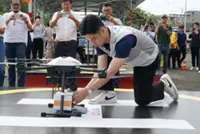
VTAR students and teachers gain specialised skills through training programme in China
WITH rapid technological advancements, unmanned aerial vehicle (UAV) technology has seen significant growth in recent years.
Its applications have expanded far beyond traditional aerial photography and agriculture, increasingly extending into emerging fields such as logistics and transportation, surveying and mapping, infrastructure inspection, emergency response, smart cities and the low-altitude economy.
Amid these expansions, some 28 students and teachers from VTAR Institute’s electronics and electricals programmes are gaining specialised training in UAV technology through a one-month scholarship-funded programme at Nanjing Vocational Institute of Transport Technology in China.
The programme aims to give Malaysian technical and vocational education and training students exposure to advanced UAV technology in China.
At the opening ceremony, VTAR Institute chief executive officer Tan Cheng Liang said UAVs are no longer simply flying devices, but represent a highly integrated and advanced field of technology that combines multiple disciplines, including mechanical engineering, electrical and electronic engineering, automatic control, communication networks, artificial intelligence and data applications.
“Therefore, through this training programme, we hope our students will not only learn how to operate UAVs, but more importantly, understand the technological principles, system architecture and industrial applications behind UAV technology, while gaining a broader understanding of future technological trends,” she said.
Tan added that the programme is part of VTAR’s efforts to promote cross-disciplinary learning, international exchange and industry-education integration.
“By gaining exposure to UAV technology, students from the electronics and electricals programmes can connect their existing technical knowledge with emerging technology fields, allowing them to develop a more comprehensive approach to technology and problem-solving through hands-on learning,” she said.
She urged the students to maintain an open and proactive attitude towards learning and embrace technological changes while strengthening their professional skills.
“Future workplace competition is no longer simply about possessing skills in a single discipline. Employers increasingly need versatile talent who can think across disciplines, integrate different technologies, and apply innovative approaches to solve real-world problems,” she said.
She also encouraged the students to make full use of the international learning opportunity by observing, engaging and interacting actively beyond the classroom, and to bring their knowledge and experience back to Malaysia.
Student representative Goh Jia Weng said the programme is a meaningful and valuable experience for the students.
Apart from gaining knowledge of advanced UAV technology, the programme also gives them an opportunity to experience first-hand the development of vocational education in China and understand the close connection between technological innovation and industrial applications, he said in a press release.
“This is not just a learning journey, but also an opportunity to challenge ourselves and step outside our comfort zone. We have the opportunity to experience new technologies, new teaching approaches and a different culture. I believe these experiences will become an important part of our personal and professional growth in the future,” he added.