TEACHING mathematics, science and languages may be straightforward, but instilling values such as responsibility, discipline and respect for labour can be more complex.
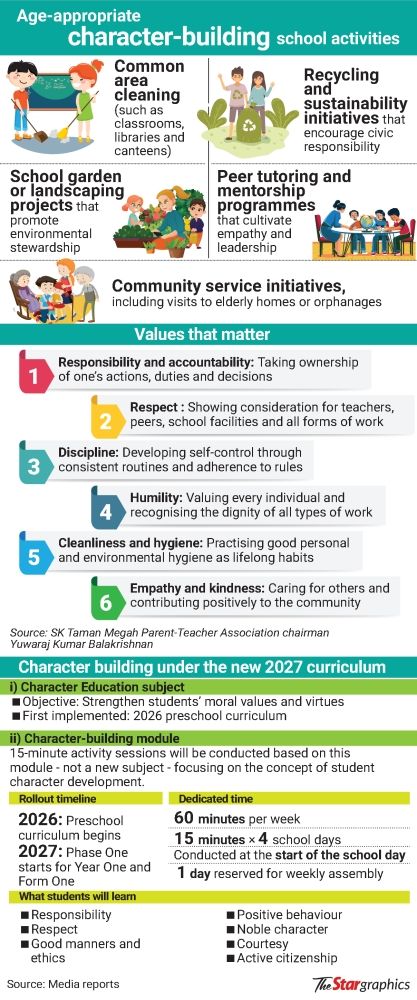
As schools prepare to roll out the new curriculum next year, including the Character Education subject as part of a broader character-building programme (see infographic), stakeholders stress that cultivating lasting values requires more than a single subject, activity or lesson.
They caution that meaningful character development depends not only on the activities chosen but also on how consistently values are reinforced.
Their comments also come amid Prime Minister Datuk Seri Anwar Ibrahim’s proposal for students to clean school toilets as a way of instilling responsibility and discipline.

He told reporters on April 17 that the proposal should not be disputed as it would apply to all students, regardless of their family background or social standing.
While awaiting further details from the Education Ministry, SK Taman Megah Parent-Teacher Association chairman Yuwaraj Kumar Balakrishnan said one of parents’ biggest concerns is whether the activity is age-appropriate.
“Many parents feel that children in Years One to Three are too young for this task. They worry about safety, hygiene and the risk of children treating it as ‘playing with water’ rather than actual cleaning,” he told StarEdu, which reached out to the ministry for updates but did not receive a response by the time of publication.
Despite these concerns, Yuwaraj Kumar stressed that parents are not opposed to character-building efforts.
Instead, they believe the same objectives can be achieved through age-appropriate activities without compromising safety (see infographic).
A whole-system approach
Behavioural change, said Parent Action Group for Education Malaysia chairman Datin Noor Azimah Abdul Rahim, does not happen automatically through any single activity.
“It depends on how the activity is implemented, explained and reinforced,” she said.
Instead of relying on a single initiative, Noor Azimah believes schools should embed values through sustained, community-based programmes.

“These include student-led classroom and school maintenance programmes that encourage shared ownership of school facilities.
“Community service and volunteer initiatives involving elderly homes, environmental conservation, food banks and neighbourhood improvement projects also help,” she said.
Peer mentoring and buddy systems, she added, can also foster empathy and responsibility across different age groups.
However, she cautioned that cleaning school toilets alone is unlikely to change deeply rooted attitudes towards social status.
Meaning matters more
Agreeing, Taylor’s University clinical psychologist and senior lecturer Dr Sam Jeng Mun said students are more likely to internalise values when an activity feels meaningful, fair and aligned with their identity, rather than being imposed purely through authority.
She pointed to the Self-Determination Theory, which suggests that people are more likely to adopt values when three psychological needs are met.
“The first is autonomy – students understand the purpose behind the activity and have a say in how it is carried out.
“Next is competence – students know what to do and feel capable of completing the task successfully.
”The third is relatedness – students feel connected to their school community and understand that their actions benefit others,” she explained.

Walking the talk
Sam also highlighted the Social Learning Theory, which emphasises that children learn values by observing adults’ behaviour.
“For instance, if teachers, school leaders and parents consistently demonstrate respect for cleaners and shared spaces, students are more likely to develop respect.
“However, if adults frame cleaning as “low-status work”, children may internalise those beliefs instead,” she said.
The key, she stressed, is not the activity itself, but how adults frame the experience.
Echoing this, Yuwaraj Kumar said character building should not rest on schools alone.
“Schools cannot and should not be solely responsible for character development.
“Parents must model these values by keeping their own homes clean, showing respect, and involving children in household chores,” he said.
The school’s role, he added, is to reinforce and build upon the values children first learn within their families.
Building a culture
National Union of the Teaching Profession Malaysia secretary general Fouzi Singon emphasised the need for a structured, long-term approach to character education.
He expressed hope that the values and practices promoted through the new 2027 curriculum would eventually become embedded in Malaysian society.

“If this can be achieved, there may come a time when a dedicated character-building curriculum is no longer necessary because these values will already be firmly rooted in society,” he said.
However, Fouzi stressed that introducing a curriculum alone is not enough, as the real challenge lies in its implementation.
“The challenge is not merely introducing a new curriculum, but ensuring that teachers, parents and students fully understand its purpose and intended outcomes,” he said.
Until then, he added, implementing character education will continue to present both opportunities and challenges for Malaysia’s education system.
Students weigh in

"A better approach to strengthening character education would be through volunteer programmes, leadership opportunities, community service and campaigns that encourage students to take pride in their school.
When students understand why they should care for public property, they are more likely to act responsibly even when no one is watching.
Responsibility is about developing the right mindset and lasting character, not assigning a specific task." --Vinitha Anne Puttagunta, 16

"Cleaning shared spaces can teach responsibility, respect for school property, and consideration for others. However, schools should also provide proper cleaning equipment, gloves and clear hygiene guidelines so students can do it safely.
That said, there are more urgent issues that many schools should address first, such as bullying, damaged facilities and overcrowded classrooms.
Students are more likely to take pride in keeping facilities clean when the school already maintains a good standard." --Isabel Tang Mea, 15

"There are meaningful ways to build discipline and civic responsibility, and it should be a collective effort involving students, teachers, administrators and support staff.
Schools could involve students in monitoring facilities, reporting maintenance issues, leading environmental initiatives and contributing ideas to improve the school environment.
Responsibility is built through ownership and participation, not simply by assigning cleaning duties." --Isabel Lim, 15