
MALAYSIA’S top ranking in the 2025 Education First (EF) English Proficiency Index (EPI) reflects progress and potential, but does not capture the full picture of English proficiency nationwide, say education experts.

“Several areas that need urgent improvement to match the reality on the ground include equitable access for rural and underserved communities that still lack consistent exposure to English beyond the classroom,” she told StarEdu.
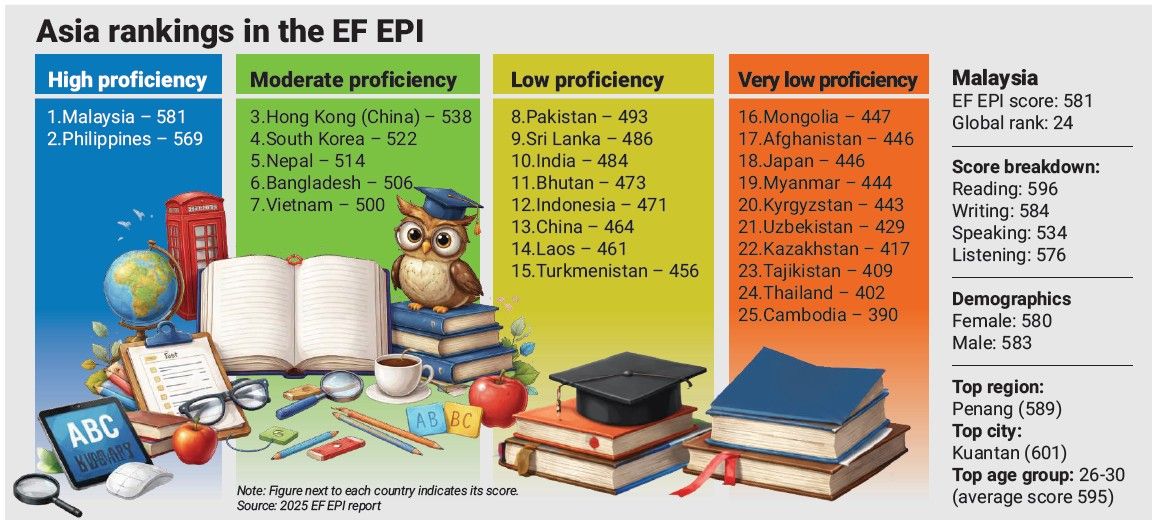
In the 2025 EF EPI released on Nov 21, Malaysia ranked first in Asia (see infographic) and climbed two places to 24th globally. The EF EPI is the world’s largest international survey of adult English skills, assessing 2.2 million non-native English speakers across 123 countries and regions.
Overall, Malaysia secured a score of 581 in the 2025 index, an increase of 15 points from last year. Kuala Lumpur was classified as a high-proficiency capital city with a score of 588, up from 584 previously.

Within Malaysia, Penang emerged as the top region for English proficiency with a score of 589, while Kuantan took the spotlight as the top city, achieving a score of 601. Those aged 26 to 30 recorded the highest level of English mastery in the nation, with an average score of 595.
Malaysian English Language Teaching Association (Melta) president Prof Dr Sivabala Naidu said while the recognition highlights real progress, especially among younger, urban Malaysians, it does not fully capture the experience of the entire population.
“We still have a huge task to address the significant disparities in access to English education between urban and rural areas and to transform learning to be relevant for adults.
“Community classes, flexible online courses and workplace programmes can make a big difference.
“Shifting the focus from textbook learning to real communication skills, particularly speaking and listening, will convert test success into genuine proficiency,” he said.
Focus on practice
For the first time, the 2025 edition of the rankings includes results from speaking and writing assessments, offering a broader view of English proficiency than previous editions, which assessed only reading and listening comprehension skills.
In this edition, Malaysia scored 596 for reading, 584 for writing, 534 for speaking and 576 for listening (see infographic).
Prof Surinderpal said the gap between speaking and reading scores suggests that the education system has been more successful at teaching English as knowledge than as practice.
“We need to focus on practice, especially in building confidence in speaking and interaction. Ultimately, English proficiency grows when learners use the language to think, express and connect, not just to answer questions,” she said.
Among the strategies she proposed are transforming classrooms into safe spaces for speaking, where mistakes are viewed as part of learning.
“More project-based, discussion-based and real-world tasks should be introduced. Reading and writing should also be connected to meaningful communication, not treated as isolated exercises,” she added.
Never too late
Prof Surinderpal said Malaysia must reframe English as a life skill rather than merely a school subject, and create environments where adult learners understand that it is never too late to learn the language.
“English language learning for adults must be accessible, non-threatening and relevant, through community-based programmes in libraries, community halls and workplaces.
“Workplace-linked English tied to employability, micro-credentials and short courses, as well as mobile learning platforms such as podcasts and short videos, can also be highly effective,” she said.
Prof Sivabala added that collaborations with non-governmental organisations and universities can help adults see English as a tool for career advancement and personal growth.
He noted that such partnerships allow learning to be embedded in real-life contexts, enabling adults to apply English skills immediately in their jobs, small businesses and daily interactions.
“By removing the pressure of exams and grades, these initiatives can help rebuild confidence among adult learners and encourage lifelong learning,” he said.
Supporting teachers
Prof Sivabala also stressed that equity for teachers must be a priority, noting that ensuring qualified educators and up-to-date, practical resources reach rural and underserved schools is essential.
“Continuous, practical support for teachers’ professional development in modern teaching practices, access to digital tools and mentorship programmes, especially for educators in remote locations, is important.
“Investing in teachers is the most effective path to raising student proficiency nationwide,” she said.
Concurring, Prof Surinderpal said English teachers need context-sensitive support.
“Some support should focus on training in communicative and task-based pedagogy, especially for mixed-ability classrooms; digital and artificial intelligence-assisted teaching tools, particularly for rural and under-resourced schools; and professional learning communities where teachers can share best practices,” she concluded.