THE elevator industry is an important component of Malaysia’s construction and service sectors.
In recent years, with accelerating urbanisation and the continuous development of high-rise buildings, the demand for elevator and escalator installation, maintenance and inspection has increased significantly.
In response to the rising need to develop a talent pool in this field, VTAR Institute and Guangdong Engineering Polytechnic, China, have joined hands to introduce an Elevator Engineering Technology programme.
VTAR chief executive officer Tan Cheng Liang said the programme will include three core modules, namely Sensors Technology, PLC Technology and Applications, and Elevator Maintenance and Repair Technology, for students enrolled in the Electrical Installation and Maintenance course.
“With the development of smart buildings, green energy and digital automation, the employment market in the elevator engineering field will continue to expand.
“Through this collaboration, we aim to integrate elevator engineering technology into the Electrical Installation and Maintenance curriculum, providing students with additional skills and broader career opportunities. This not only helps fill the domestic skills gap but also paves the way for students to pursue high-skilled, high-paying careers,” she explained.
She added that the entire programme comprises 216 training hours, with theoretical courses delivered primarily online and practical sessions conducted on-site at the campus in China.
“Guangdong Engineering Polytechnic will provide a one-month free short-term study programme in China for selected VTAR students. Students will only need to cover their own travel, accommodation and personal expenses,” she said in a press release.
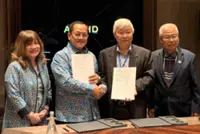
The signing of the memorandum of agreement (MoA) to jointly establish the programme was held at VTAR, which recently hosted a delegation from the polytechnic.
Present to sign the MoA were Tan and Guangdong Engineering Polytechnic party committee secretary Ye Zhongming.
Tan shared that this latest collaboration is built on the achievements of existing partnerships between the two institutes.
“The first batch of Digitalisation Manufacturing Automation students went to the polytechnic in February this year for a three-week industrial robotics study programme and received high praise from local leaders and instructors.
“We are very pleased to see that upon returning, the students have made significant improvements in their professional skills, learning attitudes and international perspectives. This demonstrates the success of our collaborative model,” she said.
“The second batch of students has already begun online courses this year and is scheduled to depart for China in March 2026 for a one month industrial robotics practical training programme,” she added, while expressing her gratitude for her counterpart’s strong support in the joint training programmes.
In his speech, Ye noted the successful launch of the joint industrial robotics programme last February.
“The arrival of 20 students and a teacher marked a vivid milestone in the collaboration between our two institutions,” he said.
Emphasising that China-Malaysia technical and vocational education and training cooperation benefits not only from favourable policies but also from a solid practical foundation, he proposed four points of cooperation.
“Deepen joint programme development by leveraging our strengths in elevator engineering, robotics and related fields to jointly develop a ‘Chinese + Vocational Skills’ curriculum and share practical training resources.
“Promote faculty exchange by establishing regular teacher training and exchange mechanisms to jointly explore innovative teaching methods in technical and vocational education.
“Expand industry-education integration by collaborating with Chinese and Malaysian enterprises to build training bases, carry out technological research and provide customised talent development.
“Enrich cultural exchange by fostering student exchanges and skills competitions, allowing friendships to grow alongside the transmission of technical knowledge,” he said.
Ye also expressed the polytechnic’s commitment to working with VTAR to advance the vocational education mission under the Belt and Road Initiative, enabling skills to become “the wings for youth success in both countries and making this cooperation a driving force for regional development”.
Also in attendance at the signing ceremony from VTAR were accredited centre manager Danny Teng Howe Cheng, marketing manager Low Feh Theng, and marketing executive and registrar Wong Yi Wen.
Representing Guangdong Engineering Polytechnic were School of Intelligent Engineering dean Mai Xiaodong, International Education director Qiu Zhiyuan, School of Advanced Manufacturing (School of Elevator Engineering) deputy dean Hu Rong, School of Architectural Engineering deputy dean Ni Xiaozhen, and Teaching Quality Monitoring and Evaluation Centre deputy director Wen Zhenzhen.