
This, says Monash First Aiders Bureau (MFAB) president Lee Yi Hern, equips everyone with the basic knowledge to handle unexpected situations responsibly and effectively.
“Accidents can happen anytime, whether at school, home or during daily activities. Being prepared can make a real difference in emergencies,” he told StarEdu.
The 22-year-old added that the need is growing as Malaysia becomes an ageing nation.
“First aid training empowers students to act quickly and confidently, creating a safer and more caring community.
“We often hear of emergencies at home, on the road, or in public where outcomes could have been much better if someone nearby knew what to do – because in an emergency, every second counts,” he stressed.

“I would estimate about a 25% rise in participants attending our weekly first aid classes compared to previous years,” he shared.
However, misconceptions remain, he noted.
“Some students still hesitate to take up first aid because they perceive it as irrelevant or assume it is only meant for healthcare students,” he said.
He opined that educational institutions can encourage greater participation by actively supporting the growth of first aid clubs.
Funding, he added, can make a huge difference.
“Providing funding for essential training equipment would allow more frequent and effective sessions to be conducted. By making first aid training more accessible and inclusive, schools can help students realise that these are valuable life skills for everyone – not just those in healthcare fields,” he said.
Personal motivation
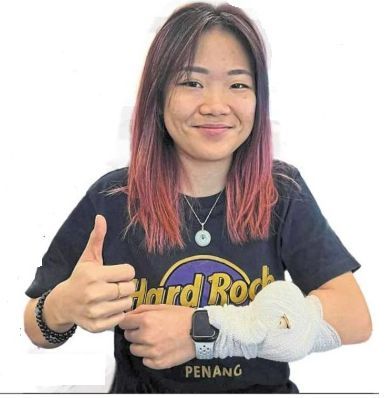
“Since I was young, I’ve always enjoyed watching medical and emergency dramas, and that inspired me a lot.
“Rather than just being an audience member watching the medical team respond to casualties, I wanted to be someone who could actually help in real-life situations,” the second-year medical student shared.
The benefits of first aid, the 21-year-old added, go far beyond handling medical crises, as these experiences have built her confidence and strengthened her sense of preparedness.
“First aid training emphasises collaboration, where each person has a role to play in helping the casualty.
“For example, when managing an unconscious patient in cardiac arrest, team members must coordinate to perform cardiopulmonary resuscitation – delivering 30 chest compressions followed by two rescue breaths – while supporting one another to maintain rhythm and focus.
“Without proper communication, this dynamic will be challenging to achieve. First aid helps students learn how to work efficiently as a team under pressure,” she said.
Personal fear, on the other hand, was what spurred Lujain Robert Wadie Swaidan to begin her first aid journey.
“It actually started with me living alone and realising I didn’t know how to help myself if I choked.
“I joined a first aid class just to learn that one skill, but I ended up falling down a rabbit hole of first aid. The more I learnt, the more I found this knowledge fascinating,” she recalled.
The 24-year-old Monash School of Science graduate added that training builds not just competence but also calmness.
“You gain communication skills and become more observant of your surroundings. It also improves your general health awareness and people skills. Once you begin, you start to notice when something’s off and how to respond confidently,” she enthused.
Her advice to new learners was simple: “Bring a friend – that’s what helped me. Having someone familiar around makes it less intimidating, and honestly, there’s no need to be nervous as everything starts from the basics.”
Lessons for everyone
Since its inception in 2017, the student-led MFAB has trained hundreds of students in essential life-saving skills through classes and workshops, in addition to supporting the wider community.
“We conduct numerous first aid workshops with different organisations. We also go to primary schools to teach first aid skills upon request.
“We provide professional yet affordable first aid services to any organisation that approaches us for medical standby. Some of the events our team supports include taekwondo and badminton tournaments, marathons, hikes and even local concerts,” Lee said.
He added that this year, the society has doubled its number of collaborations through organisations like the Society of Malaysian Medical Association Medical Students, Malaysian Medics International, and the Malaysian Pharmacy Students’ Association to organise workshops and talks.
“These are lessons that every student should have,” Lee concluded.
Li Lian, 20, a student in Kuala Lumpur, is a participant of the BRATs Young Journalist Programme run by The Star’s Newspaper-in-Education (Star-NiE) team. For updates on the BRATs programme, go to facebook.com/niebrats.

With the theme of the article in mind, carry out the following English language activities.
1 Think about a time when you hurt yourself and needed medical attention. What steps were taken to help you?
Write down those steps for the benefit of others who might find themselves in the same situation one day.
Then, present your work in class.
2 Imagine a situation where someone feels unwell and needs help, such as a classmate fainting during an assembly.
Write a short, news-style story showing how first aid made a difference.
The Star’s Newspaper-in-Education (Star-NiE) programme promotes English language learning in primary and secondary schools nationwide. For Star-NiE enquiries, email starnie@thestar.com.my.