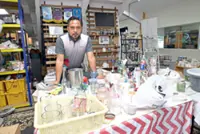
THE art of making traditional Punjabi furniture, once touted as a thriving business, is fast turning into a dying trade.
There are only two places in the country where such furniture, especially the traditional Punjabi bed or “manjaa”, is produced — one in Perak and the other in Kuala Lumpur.
The manjaa, where ropes are weaved according to a wooden bed frame, used to be a must for Punjabi families during the olden times.
However, due to modern times, contemporary beds and mattresses have taken over its place.
Punjabi furniture maker Arvinder Singh said there were still some who favoured the manjaa, which comes in a variety of sizes.
“It is believed that sleeping on the bed helps to reduce backache and it also has better ventilation due to the gaps in between,” he said, adding that no nails were used to make the furniture as they were fitted accordingly.
The manjaa, also known as charpoy, is synonymous with Sikh night watchmen, who used to be seen sleeping in front of banks and business premises before big time security companies came about.
When morning came, they would carry the beds on their heads to be put aside for use again that night.
In India, the versatile charpoy, which is used indoors, outdoors, and sometimes even on rooftops, is an important part of its people’s lifestyle.
It is used as a bed as well as a chair where guests are invited to sit on.
Arvinder, 27, is the third generation in his family still plying the trade.
“It may not be something youngsters are interested in but I asked my father to teach me the trade.
“It will be such a waste if we do not continue with our tradition and culture,” said Arvinder, who works alongside his parents and wife, who are all involved in traditional Punjabi furniture making.
Both his parents, Sokbber Singh, 50, and Rajwinder Kaur, had learned the trade from their own parents.
“In the old days, jute was used to weave the bed but it is difficult to obtain the material these days and it can be pretty expensive if we were to import them from India.
“It used to be cheap because they were made by prisoners and were easily available.
“Since it is difficult to obtain jute now, the other best alternative is nylon ropes,” Arvinder said.
The bed frame, he continued, were made from solid cengal or merbau wood.
“It is better to use second-hand wood, especially those from old houses, as they are dry and more solid compared to the new wood,” he explained.
According to Arvinder, the crafting and assembling of the bed frame were carried out at an empty space behind the Gurdwara in Tronoh while the weaving was carried out in either Tronoh or at their home in Gunung Rapat, Ipoh.
They also have a shop on Jalan Silang near Lahat Road, Ipoh.
Besides the manjaa, the family also makes the menji (a smaller version of the manjaa for the living room), pirie (small stool), bench and palki where the Sikh holy book is placed.
Surprisingly, Arvinder’s customers are not only Punjabis.
“We have Malay, Chinese and Indian customers as well,” he said.
Already a subscriber? Log in
Get 20% OFF The Star Digital Access
Cancel anytime. Ad-free. Unlimited access with perks.