The Malaysianisation of staff and the switch from English to Bahasa Malaysia as a medium of instruction were among the challenges the country’s oldest university had to address in the 1970s.
These and other issues pivotal to its foundation years are captured in A Living History: Personal Recollections From The University Of Malaya, a commemorative publication marking 121 years since its founding in Singapore.
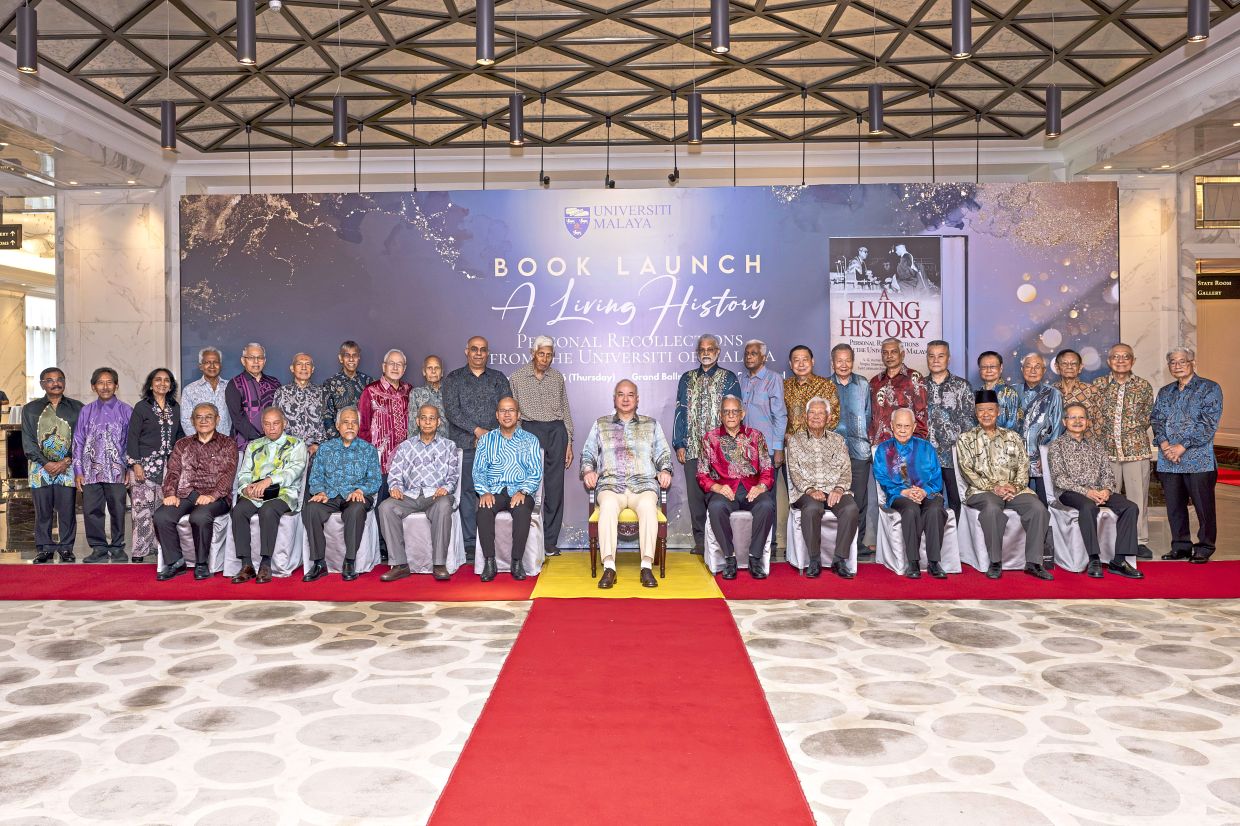
The book features 40 contributors, comprising mostly academic staff who had served UM from 1960 to 2010.
It is the work of three emeritus professors – Prof Datuk Dr VG Kumar Das as chief editor, together with his two co-editors Prof Datuk Tengku Shamsul Bahrin and Prof Tan Sri Dr Syed Jalaludin Syed Salim.
Prof Kumar Das said the book had its origins in a lunch attended by several senior UM staff to celebrate his 85th birthday in 2025.
“The reminisces and anecdotes shared at the meeting were so captivating that I proposed we try to secure more such ‘living recollections’ bearing on the university’s history, which are abysmally absent from its archives, from ex-staff and students across faculties.
“Our goal was to document UM’s rich history, vibrant culture and remarkable growth, particularly from the late 1950s to the 1990s,” he said in an interview.
Prof Kumar Das said that period coincided with UM’s “golden decades” which saw it undergo major transformative changes.
He then wrote personally to prospective contributors across the arts and social sciences, as well as the medical, biological and physical sciences.
The brief asked for details of the obstacles encountered in teaching and research and how they were overcome, impacts of national educational policy changes, student and staff activism and the resulting clampdown, perspectives on the Malaysianisation of UM, academic disagreements and political interference in university affairs.
The former Science Faculty dean, who later became founding vice-chancellor of two private universities, said while much has been written about UM’s early history and its illustrious alumni, including five prime ministers, “its internal dynamics and the efforts to establish and sustain its premier status have largely remained underexplored.”
Prof Kumar Das hopes the 454-page book will make a meaningful contribution to UM’s memoir collection, offering insights into its history, culture and development.
“Readers should expect a diversity of perspectives – nuanced, and at times even conflicting – as such diversity reflects the richness of any well-established institution.”
Among the contributors are the three editors, two former vice-chancellors Emeritus Prof Datuk Dr Hashim Yaacob and Emeritus Prof Tan Sri Dr Ghauth Jasmon, as well as Emeritus Prof Datuk Seri Dr Osman Bakar and Prof Dr Wang Gungwu.
Other notable contributors include Emeritus Prof Datuk Dr Isahak Haron, Emeritus Prof Datuk Dr Mohamed Ariff, Emeritus Prof Datuk Dr Sothi Rachagan, Emeritus Prof Dr Lam Sai Kit, Emeritus Prof Dr Yong Hoi-Sen and Prof R Rajakrishnan.
There are only two women contributors, Prof Puan Sri Dr H.O. Wong and Dr Ravigadevi Sambanthamurthi.
Regarding the book’s inclusion of only two women to represent UM over the past five decades, Prof Kumar Das said some of the older staff approached were unable, for health and other reasons, to participate in the project.
Universiti Malaya Press published the book, and the university’s chancellor and Perak Ruler Sultan Nazrin Muizzuddin Shah launched it and wrote its foreword.
His Royal Highness also sponsored the launch, which was held in Kuala Lumpur and attended by a packed audience.
Also present was UM vice-chancellor Prof Datuk Seri Dr Noor Azuan Abu Osman.
In his speech at the launch, Sultan Nazrin said the book was more than a worthy tribute to an esteemed institution.
“Just as the nation confronted the task of building equity from diversity, the university likewise faced difficult choices as it moved ahead.
“But all were navigated capably, if not always flawlessly, by the university’s leaders, professors, staff and students.
“And it is this that is brought to life so vividly in these pages, by some of the key players and protagonists, alongside other keen observers.
“In this way, the book stands as a testament to just how much our flourishing higher education sector of today owes to the groundwork painstakingly laid during these early post-independence years.”
As Sultan Nazrin noted, the book also sheds light on some more uncomfortable historical episodes and how the university responded.
These include the flourishing of intellectual and political discourse on campus in the university’s earliest years.
However, the difficult choices that followed the May 1969 crisis, subsequently eroded this vibrant, productive atmosphere, he said.
For many of those who attended the launch, it was a reunion of sorts as most had not met each other since leaving UM.
They included Arts and Social Sciences Faculty former deputy dean Prof Dr Lee Kam Hing, who is now with New Era University College.
He said he was glad to see several former colleagues, many of whom he had not met since retiring in 1997.
“This gathering has brought together a generation of scholars who helped lay the foundations of a great university.
“It is a fitting celebration of UM’s scholarly tradition, which the book itself seeks to capture,” he said.
Another contributor, former UM deputy vice-chancellor Prof Dr Kurunathan Ratnavelu, who is now with UCSI University, echoed similar sentiments about the university.
“I stand on the shoulders of past giants. UM has rewarded many regardless of their race or religion.
“The tradition of striving for excellence at UM has never ceased and never will.”
The book is priced at RM120 and can be purchased from UM Press’ on-campus bookstore, Halaman, in Lembah Pantai, Kuala Lumpur.
For information, call 03-7967 5495.