THE first thing that hits you upon arriving at the 11th floor of the National Library of Malaysia (PNM) in Jalan Tun Razak, Kuala Lumpur, is the cold.
It is no accident. This is the National Centre for Malay Manuscripts, where the temperature is kept between 15.5°C and 20°C, and humidity at 45% to 50%.
These strictly controlled conditions ensure pages that have
survived for centuries do not crumble over time.
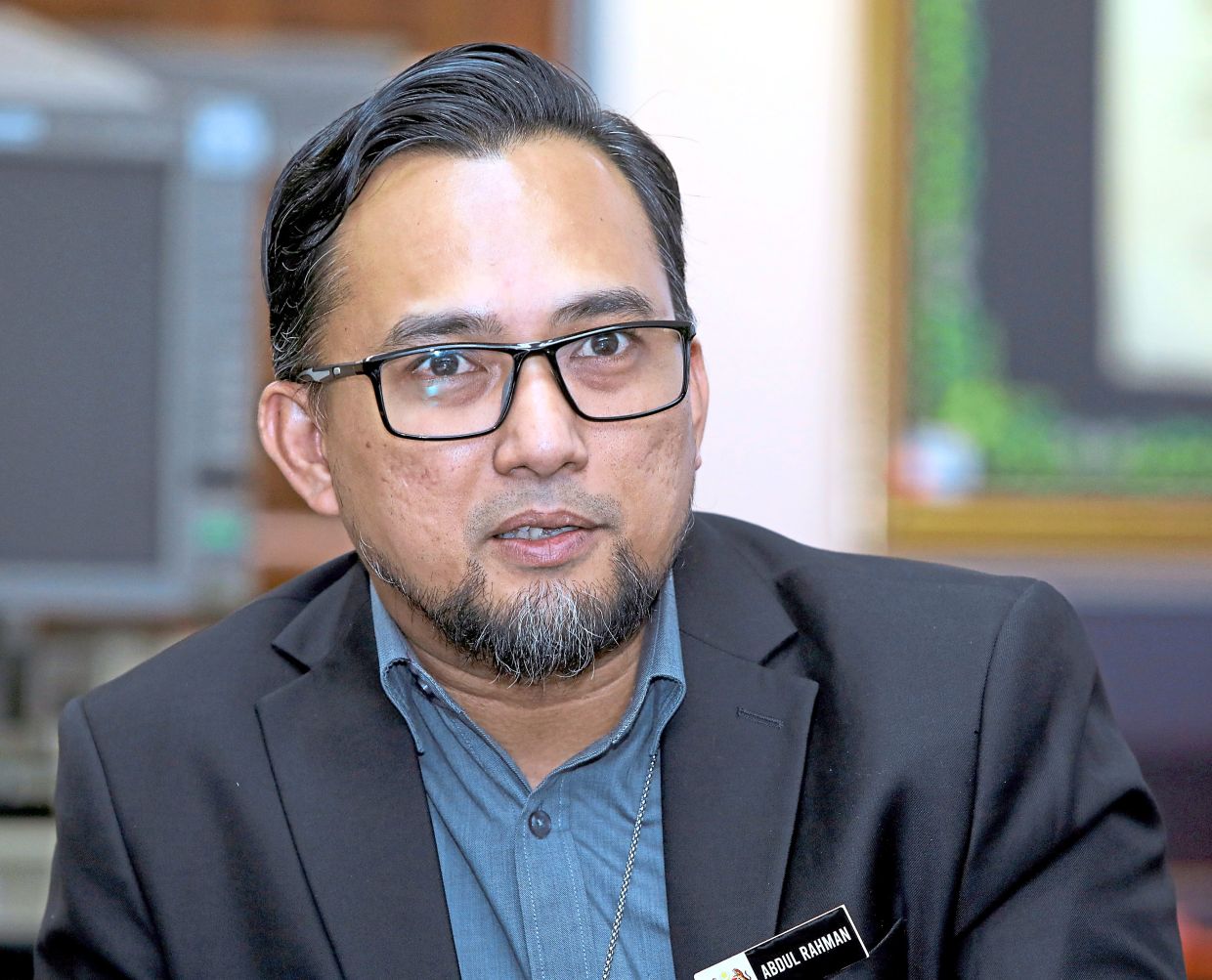
For the centre’s assistant director Abdul Rahman Mohamed Shariff, the chilly environment is the primary line of defence against a host of threats.
Asked what poses the greatest danger to these delicate records, he points straight to dampness.
“Moisture is one of the main enemies of manuscripts,” he said. “If the surroundings are too damp, it can encourage mould and create conditions that attract pests.
“Termites and silverfish are among the most destructive. They feed on paper, and their presence may not be noticed until parts of a manuscript have already been lost.”
Heat, humidity, light, insects and improper handling can all shorten the lifespan of a document that has weathered over the centuries.
This is why indoor conditions must remain strictly controlled, rather than fluctuating with the weather outside.
“The temperature is not kept low for our comfort,” Abdul Rahman said.
“It is maintained for the manuscripts. Once the paper, ink, or binding deteriorates, it may not be possible to restore it to its original condition.”
Clues in the paper
The work, however, begins long before a manuscript reaches the cold room. First, specialists must locate and identify it.
Abdul Rahman’s role regularly takes him beyond the secured archives. He travels across the country to examine manuscripts and historical documents held by families, private collectors and institutions.
Earlier this year, he joined a manuscript-tracing exercise in Lahad Datu, Sabah.
Such journeys often start with little more than a family story: a volume handed down through generations, a text whose origins have faded, or a document believed to date back hundreds of years.
Those accounts offer valuable leads, but they are not proof.
“When someone says a manuscript has been in the family for generations, that forms part of its history, but it is not enough for us to conclude that it dates from the 16th century,” Abdul Rahman said.
“We still have to determine whether the physical evidence supports that claim.”
Establishing authenticity requires patience.
“We have to examine the paper, handwriting and other physical details, so it can be quite a lengthy process,” he said.
The first clues usually lie in the paper itself.
Abdul Rahman studies its type, texture and quality. If the paper was produced in Europe, a watermark may indicate its production period. Yet a watermark is only one piece of the puzzle. The paper, ink, binding, handwriting and text must be evaluated together.
“We cannot rely on only one feature. All the available indicators must be examined together,” he said.
In complex cases, the centre consults academics and external specialists to cross-reference findings before reaching a conclusion.
“Sometimes, a family genuinely believes an heirloom dates from the 16th century because it has been passed down for generations,” Abdul Rahman said.
“However, when we examine the paper and other physical evidence, we may find that the copy was produced much later, perhaps even in the 20th century.
“That does not necessarily mean it is a forgery. It could be a genuine handwritten copy of an older work.”
The distinction is crucial: while the story may be centuries old, the specific physical volume might be of a much later vintage.
The subjects preserved in these volumes can also be surprisingly personal.
Petua, Azimat, Doa, Mantera (MSS 5252), for instance, gathers traditional remedies, practices, charms, prayers and incantations used by historical Malay communities.
Originals, digital copies and replicas
Once a manuscript joins the national collection, access is strictly regulated.
Researchers cannot simply walk into the repository and pull a volume off the shelf.
Anyone wishing to consult an original must fill out a request form, specify the material required and state their research purpose. They must also sign a declaration committing to the centre’s handling rules.
Food and drinks are strictly forbidden, and visitors may not mark or alter a manuscript in any way.
A staff member retrieves the item from the secured repository and brings it to a designated reading area, where it is examined under supervision.
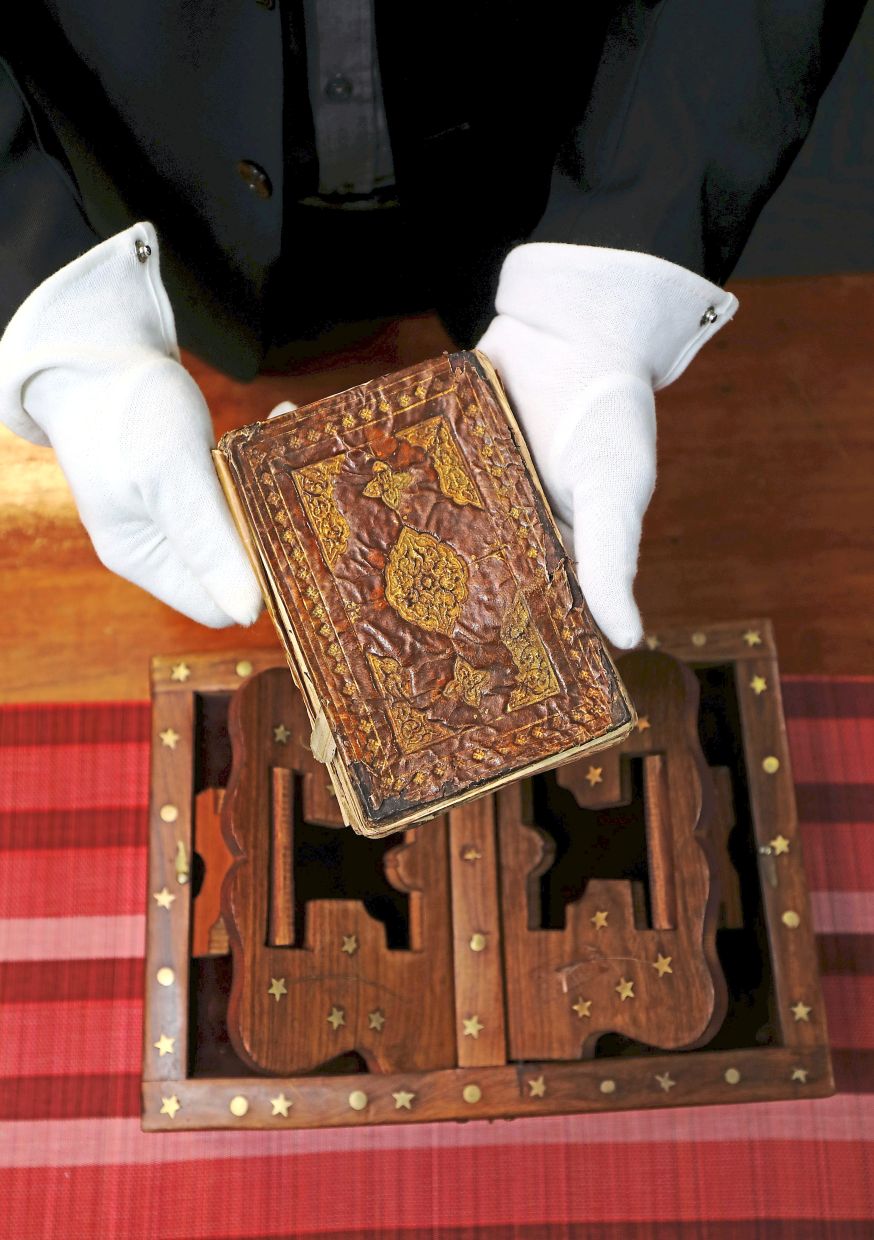
Visitors must wear protective gloves and turn every page with care.
“A manuscript is not an ordinary book that can simply be taken from a shelf and handled freely,” Abdul Rahman said.
“Every precaution is necessary because we are responsible for ensuring that it remains available for future generations.”
For the general public, access takes two alternative forms: digital copies or physical replicas.
A digital copy provides high-resolution scans for screen viewing.
A digitised version of Hikayat Hang Tuah (MSS 1713), for example, can be viewed through
PNM’s MyRepository portal, without the original volume leaving its climate-controlled environment.
A display replica serves a different purpose.
It is a physical model crafted to convey how the original looks as an object, though it does not contain every page.
“We keep the originals for research and reference, rather than put them on display,” Abdul Rahman said.
“For exhibitions, we commission replicas using digital photographs of selected pages.
“Each replica is made to resemble the original as closely as possible, including its size, thickness and appearance.
“It is essentially a display model, not a complete copy of every page in the manuscript,” he said.
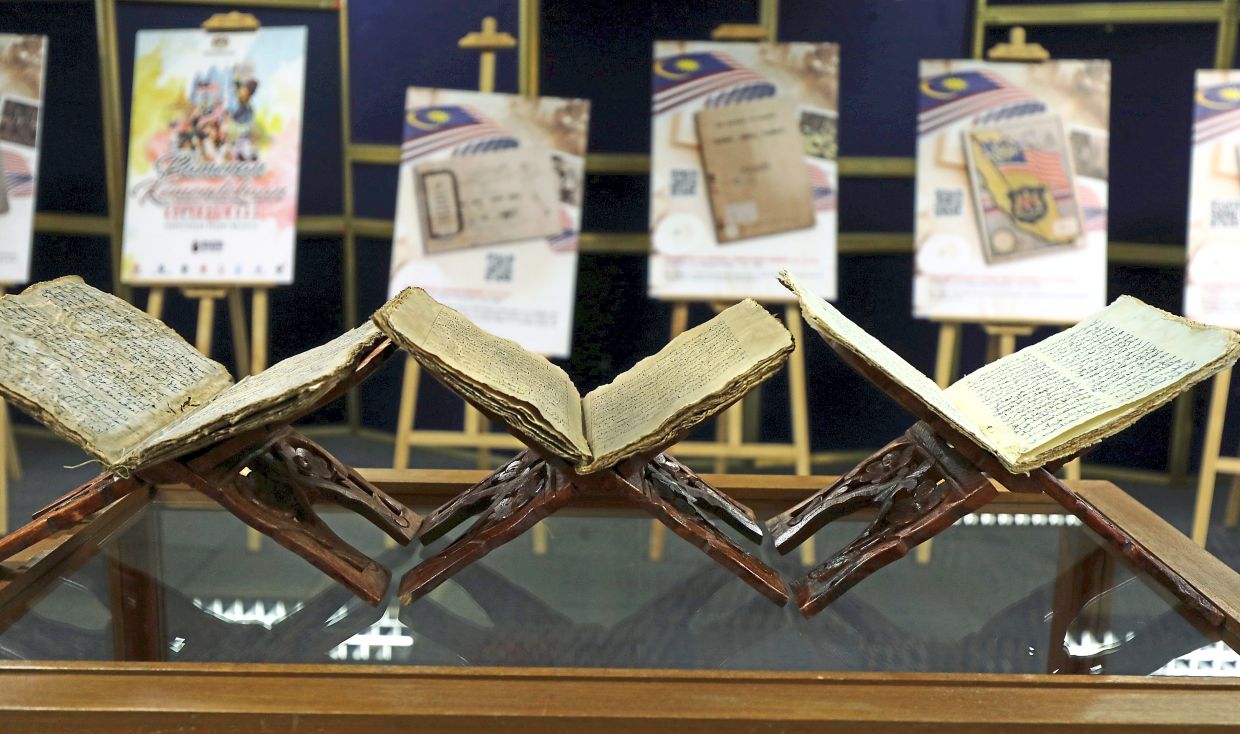
In PNM’s exhibition areas, visitors can lean over glass display cases for a closer look at replicas without placing the originals at risk.
Among the display pieces is a replica of Al-Quran (Terengganu) (MSS 4136), open on a wooden stand to show its decorated
opening pages, with floral and geometric motifs in red, blue and gold.
It is an easy distinction to miss. A replica may share the dimensions and visual character of the genuine manuscript, but the real document remains safely behind locked doors.
Treasures in print
Not every historic volume in the National Library’s care is a handwritten manuscript; rare printed books hold their own surprises.
Among them is Dictionarivm Malaico-Latinvm & Latino-Malaicvm, a Malay-Latin and Latin-Malay dictionary published in 1631.
Compiled by Davidis Haex, it contains 1,805 Malay entries and 3,639 Latin entries.
PNM highlights its publication as clear evidence that Malay was already functioning as a regional lingua franca across Nusantara at the time.
The dictionary is six years older than Khalq al-samawati wa al-ard (MSS 1517), dated 1637 and identified by PNM as the oldest Malay manuscript in its custody.
Another gem is a 1932 edition of Malay Sonnets: Pantun Melayu, which pairs selected Malay poems with English translations by AW Hamilton and illustrations by WG Stirling.
The accompanying description highlights the pantun as a distinctively Malay poetic form used to express grief, joy, affection and counsel.
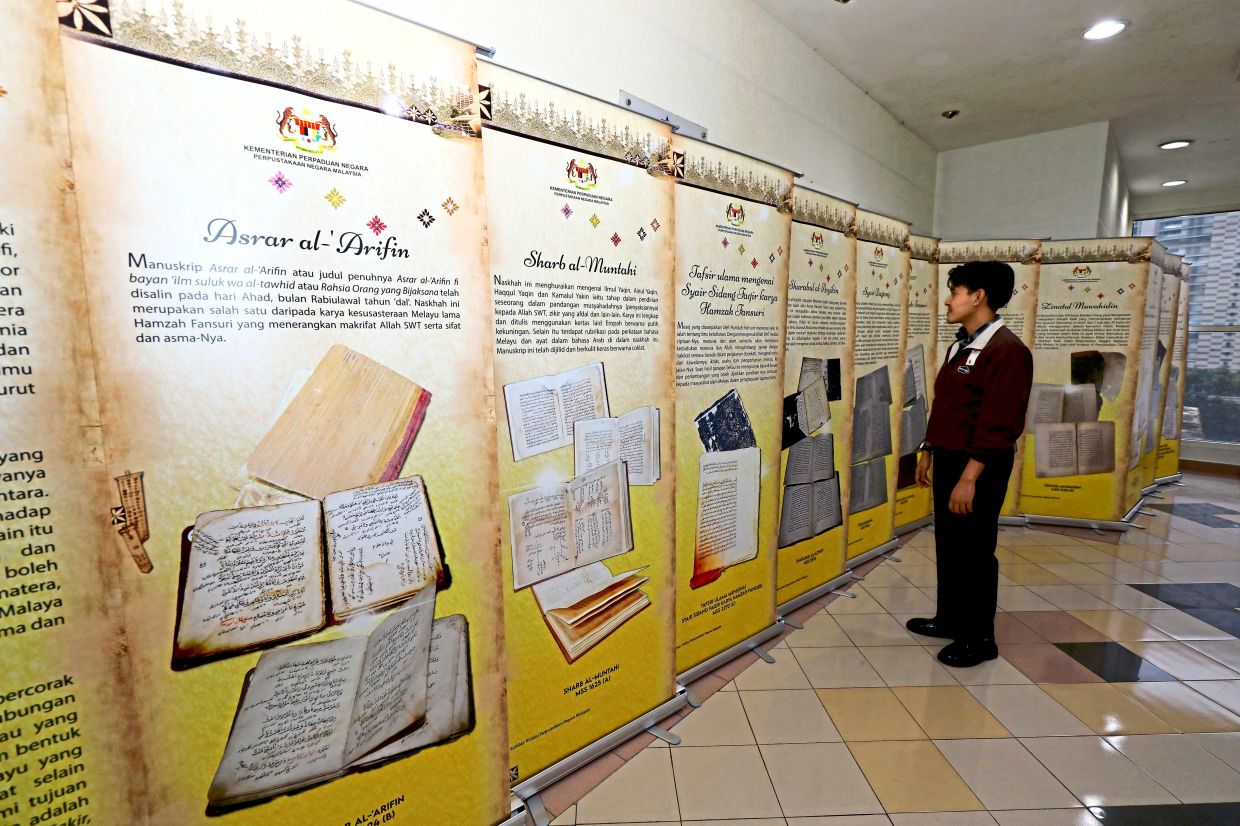
Elsewhere in the exhibition space, panels profile National Laureates such as S. Othman Kelantan and Mohd Anwar Ridhwan, placing the manuscript tradition alongside early print, translation and modern literary achievements.
Taken together, it shows the different ways a library can keep the past alive. Researchers can study the originals up close, anyone with an Internet connection can view the digital scans, and gallery visitors can admire the physical replicas.
Back on the 11th floor, though, the real manuscripts stay behind locked doors – safely out of reach so that the stories inside them survive for those who come next.