



DID you know there is an island in a lake, on an island in a lake on another island in Canada?
Well, the Hanson Hurricane team from Chung Ling Private High School in Air Itam, Penang does.
The trio, all in Form Two, emerged victorious in the Water Watch Penang (WWP) annual Escape Room 6.0: River, Water and Environmental Quiz, taking home the top prize of RM1,000.
The school won the competition for the second year running.
Kenneth Lim Chen Liang, who led the team, had participated in the quiz before.
His team members were Toh Yu Hom and Chong Hee Zhu.
Splitting up six areas of study among themselves, the group met online for six two-hour study sessions before the competition.
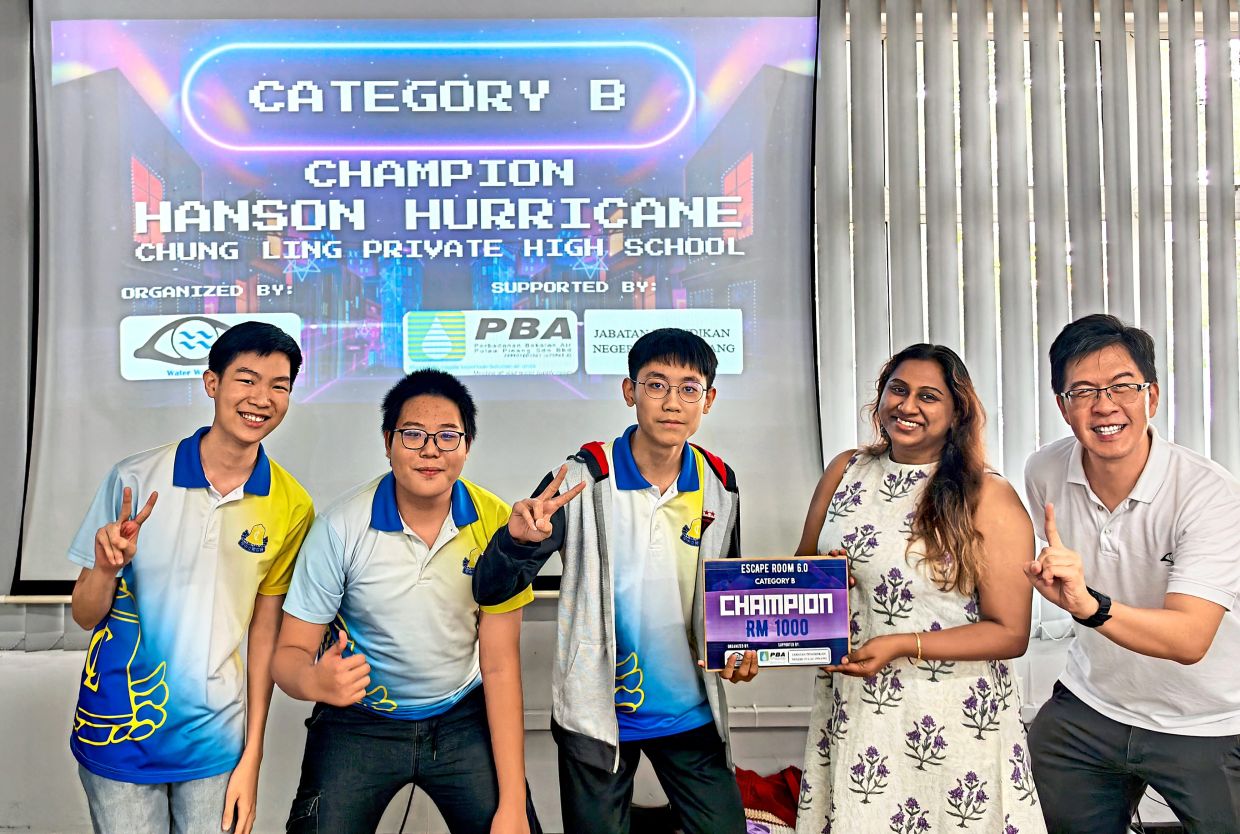
“We were a bit nervous and fumbled in the preliminaries, so we only ended up in second place going into the finals,” said Hee Zhu.
But, experience from that first round spurred their determination, powering them to the championship title.
Held at the Penang Math Platform in Gelugor, the sixth edition of the contest drew over 90 students from primary and secondary schools.
It aimed to promote meaningful knowledge and awareness on water conservation and broader environmental issues.
Participants were tested on local, regional and global water matters – ranging from water footprints and desertification to damselflies.
Teams were split into two groups during the preliminary stage to answer five increasingly challenging sets of questions.
Eight teams (four each from the primary and secondary categories) advanced to the finals.
The top five teams from each category earned cash prizes and book vouchers.
In the secondary schools category, Han Chiang High School and SMJK Heng Ee (Bayan Baru) finished as first and second runners-up, while two teams from SMJK Jit Sin 2 bagged consolation prizes.
In the primary schools category, SJK (C) Kwang Hwa Sungai Nibong teacher Chung Boon Jin helped put together the winning team of Enya Lim Xi En, Ang Carl Shu and Marcus Hong Ming Jun, all 12.
“I liked the whole process of the competition. It was very thrilling and exciting,” Enya said.
Carl Shu added that excitement grew in the finals as the questions became more challenging and complex.
Among the new things the team learnt for the competition was the chemical composition of rivers.
“I learned how to differentiate between how clean and how dirty rivers are,” Marcus said.
SJK (C) Shih Chung Cawangan took both second and third places, while another team from SJK (C) Kwang Hwa Sungai Nibong and SJK (C) Chong Cheng won consolation prizes.
The competition has grown significantly since its inception.
In 2021, 12 teams comprising seven lower secondary teams and five upper primary teams competed in a single mixed-category format.
Sponsor Penang Water Supply Corporation (PBAPP) increased funding in 2023, allowing for separate primary and secondary school divisions to be established.
WWP executive manager Dr Hong Chern Wern said the event was initially created as a game show testing environmental knowledge.
“The programme has continued to evolve over the years, introducing expanded finalist rankings and consolation awards, which reflects its growth, increased school participation and ongoing commitment to recognising students’ achievements in environmental and water literacy,” he said.
WWP assistant manager Rebecca Anne Chin Hui Wen said in previous years, participants were allowed to search online for answers during the quiz.
“However, with AI tools such as ChatGPT and Gemini making information so convenient now, we felt that finding the answers would be too simple and quick.
“So, we decided to go ‘old school’ and have the participants bring in only their handwritten or printed notes and references this time,” she said.
This year’s quiz encouraged students to look at the bigger regional view.
“This year, our theme still focused on water and environmental related issues in Malaysia as we still believe that there is a great need to highlight these issues.
“However, we wanted to challenge the participants a little bit more by including critical thinking questions regarding South-East Asian countries,” Chin said.
The topics covered included water treatment process, the United Nations’ Sustainable Development Goals, regional sustainable water management practices, river ecosystems and assessments in Malaysia and water-related disasters both at home and abroad.
“The questions were made in a way that does not just test their general knowledge but to also apply concepts on real-world scenarios.
“We are always pleasantly surprised by the participants’ determination and enthusiasm during the competition, which I personally feel is much needed in this day and age to spark interest in our communities to better care and protect our planet and our natural resources through education,” she added.
