
TURNING homes into businesses may boost returns for owners, but residents in the neighbourhood are often the ones paying the price in terms of traffic, noise and parking.
Association of Valuers, Property Managers, Estate Agents and Property Consultants in the Private Sector, Malaysia (PEPS) president Subramaniam Arumugam said there were several factors driving the trend, including lower rental for residential properties compared with commercial premises.

“However, offices, warehouses and religious premises are not automatically permitted in residential areas and would normally require approval from the local authority,” he said in a statement in response to StarMetro’s report, “KL residents reeling from rise in home-run businesses” on Sept 7.
Subramaniam added that planning authorities must ensure changes in land use would not unnecessarily disrupt surrounding communities, with affected parties and the public’s views taken into consideration where significant changes were proposed.
He added that small-scale businesses should not be barred from residential areas altogether, particularly in mature neighbourhoods where demand was strong and commercial space was limited.
“But there has to be a line. We should not allow this to become wholesale commercialisation of residential neighbourhoods.
“Before approving such uses, there should be proper consideration of public opinion, traffic and parking, infrastructure capacity and the likely social and environmental impact.”
Subramaniam said owners and tenants were responsible for ensuring properties were used only for authorised purposes, while estate agents and property managers should exercise due diligence and not knowingly facilitate unauthorised use.
He said controlled commercialisation was more suitable along established commercial rows and major roads with adequate road capacity and public transport, citing parts of Jalan Maarof in Bangsar as an example.
“Properties bordering established commercial areas may be able to accommodate limited commercial activity, but quieter inner streets should remain residential.
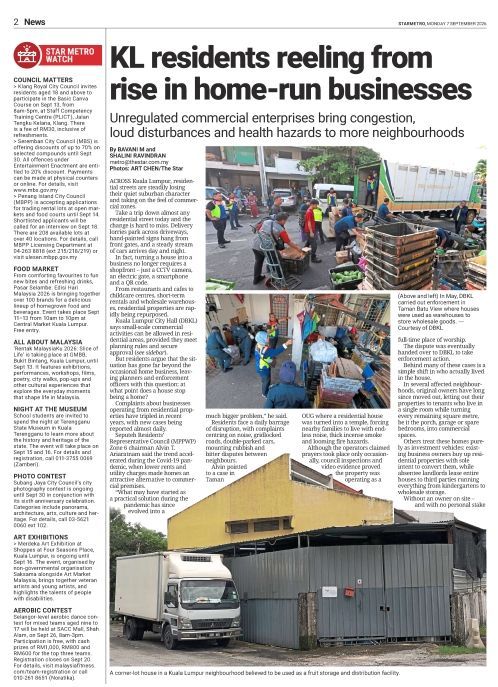
“If you start bringing commercial activity into narrow inner roads with limited parking and low-density residential layouts, you are likely to create bottlenecks, parking problems and unnecessary disturbance.”
Subramaniam said the issue was not about stopping commercial activities in residential areas altogether, but ensuring they were allowed only where and when the surrounding neighbourhood could support them.
Real estate veteran K. Soma Sundram said converting homes for commercial use was not necessarily negative, but excessive traffic, parking problems, noise, deliveries and congestion could erode the residential appeal of surrounding properties.
“Buying a home is a combination of factors. Buyers invest in homes, as well as the environment in which they live.
“The commercial property may gain additional business value, while neighbouring homeowners may bear the pain and discomfort.”

“Well-planned commercial areas with adequate parking, suitable operating hours and traffic management can allow commercial and residential uses to co-exist.”
He said changes in land use must also undergo planning consideration, rather than residential properties being treated as business premises by default.