
DEVELOPERS in Penang must now build covered walkways and pedestrian links around transit stations under new rules designed to prioritise public access over property density.
Penang local government and town and country planning committee chairman Jason H’ng Mooi Lye said the move was aimed at improving connectivity and encouraging people to walk and use public transport, rather than simply allowing developers to pursue higher density or plot ratios.
“Developers should not think that transit-oriented development (TOD) means they can ask for higher density or plot ratios.
“TOD is about connectivity and the basic facilities for the public living around the area, so that when there is an LRT, bus station, taxi station and other facilities in the future, they can access them easily,” he said.
H’ng was speaking to reporters after opening the Transit-Oriented Development (TOD) in Penang: Promise, Potential and Perils conference organised by the Malaysian Institute of Planners Northern Branch (MIPNB) in Sungai Nibong.
H’ng said the Penang Island City Council (MBPP) had imposed covered walkway requirements on certain developments, even outside designated TOD zones, as part of efforts to address connectivity weaknesses.
“The first- and last-mile (FLM) connectivity was one element of TOD, but the concept was much broader than simply developing buildings around transit stations,” he said.
“We need to start from now, otherwise, when the LRT comes, the lack of covered walkways will become a problem.”
H’ng said the state had appointed a consultant to develop a TOD concept for Penang, while TOD areas had also been identified in local plans under both MBPP and Seberang Perai City Council (MBSP).
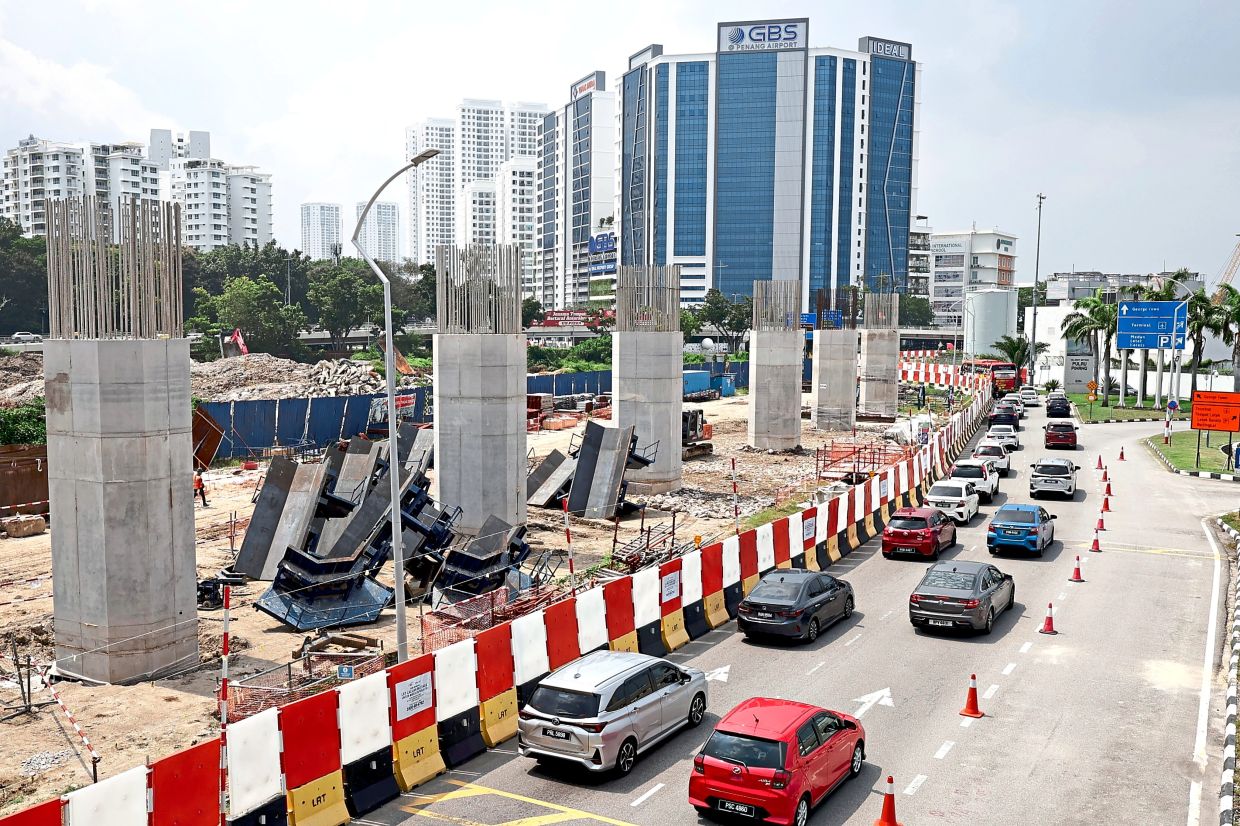
In his opening speech, H’ng said Penang could no longer allow land-use planning, development and transportation to evolve independently, particularly with the ongoing construction of the Mutiara Line LRT.
He said the state, through PLANMalaysia@Pulau Pinang, MBPP and MBSP, was taking proactive steps to implement planning requirements to promote TOD.
He said TOD components had also been incorporated into the Draft Penang Structure Plan 2040 (Review), including FLM connectivity.
“Supporting services and facilities such as feeder buses, covered walkways, pedestrian crossings, pick-up and drop-off areas, as well as traffic and parking management are all important in realising a successful TOD system,” he said.
MIPNB chairman Datuk Michael Ong Chin Keong said TOD should not be viewed merely as a planning concept or a means to increase development intensity around rail stations.
“Transit-Oriented Development is not about building around stations.
“It is about building communities around people,” he said.
He said Penang now had a “once-in-a-generation opportunity” with the Mutiara Line to reshape how neighbourhoods developed around its stations.
Ong said successful TOD should be measured by whether it provided shorter, safer and more convenient journeys, while improving quality of life and making public transport the first choice for daily travel.
The conference drew about 300 participants, with professional consultants and developers making up almost three-quarters of attendees.
The programme featured sessions on local authority planning, human-scaled TOD, gender-responsive urban mobility, policy and governance, land value capture, and safe, connected and inclusive mobility.
Speakers included MBPP planning development director Mohd Bashir Sulaiman, Pulau Tikus assemblyman Joshua Woo and industry representatives.