



HISTORIC structures and city streets have become a stage for artistic expression at George Town Festival (GTF) 2026.
Padang Kota Lama was at the centre of it all with Six to Eleven, a two-day public event combining visual arts, live music, theatre and interactive experiences.
Crowds unfurled picnic mats and settled on the field to watch Terang|Heritage in Motion, a projection mapping display that transformed the facade of the Town Hall into a kaleidoscope of colours.
The spectacle comprised the works of 20 finalists of an international competition, along with three guest artists and the top three of last year’s edition.
Each snippet offered a unique interpretation of the theme “Pasar” (market) through vibrant animations and creative visual storytelling.
Terang director Abdul Shakir Abu Samah said 125 submissions came in from eight countries for the 2026 edition, and there was a rise in both quality and ambition.
“This year, we wanted to celebrate the intangible culture of Malaysia.
“Markets have long been spaces where our communities come together.
“These interactions influence our food, traditions and even language, creating the diversity and vibrancy we have today,” added Abdul Shakir.
The sense of wonder was heightened when a glowing giant appeared and roamed the field to interact with spellbound visitors.
Towering at 5m, it was part of Dundu − a renowned German puppet theatre company making their GTF debut − in a presentation called “Sharing the Light”.
The large puppet was operated by a team of five and accompanied by a musician playing the kora, a West African harp. Two smaller puppets also made an appearance.
State tourism and creative economy committee chairman Wong Hon Wai said GTF was a time when the city came alive with creativity, curiosity and sense of anticipation.
“When people think of Penang, they tend to think of our food, heritage and unique character.
“But the state is also a place where creativity thrives.
“Our artists, performers, musicians and cultural practitioners continue to shape the identity of George Town.
“This is why GTF is so important. It brings fresh ideas and new perspectives every year, while creating opportunities for the local creative community,” Wong said of the festival which runs until Aug 9.
Penang Chief Minister Chow Kon Yeow described the festival as a key economic driver for the state – with 200,000 people expected this year.
“Every visitor supports our hotels, restaurants, cafes, shops, tour operators and local businesses.
“With GTF filling our streets with performances, exhibitions, installations and community activities over nine days, it encourages one to stay longer.”
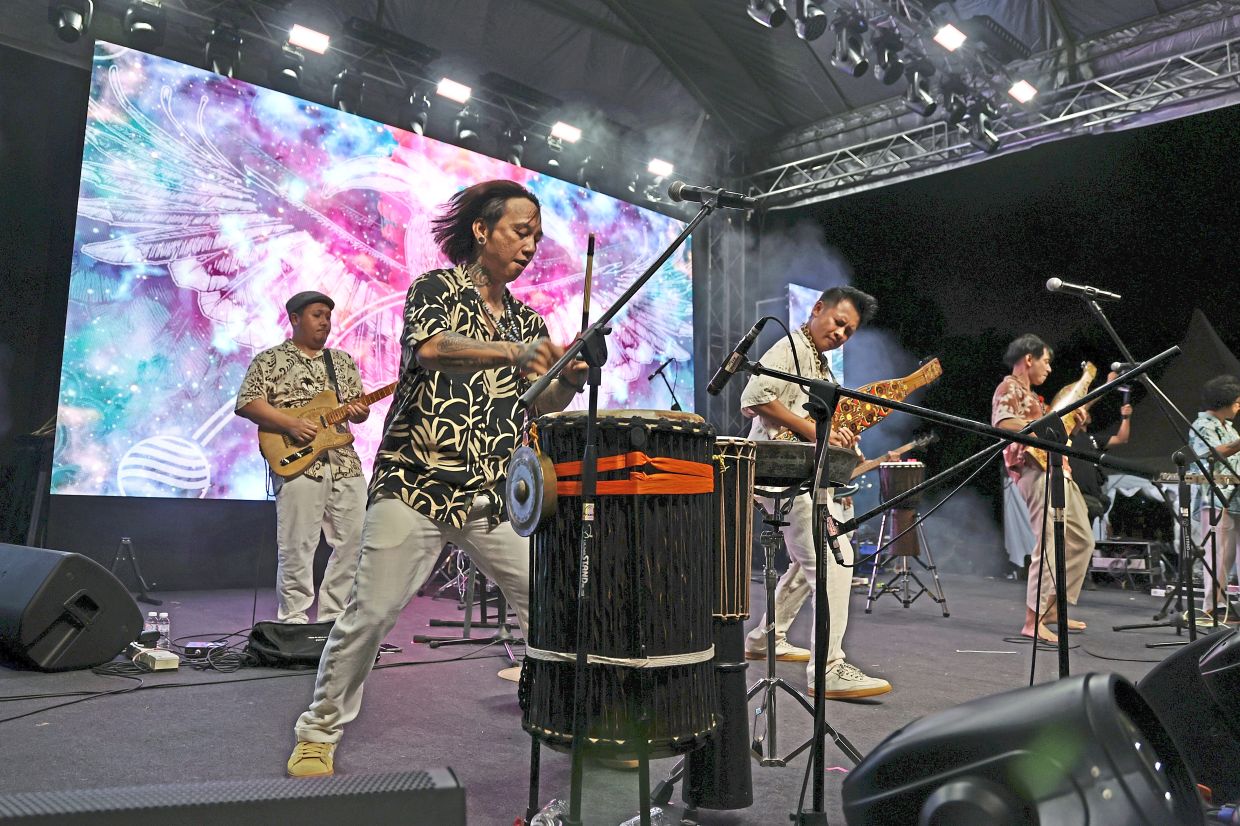
Also headlining Six to Eleven were award-winning Sarawakian artist Alena Murang and independent ethnic fusion band At Adau, whose sets celebrated Borneo’s cultural heritage.
Murang’s “Nalan!” performance included numbers in the endangered Kenyah and Kelabit languages, accompanied by the sape, a traditional lute.
At Adau’s “Suara Rimba dan Arus” saw them combining traditional and modern instruments, creating a soundscape that was rooted in heritage.
Elsewhere around the field, there was “Stories Over(Seas): Cerita Malam”, a storytelling session in collaboration with Singapore Night Festival.
“Jom Layan Selects: A Showcase of Track Digging and Sonic Diversity” allowed young and old to delve into DJ culture and experience the art of spinning tunes.
The “Con-Temporary Art” (CTA) 1/12 scale travelling art gallery by Joshua Kon and B. Arrvinraj − mounted on the back of a traditional bread vendor’s bike − drew the curious to Padang Kota Lama.
The regular bread cabinet was reimagined as a mini white cube gallery, complete with a series of curated works, also done to scale.
“We wanted to break barriers between conventional galleries and people who might otherwise be intimidated by art,” Arrvinraj shared.
It is ongoing until Aug 9 and will move to different spots in the city.
Eventful weekend
GTF 2026 is themed “Beyond Boundaries” and features over 40 programmes across the city.
Among other highlights are exhibitions like “Artisan II” held at O Sculpture Art Space in Hin Bus Depot until Aug 30.
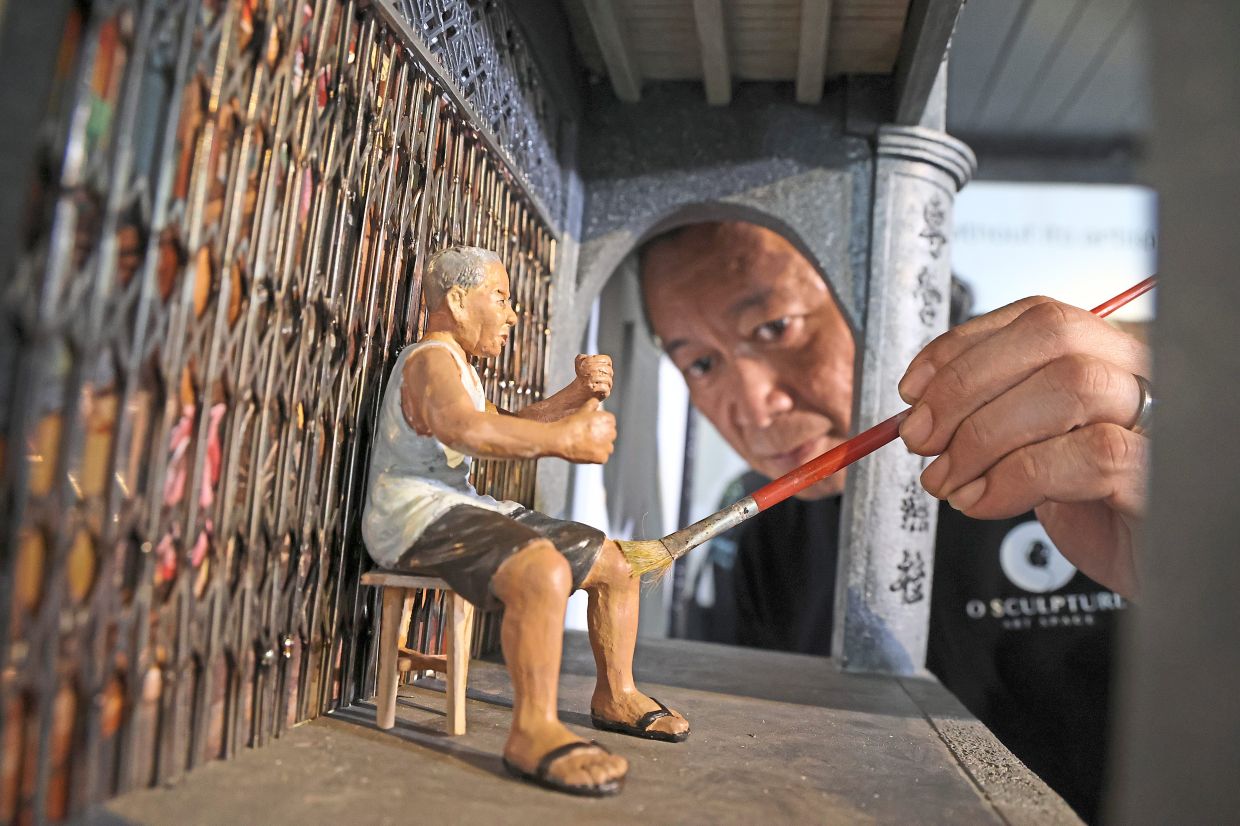
Sculptor Low Chee Peng presents eight new pieces from his ongoing series of mixed-media, heritage shophouse sculptures of Penang’s traditional trades and master craftsmen.
The latest subjects are a batik artist, makers of beaded shoes, prayer altars and bamboo and wooden blinds, a Chinese medicine hall, five-foot-way cobbler, traditional goldsmith and seal engraver.
The shophouses have been faithfully recreated down to the tiniest detail – from the signage on pillars to the weathered paintwork and patterns on floor tiles.
“Crafting this series was a bittersweet experience,” said Low.
“Meeting these craftsmen made me realise how fragile our living heritage is.
“Many are elderly and unable to continue much longer.
“And with no one willing to take over, their legacies spanning decades may end with them.
“Some have even closed down or passed on.
“For me, an old shop without its artisan is like a body without a soul,” he added.
Fortunately, most artisans from the latest set are still doing well, including goldsmith M. Raju and batik artist Rozana Mohamed, both of whom attended the opening ceremony.
Raju, the fourth generation of his family to practise the craft, was pleased to see a mini version of himself at his premises located in Lebuh Queen.
Rozana, trading in Lebuh Acheh, said: “It is fantastic to see (the business) recreated like this. Hopefully this gets more people interested in the craft.”
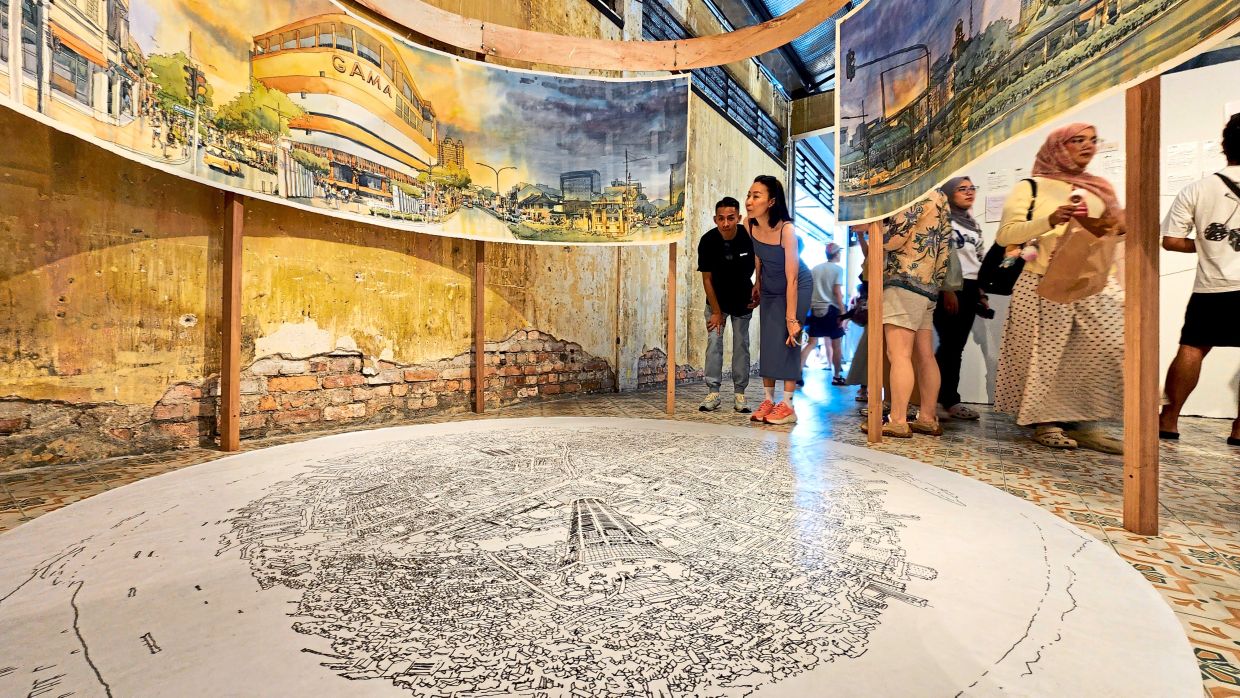
Steps away at Hin Bus Depot’s Hin Gallery is the “Street Fragments: Jalan Gurdwara” exhibition presented by COEX and Ruang Kongsi until Aug 9.
Its selection of artworks, illustrations, archival materials, photographs and community memories invite audiences to rediscover one of George Town’s main arteries, formerly known as Brick Kiln Road.
Curator Ho Koe Jing said the street had changed so much over the years that many people who live or work there today feel disconnected from its past.
“The project began as our own journey to rediscover and better understand the area we were in.
“Along the way, we realised that there were so many stories worth sharing.
“Jalan Gurdwara’s workshops, maintenance facilities and industrial legacy played a key role in enabling the city’s growth.”
Over at Cultprint is “The Natural History Museum of Yeahnahnesia” exhibition by international artist duo Yok and Sheryo, which runs until Oct 4.
It features artefacts, biological specimens and sacred cultural objects from a fictional tropical island with made-up traditions and mythology.
Curator Deborah Lim said every “traveller” that came by would experience Yeahnahnesia differently.
“For me, it was a place that invited me to slow down and find humour in the unexpected and life’s peculiarities.
“Whether it is a destination, a state of mind or somewhere in between, it’s entirely up to you.”
Taking centre stage
Festival stages were equally alive with performances, as storytellers, dancers, musicians and others presented stories both classical and contemporary.
Tewas: No Light at the End of the Tunnel exposes the devastating impact of bullying, be it within school corridors or workplace hierarchies.
Performed by JDEV Studios at The Courtyard Beach Street, it represents a collective scream from those trapped within systems that fail them. An additional show has been confirmed for tonight, at 8.45pm.
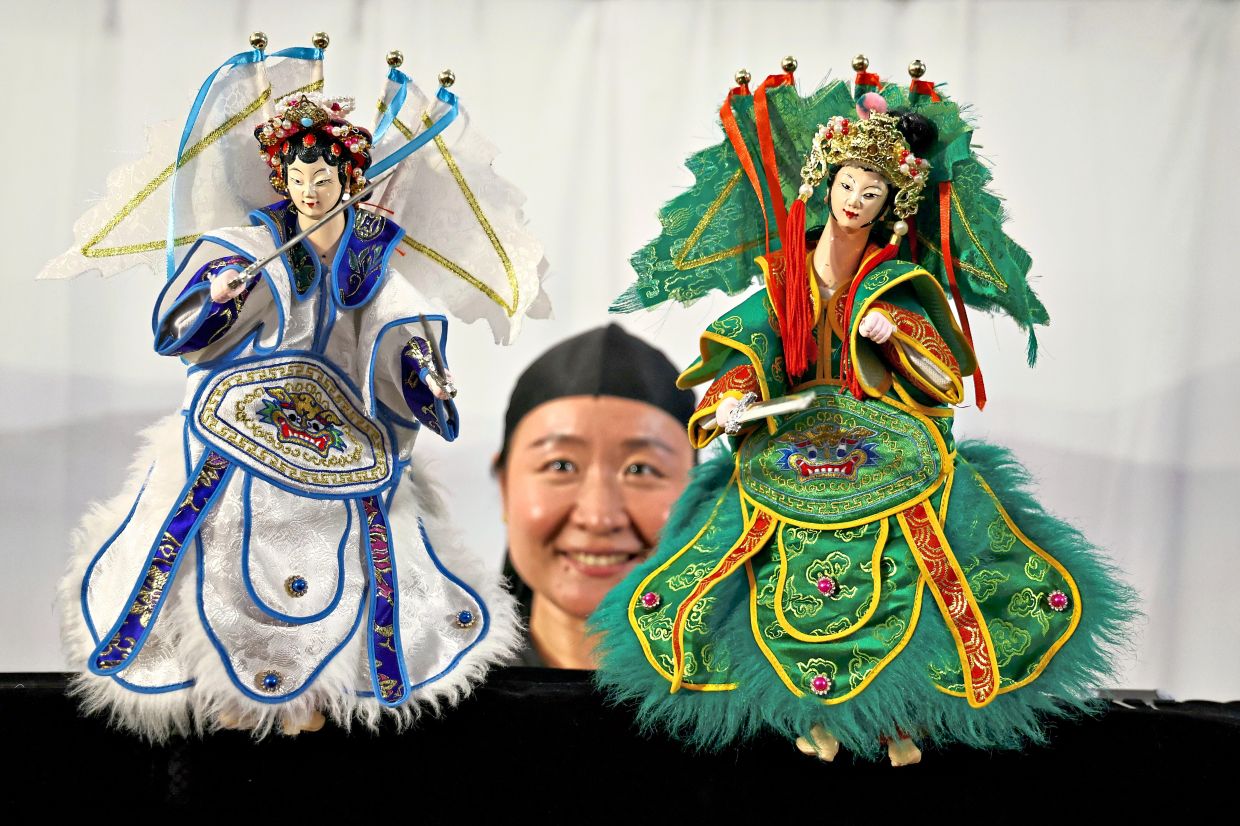
Nearby at The Whiteaways Arcade was the “Web of Deceits” hand-puppet performance inspired by the Chinese classic Journey to the West.
Presented by Singapore’s Paper Monkey Theatre, it followed Tang Sanzang and his disciples on an adventure where they encountered spider demons and had to devise a clever plan to prevail.
Artistic director Benjamin Ho said he made spiders key characters because they were often misunderstood and feared.
“We wanted to encourage audiences to reflect on their own perceptions and question the prejudices they may have.
“A major barrier to traditional puppet theatre has always been the dialects, which many don’t understand.
“That was why we chose to deliver it in English.
“When people of different backgrounds can connect with it, more may grow to love it.”
There was also Matahari by ZXC Theatre Troupe at Majestic Theatre in Jalan Phee Choon.
The post-apocalyptic fable explored the fragile relationship between humanity and the natural world and asked what would happen if the sun disappeared.
More to come
More programmes are lined up for GTF 2026’s closing stretch.
Free-to-attend ones include the Wayang Pacak screening of independent films, documentaries and animated series at Seh Tek Tong Cheah Kongsi, at 9pm nightly until Aug 9.
On Aug 6, there is the 8pm staging of Fence by South Korea’s Baek.S.Factory at Gurney Plaza.
The play explores the invisible barriers that can grow between loved ones.
The third Malaysian edition of Asian Board Games Festival kicks off at 1st Avenue Mall on Aug 7 and runs until Aug 9.
Grab your Play Passport, explore dozens of the latest tabletop titles from over 40 exhibitors across 10 countries, collect stamps and redeem goodies.
The closing highlight is CTRL A+C (Control Arts and the City) at Armenian Park and Lebuh Armenian, from Aug 7 to 9.
This features a series of site- responsive works, including “Beyond Borders” created specially for GTF 2026 by Italian theatre company Instabili Vaganti in a collaboration with Malaysian artists.
There is also the coming of age story Los|Kembali by Sekolah Main Wayang; the post-apocalyptic Steamplant Movement by Italy’s Shedan Theatre; the heartwarming Click Click by South Korea’s Lumos Theatre; and the poetic Nenda: Fruit in Palm by Singapore-based Off Root Theatrics.
Ticketed highlights
The “Malaysian Real Book II: Past to Present” concert, featuring Ida Mariana, Janet Lee and Yon Lynn, takes place at Majestic Theatre on Aug 5, 8pm, with seats starting from RM80.
Lament of the Wondering Head by Taiwan’s Sun Son Theatre plays at Bangunan UAB at 8pm on Aug 7 and 3pm on Aug 8 with tickets priced from RM64.
The play transforms a South-East Asian supernatural legend into a metaphor for the collective trauma and displacement experienced by Chinese diaspora communities.
Shakespeare Meets Noh: Desdemona is on at Majestic Theatre at 5pm on Aug 8 and 9 with tickets also starting at RM64.
This reimagines “The Tragedy of Othello” through Japanese Noh theatre and shifts its focus to the central female character.
“When Spirits Meet: The Rainbow Bridge and Ocean Chants”, a song and dance performance celebrating traditions of Taiwan’s indigenous Truku and Amis peoples, will take the stage at Dewan Sri Pinang at 8pm on Aug 8 and 3pm on Aug 9.
“Islander Surge 3.0” concert, featuring performers from Penang and Taiwan, takes place at Khoo Kongsi at 6.30pm on Aug 8 with tickets starting at RM20.
The non-verbal omnibus puppet show “Dream Space” by South Korea’s Creative Group SSAK plays at Loft 29 at 12pm and 5pm on Aug 8 and 5pm and 8pm on Aug 9, with tickets starting from RM48.
Visit www.georgetownfestival.com or follow on Facebook (George Town Festival) and Instagram @georgetownfestival



Spectators taking photos during Terang | Heritage in Motion, which turns the Town Hall facade into a canvas for storytelling during George Town Festival 2026. Shows will be held daily 8pm to 11pm until Aug 9.
Low putting the finishing touches to his miniature of the proprietor of Lee Hong Huat Chinese medicine hall on Lebuh Pantai, which ceased operations earlier this year. The sculptor says the project, on show at O Sculpture Art Space, has been bittersweet, as it highlights the fragility of the country’s living heritage.
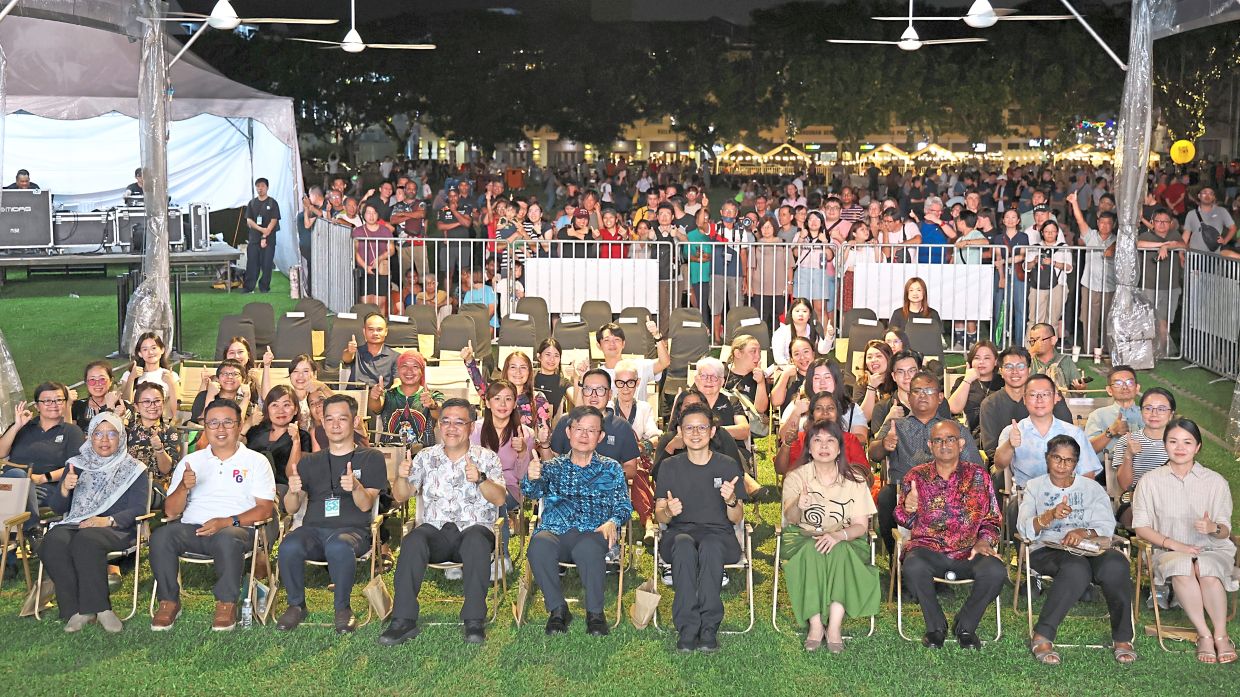
Chow (fifth from left) flanked by Wong (to his right) and George Town World Heritage Incorporated general manager Dr Ang Ming Chee, alongside other state leaders and event organisers during the launch of George Town Festival 2026 at Padang Kota Lama.
Sarawakian ethnic fusion band At Adau performing with traditional and contemporary musical instruments.
Puppets for the two spider demons who are the antagonists in ‘Web of Deceits’.
Visitors checking out Mei Chee Seong’s panoramic artwork ‘Space, Time, Spiral’ that captures the sights of Jalan Gurdwara.
‘Tewas: No Light at the End of the Tunnel’, which exposes the devastating impact of bullying, has an extra show tonight.
Yok (right) and Sheryo posing with their works in The Natural History Museum of Yeahnahnesia running until Oct 4.
