I HAVE never been much of a runner.
As a child and young adult, my world was Indian classical dance.
From the age of nine until about 21, I spent hours practising and performing.
It was a journey that instilled deep discipline and gifted me an early foundation for a healthy lifestyle.
Becoming a dancer was never my dream; it was my father’s.
Yet, while I never particularly enjoyed such strenuous activity, those years of disciplined movement quietly built my fitness and stamina.
Today, I am a mother of two.
Like many working mothers, balancing a career and family leaves precious little time for exercise.
Staying active in my 40s is no longer a luxury, though, it is a necessity.
I also make it a point to go on evening walks with my children; my 11-year-old son has asthma, so he needs regular physical activity to help strengthen his lungs.
A few months ago, during one of his appointments at University Hospital, my son convinced me to ditch the lift and take the stairs instead.
Together, we conquered 11 floors.
Reaching the top felt like a minor triumph, but more importantly, I experienced absolutely no muscle aches in the days that followed.
That small victory sparked a new-found confidence.
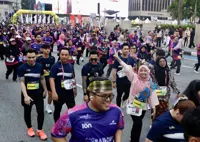
Soon after, I spotted an announcement for the Petaling Jaya City Council’s (MBPJ) International Tower Run 2026, held to mark the city’s 20th anniversary celebrations.
The challenge? To climb 552 steps over 25 floors of Menara MBPJ.
For someone who has never considered herself athletic, it sounded utterly intimidating.
Yet, something inside me compelled me to give it a go.
I signed up for the Media Open category with one simple goal: reach the top.
As the event loomed, excitement gave way to anxiety.
The night before the climb, my mind raced with worst-case scenarios.
What if I get leg cramps? What if I seize up halfway? What if I simply cannot finish the run?
To calm my nerves, I went for my usual evening stroll and ensured I was well-hydrated.
Arriving at the venue the next morning before 7am, my fears were instantly put into perspective.
One of the first people I noticed was a visually-impaired veteran competitor calmly preparing for the climb.
His presence was incredibly humbling.
The event was brilliantly organised, with participants flagged off individually according to their categories.
This clever formatting prevented any bottleneck congestion in the stairwells, allowing everyone to focus entirely on their own pace.
My strategy was clear: I was not going to run. I planned to climb steadily, safely and surely.
As I took my first steps in the ascent, I reminded myself to focus strictly on the next step rather than the distant finish line.
By the seventh floor, my heart was pounding against my ribs. I paused briefly to catch my breath before pushing on.
I recalled my good friend Tan Chun Lynn, an avid hiker, advising one to focus entirely on controlled breathing. That tip became my lifeline.
Past the 11th floor, I found myself taking short rests at almost every level.
Some participants stepped out through the open fire doors for longer breathers before re-entering the fray.
Giving up, however, was never an option.
Whenever my heart rate spiked too intensely, I simply paused for a few seconds, regrouped and pressed forward.
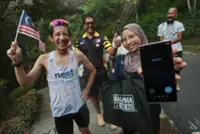
My StarTV assistant technical producer Patrick Chin, who was covering the event, cheered me on along the route. His bursts of encouragement provided a much-needed psychological boost.
By the time I reached the 22nd floor, the muffled cheers from the finish area above began to echo down the stairwell.
Knowing the summit was within reach injected a sudden burst of renewed energy into my legs.
A few more flights. A few more steps. Then, I crossed the finish line. I had completed the challenge in exactly 12 minutes.
While the elite competitors clocked truly astonishing times, I felt an immense wave of pride in my own achievement.
I had set a goal, faced down my doubts, and accomplished it.
To make the moment sweeter still, I was handed a medal – my very first medal from a sporting event.
The following morning, I braced myself for agonisingly sore muscles and aching calves. Instead, I woke up feeling surprisingly sprightly.
Perhaps years of brisk walking as a journalist, combined with my regular family evening strolls, had quietly built up a resilient baseline of stamina.
More importantly, the experience served as a powerful reminder that many of our limitations exist solely in our minds.
When I returned home and proudly showed the medal to my children − my biggest cheerleaders − they beamed and said, “We told you that you could do it.”
And truly, that was the greatest reward of all.