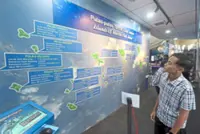
SET up as a key educational centre, Mersing Marine Park Gallery promotes sustainable tourism and environmental awareness among visitors to Johor’s island destinations.
Mersing Tourism Association (MTA) secretary Ahmad Firdaus Shaik Omar said the gallery was an education-driven product where tourists could learn about conservation rules and responsible behaviour within Sultan Iskandar Marine Park.
Site for learning
“The gallery is an educational platform giving tourists insight before heading to the islands.”

He said the broader goal was promoting sustainable tourism by instilling environmental values and giving clear guidance.
The principle of “take nothing but memories, leave nothing but footprints” reinforced visitor ethic promoted across the Mersing islands, he said.
“To shape sustainable tourism, we are trying to instil environmental responsibility while guiding visitors on dos and don’ts at our marine park.”
Ahmad Firdaus said such efforts were important in ensuring environmental balance was preserved while strengthening public awareness on recycling and conservation practices.
The gallery, he said, played a crucial role in translating conservation messages into a more engaging and interactive experience for visitors.
“This includes explaining why fish feeding is prohibited and why certain behaviours harm marine ecosystems.”
Among the exhibits are a dugong replica and whale skeletons, designed to give visitors a clearer idea on the scale and importance of the region’s marine biodiversity.
Other exhibits explain through visual and interactive displays the fish reproduction cycles, squid movement patterns and sea turtle nesting processes.
Visitors can also watch fish and jellyfish movements through 3D holographic fans that project lifelike images of the marine creatures.
Ahmad Firdaus said the use of interactive technology helped to attract younger audiences and make conservation education more engaging.
He said island-hopping in Mersing previously focused on leisure, with insufficient emphasis on sustainability education.
“Mersing is being developed as a sustainable tourism district where conservation and tourism growth go hand in hand,” he added.
Ahmad Firdaus said MTA was also working closely with the Fisheries Department (DOF), non-governmental organisations (NGO) and international conservation groups on strengthening marine protection efforts.
“Among the partners involved are Universiti Kebangsaan Malaysia (UKM), Reef Check Malaysia, Tengah Island Conservation and DOF.”
He said such collaborations were crucial in ensuring conservation efforts were backed by scientific research and supported by community engagement.
Seeking recognition
Through such partnerships, MTA is hoping to position Mersing for recognition under the UN Tourism International Network of Sustainable Tourism Observatories (Insto).
There are currently 45 Insto destinations worldwide, including China, Greece, Mexico, Brazil, Indonesia, Croatia, the US, Italy, Spain and Japan.
“Our hope is for Mersing to become the first destination in Malaysia to get Insto recognition,” said Ahmad Firdaus.
He said efforts to achieve Insto status began about three years ago through collaboration with United Nations Development Programme (UNDP) Malaysia and Tourism, Arts and Culture Ministry (Motac).
“Achieving the recognition is no easy feat, as it requires strict standards and comprehensive data collection.
“There are 13 main indicators needed, including data management, socio-economic factors, sustainability as well as arts and culture.”
He added that Mersing’s strong cultural foundations, such as zapin and silat, set the district apart.
The Mersing district also boasts of 250km scenic coastline besides its well-known marine attractions.
Beyond the marine park, Mersing is home to Endau-Rompin National Park, further strengthening its eco-tourism appeal.
Ahmad Firdaus said MTA was actively carrying out training programmes too for local tourism players and residents.
“These include English language classes, tourism service training and handicraft development courses aimed at improving local income opportunities.”
He said around 1,200 locals were involved in Mersing’s tourism sector, with about 80% aged 40 and below.
Empowering the local community was key to ensuring that tourism benefits were widely shared, he highlighted.
Ahmad Firdaus said the gallery played a role in increasing awareness of conservation among tourists and locals.
“This dual awareness is crucial in strengthening Mersing’s case for Insto recognition.
“With Insto status, we believe it will attract more international tourists to Mersing.”
He said MTA was optimistic of achieving the recognition by September.
“If successful, Mersing will become the first Malaysian destination and 46th worldwide to receive Insto recognition.” — By MOHD FARHAAN SHAH