



SINGLE-use plastics do not benefit the environment, and extending the lifespan of the plastic is only a temporary solution.
Nevertheless, it is still important to repurpose or recycle such plastics instead of having them discarded at landfills.
Plastic waste can take hundreds of years to decompose and repurposing it will help avoid the slow process at dumpsites.
This waste also pollutes the marine environment and causes many kinds of environmental hazards.
As a short-term measure to address this issue, Petaling Jaya City Council (MBPJ) has embarked on several activities such as polystyrene foam recycling and the making of eco-bricks by communities.
To underscore the importance of these activities, MBPJ set up the PJ Eco Recycling Plaza in SS8, Petaling Jaya.
Petaling Jaya Solid Waste Management and Public Cleansing Department director Lee Lih Shyan said they wanted to raise awareness of recycling.
However, the ultimate goal is for the public to stop single-use plastics altogether.
Recycling waste
At the PJ Eco Recycling Plaza, polystyrene recycling was carried out prior to the movement control order as part of the city’s council advocacy work to spread the message to residents.
Once the pandemic is over, the recycling process would be open for the public to view, said Lee, adding that the process was educational.
At the centre, donated polystyrene such as those from markets, offices and individuals, is recycled and turned into various items such as photo frames or wall skirting for houses.
“Polystyrene such as those used to pack television sets are cleaner and of better quality compared to the ones discarded after transporting seafood to the market,” said Lee.
He explained that the recycling process involved physically breaking the polystyrene boxes into smaller pieces.
It is then fed into a machine that melts the polystyrene pieces.
The melted blocks are shaped into smaller blocks.
These are then sent to the respective industry’s factories to be remoulded into other usable items.
The end product would be displayed and sold at the plaza once the pandemic is over, said Lee.
The recycling plaza also makes eco-bricks and buys them from the public for RM1.
Council employee Haiz Rosli, 34, is expert at making these bricks and also inspects those sent to the council by the public.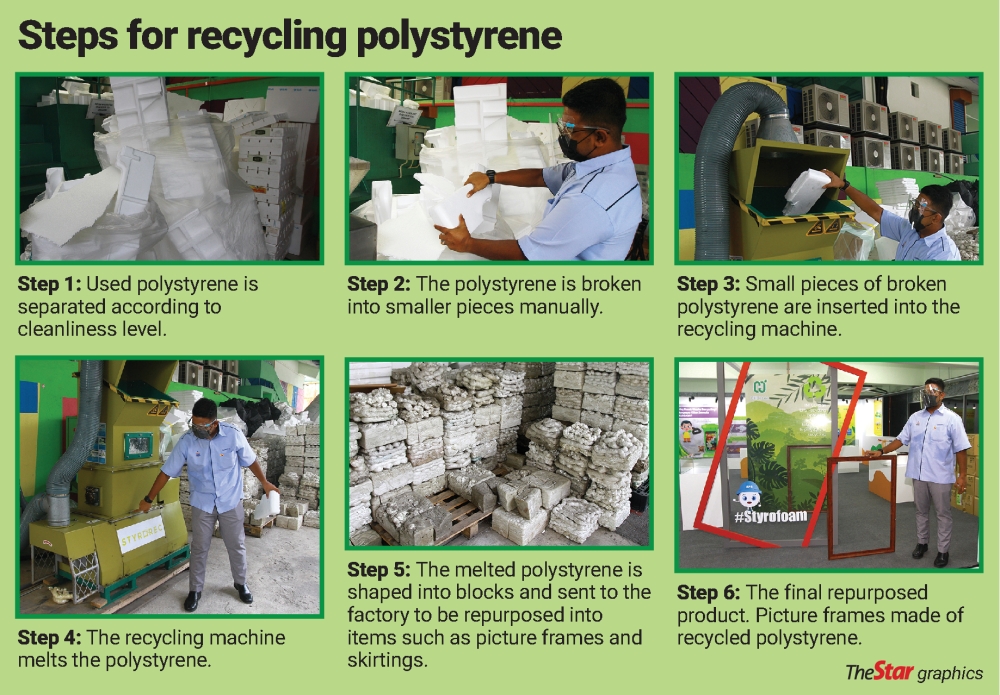
He said making eco-bricks required a lot of time and patience.
The process consists of cleaned plastic bags being shredded and stuffed into empty 1.5litre plastic bottles.
“The problem is, sometimes the public do not compress the plastics into the bottle well.
“So I would then need to compress the plastics again.
“The plastics must also be cleaned before being stuffed into the bottle.
“A lot of plastic bags are required to fill up a bottle, so the process is time-consuming.”
Each month, about 30 bottles are dropped off at the plaza by the public.
Residents groups in the city are roped in to help make the eco-bricks.
The council plans to build a recycling centre at Kompleks C, Petaling Jaya using these bricks.
Eco-bricks gaining ground
Lee said between January and August this year, eco-bricks weighing a total of 1,400kg had been collected.
MBPJ had also created a mural using plastic caps.
It measures 8.5m by 2.4m and hangs outside the plaza.
Some 25,000 plastic bottle caps were used to make it.
An expert from Universiti Pendidikan Sultan Idris was brought in to assist in the project.
Malaysia EcoBrickers Community founder Faisal Abdur Rani said the eco-bricks concept was introduced in the country in 2016.
These bricks are mainly used in countries such as Indonesia and the Philippines which do not have a good waste management system.
However, in Malaysia, eco-bricks are commonly used to make tables, garden walls and fences.
Lee said building houses using this material came with a different set of challenges.
This was because there were regulations to be followed so that electricity could be installed in these buildings, he said.
Faisal said ultimately, Malaysia must head towards a circular economy.
“Everything created must be sustainable and recycled.
“We must work towards zero waste; eco-bricks are a temporary solution to our waste problem,” he stressed.
Faisal noted that the pandemic had resulted in a worsening waste problem.
“We are using more plastics as demand for food takeaway and online shopping soars.
“Even I had more plastic waste during the lockdown because I bought more items online,” he said.
He added that more uses must be found for eco-bricks and noted that they were suitable to be made into street furniture.
Faisal called on local councils to look at this further, adding that students had done this successfully here.
“They would make benches with the end products.
“I think local councils can learn from them and further expand the use of eco-bricks,” he concluded.
Already a subscriber? Log in
Get 20% OFF The Star Digital Access
Cancel anytime. Ad-free. Unlimited access with perks.
