
IN A modest community hall in the heart of Pekan Ampang in Ampang, environmentalists, history buffs, and, most importantly, local residents gathered to unite towards a common goal — saving Pekan Ampang.
Organised by community workers Sarah Amer, 23, and Syahida Nawar, 30, the Pekan Ampang Heritage Talk and Photo Walk held last weekend was the first step in a long-term campaign to save the pre-war shoplots from being demolished to make way for the construction of the Sungai Besi-Ulu Klang Elevated Expressway (SUKE).
StarMetro had previously reported that some 44 pre-war shophouses in Pekan Ampang would have to make way for the highway, which is scheduled to begin construction next year.
These shops were built during the British colonial era, with some more than a century old, and are the state’s last few remaining buildings with colonial architecture in one of the oldest commercial areas in Ampang.
Long-time Pekan Ampang resident Pete Tan, 47, said his fondest memory of the place was its people.
“Growing up here, there was a sense of closeness within the community, where everyone was treated like part of the family.
“It will be a shame and a sad loss once the last few remaining family-owned traditional businesses are forced to leave,” he said.
Tan hoped to see more of his neighbours at the event.
“Most of the residents here are in their twilight years and are not used to speaking out. It seems a sense of ‘What can we do?’ is in the air,” he said.
Tan, who is also the secretary of the Mee Thor Gan Buddhist Temple, said a deeper awareness of the impact of the highway was needed.
“When the issue of the highway cutting through Pekan Ampang and the temple was first brought up in 2012, we managed to get 4,000 signatures against the idea.
“But, now there is a sense of acceptance among the community,” Tan said.
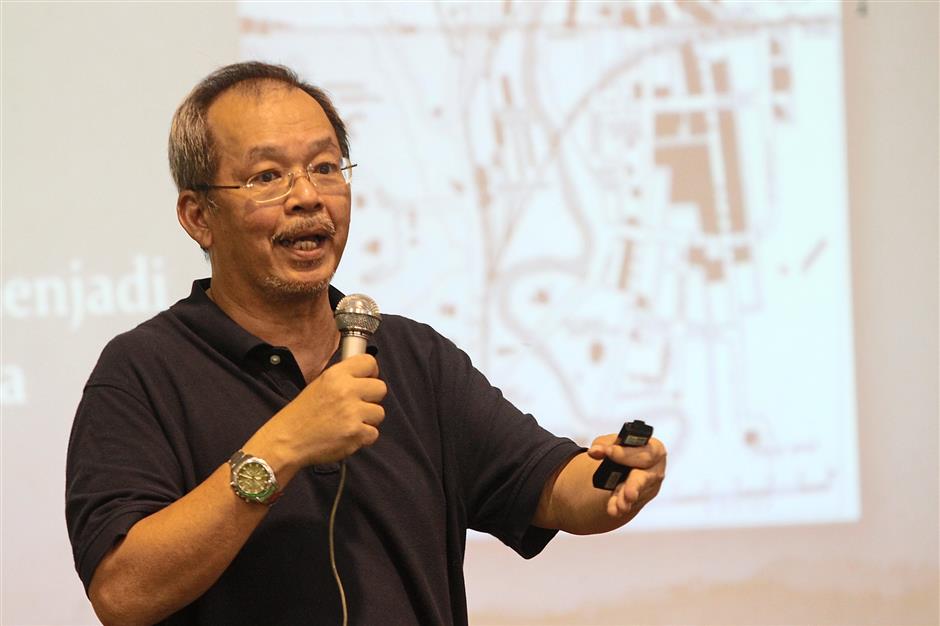
Malaysian Heritage and History Club member Abdul Razak Bahrom, who regaled the audience with the history of Ampang, said the area was the epitome of early Malayan development.
“Raja Abdullah, a representative of the Selangor Sultanate, opened up the Klang Valley for tin prospectors in 1857.
“The Chinese prospectors went up the Klang River and began prospecting in the Ampang area, which was then a dense jungle.
“A thriving tin mine was established despite 69 of them dying of malaria.
“Even the name ‘Ampang’, meaning dam, is a reflection of the dams that were built for tin mining,” he said.
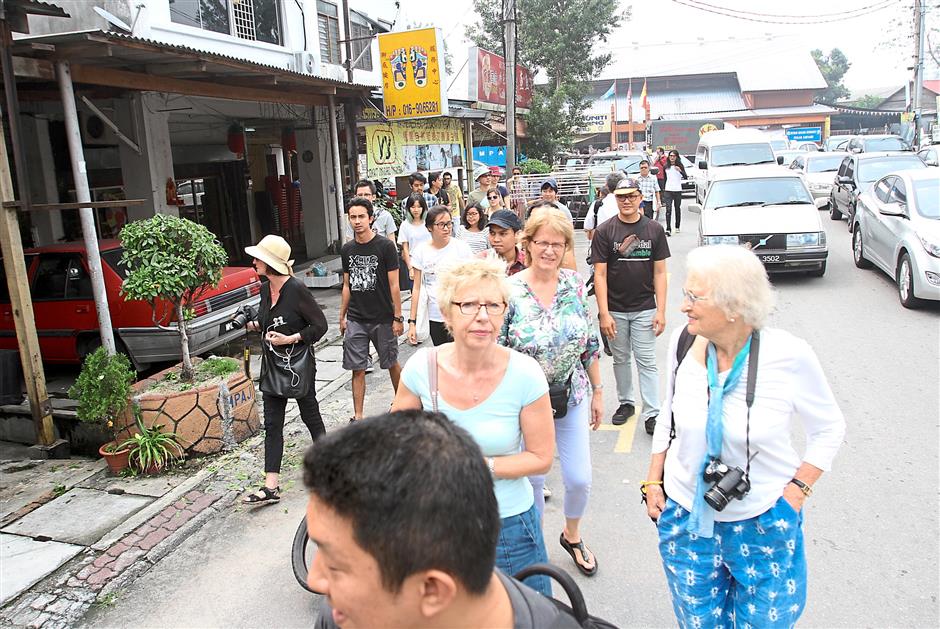
During the event, some 200 participants took part in a walk around Pekan Ampang, engaging in a cultural mapping and colouring activity.
Meanwhile, Sarah said the main challenge of the campaign was to keep the momentum going.
“Although I don’t live here, I have friends who do. I was heartbroken when I first heard that some of the shops were going to be demolished.
“The general outlook of life here is very relaxed and these types of close-knit communities are slowly dying.
“We need to gain more traction and build up momentum. One of the purposes of the photo walk today is to ‘archive’ the area’s history.
“We have about 15 photographers and videographers to create a cultural map of Pekan Ampang,” she said.
Sarah hoped to communicate with the concession holder, Projek Lintasan Kota Holdings Sdn Bhd (Prolintas), on the project’s ramifications.
The planned 31.8km SUKE three-lane highway, dual carriageway expressway that will start in Sri Petaling and pass through Sungai Besi, Alam Damai, Cheras-Kajang, Taman Bukit Permai, Taman Putra, Taman Permai Jaya, Taman Dagang Permai, Taman Kosas, Ampang and Taman Hillview before exiting at Ulu Kelang.
Already a subscriber? Log in
Get 20% OFF The Star Digital Access
Cancel anytime. Ad-free. Unlimited access with perks.