For many travellers to Italy, Turin is the city they simply pass through rather than plan for a visit, as it is overshadowed by the flashier, livelier Milan. One can say they are worlds apart in reputation.
The two cities are approximately 140km from one another, which is about a two-hour drive on an average traffic day, or a one-hour high-speed train ride.
Unlike Turin, Milan is a global brand. It has a glamorous image, being one of the world’s major fashion capitals and home to famous labels like Prada, Armani and Versace.
Then there are also the iconic landmarks like the Duomo di Milano (a Gothic cathedral that’s also one of the largest churches in the world) and the posh shopping plaza, Galleria Vittorio Emanuele II.
And of course, Milan is also where you can find Leonardo da Vinci’s world-renowned mural, The Last Supper – specifically at the Piazza di Santa Maria delle Grazie.
I had always bypassed Turin during my previous visits to Italy, but for some reason, the place remained on my mind.
In fact, I even felt a little guilty for not stopping by this quiet city when I had the chance to.
Finally, in 2024, my wife Florence and I decided to make our way to Turin, to visit the Cathedral of Saint John the Baptist, where the Shroud of Turin is kept.
The Shroud of Turin is a 4.2m-long cloth bearing the faint image of a crucified man. It is traditionally believed to be the burial shroud of Jesus of Nazareth.
The purported image shows detailed wounds that are consistent with Roman crucifixion from many centuries ago, including from scourging and the wearing of a crown of thorns. There are also blood stains, as well as wounds on the wrists, feet and sides of the body.
Scientific analysis is divided with some saying the shroud is man-made but the Catholic Church has treated it as an object of veneration, representing the suffering of Jesus.
(However, the Church does not officially recognise it as the actual burial cloth of Jesus.)
Before the trip, we had done thorough research and reading on the matter. We were well aware that we would not get to see the original physical shroud, but instead a high-resolution reproduction of it.
The original remains sealed in a climate-controlled case for preservation, and taken out only on special occasions. Yet even the replica holds gravity.
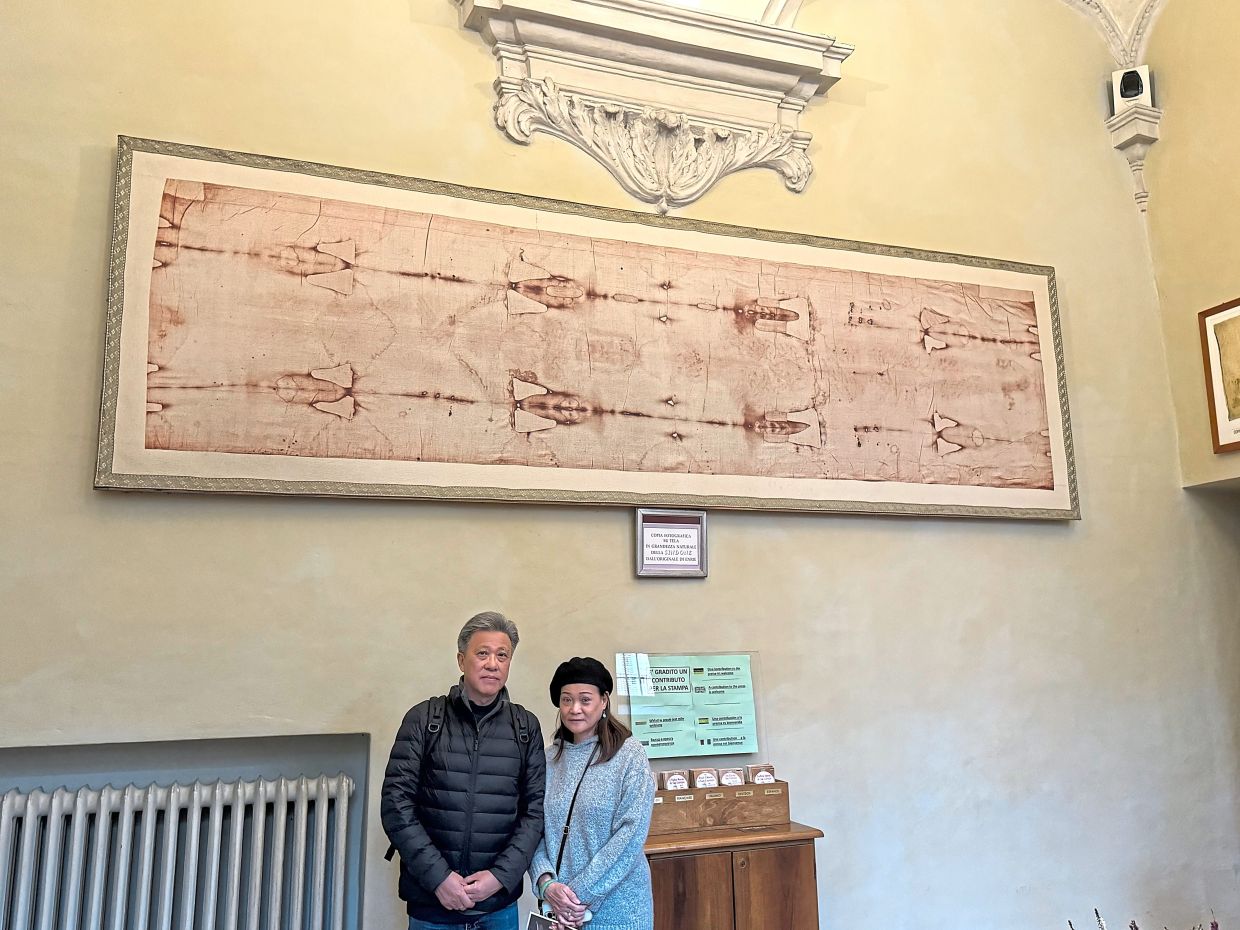
It shows the faint outline of a man – wounded, crucified, enigmatic. A negative (inverted) image that became clearer to the human eye only after photography was invented, which then deepened its mystery.
True to Turin’s reputation as a quiet, restrained, intellectual and calm city, from the outside of the church nothing prepares you for the fact that one of Christianity’s most debated and venerated relics rests inside.
No flashing signs. No grand theatrics. No tickets required to enter the Renaissance church. Just marble stone, symmetry, and silence.
Ironically, though, even one of the world’s most famous relics – the Shroud of Turin – does not guarantee crowds of visitors to the city.
Inside the cathedral the air is cool and the environment hushed, as though voices had learned over centuries to lower themselves. Candles flickered in corners.
We joined a few visitors scattered across pews, each wrapped in private thought.
When I told my Malaysian friends earlier that we would be going to Turin, many were perplexed. Why even bother? We were not going to see the real cloth anyway.
But it was faith that drew us to the city. It wasn’t a pilgrimage but rather an invisible pull to go there. Just like the shroud, it holds many different meanings for many different people. For some it is evidence, for others artifice. For many more, it’s a sacred mystery.
For me, it was faith; pure and simple. The shroud’s attraction is not in proving or disproving anything.
Those who take a detour to Turin often feel they have discovered something personal, a city that was not “performing” for them, yet welcomed them anyway.
If Rome is theatrical, Venice dream-like, and Milan outlandish, then Turin is dignified – elegant without trying, cultured without all the noise.
Once the capital of the Kingdom of Italy, the city still carries itself with a certain royal composure.
Turin has a distinctly Baroque and neoclassical personality. It is orderly, rational, almost Parisian in spirit.
Turin is also a city of cafes – not hurried coffee counters, but hushed salons where marble tables, chandeliers and gilt mirrors recall an age when conversation was considered an art.
“At historic spots like Caffe San Carlo and Caffe Torino, you sense that intellectuals, politicians and poets once sat where you now sip your espresso,’’ as one article aptly described Turin.
We left Turin with the belief that faith and reason work together in the pursuit of truth. As the Italian priest St Thomas Aquinas said, in seeking wisdom, we need to deepen our understanding and grow closer to God.
The views expressed here are entirely the writer’s own.