
As a child growing up in Port-Au-Prince, Haiti, in the 1990s, bridal designer Charles Dieujuste would often use his older sister to model his fashion creations.
“I started making her paper hula skirts,” Dieujuste, 37, said.
From paper, he moved on to chiffon – “I had this vibrant green chiffon fabric I found,” he said – and then to various blends and silks. Through all the fabric changes his guiding force has remained the same.
In 2020, he created Scorcesa.
“The brand is focused on the heritage of the women in my family,” Dieujuste said.
A portmanteau of his grandmothers’ names, he said, Scorcesa is “weaving the family line together”.
The brand’s initial emphasis was on courthouse weddings, its minimalist ethic stemming from his mother’s example.
“She got married in the chicest way possible,” he said. “She got married in a double-breasted jacket with a pleated skirt.”
That many brides were doing smaller, nontraditional weddings in 2020 contributed to the line’s early success.
At the beginning, he had some reservations.
He recalled thinking, “There is no newness in bridal, why am I even going toward it?”
Read more: Every stitch tells a story: Brides seek gowns uniquely and stylishly their own
Today Scorcesa offers bridal suits and colourful gowns.
And in an industry that has moved almost exclusively overseas, Dieujuste keeps Scorcesa’s production and manufacturing in the US.
All of his appointments, from the button maker to the trimming company, are within walking distance of his garment district studio, a loft on the 15th floor of a 1920s building, with floormates ranging from costume designers to a theater-scoring company.
All production takes place on the sixth floor of the building.
Dieujuste was born in Port-Au-Prince to a mother who worked at a large textile company. When he was young, he would spend days passing the time with his maternal aunt, who was a seamstress and whose main customers were women.
“I would play around on her sewing machine,” he said. “Sometimes she would want me to do some stitching for her, and so forth. And sometimes she allowed me to cut for her.”
It was invigorating to watch her make garments, he said, "And realise that she’s able to make things happen – she’s able to make something happen in real time.”

‘A big leap of faith’
On a mild day in August, Dieujuste explained his concerns about the space in his studio, which he moved into this past spring. He was preparing for bridal week in his studio while clad in jeans, a denim shirt and a blue woven cap.
“I am taking a big leap of faith, because tariffs and the economy and everything,” he said.
He held up a scrap of silk crepe that he uses in some of his pieces.
“This was originally US$17 (approximately RM70), and now it has increased to US$26 (RM107).”
Some months he is profitable; others he is not. Scorcesa gowns run from around US$550 to US$2,600 (RM2,270 to RM10,740).
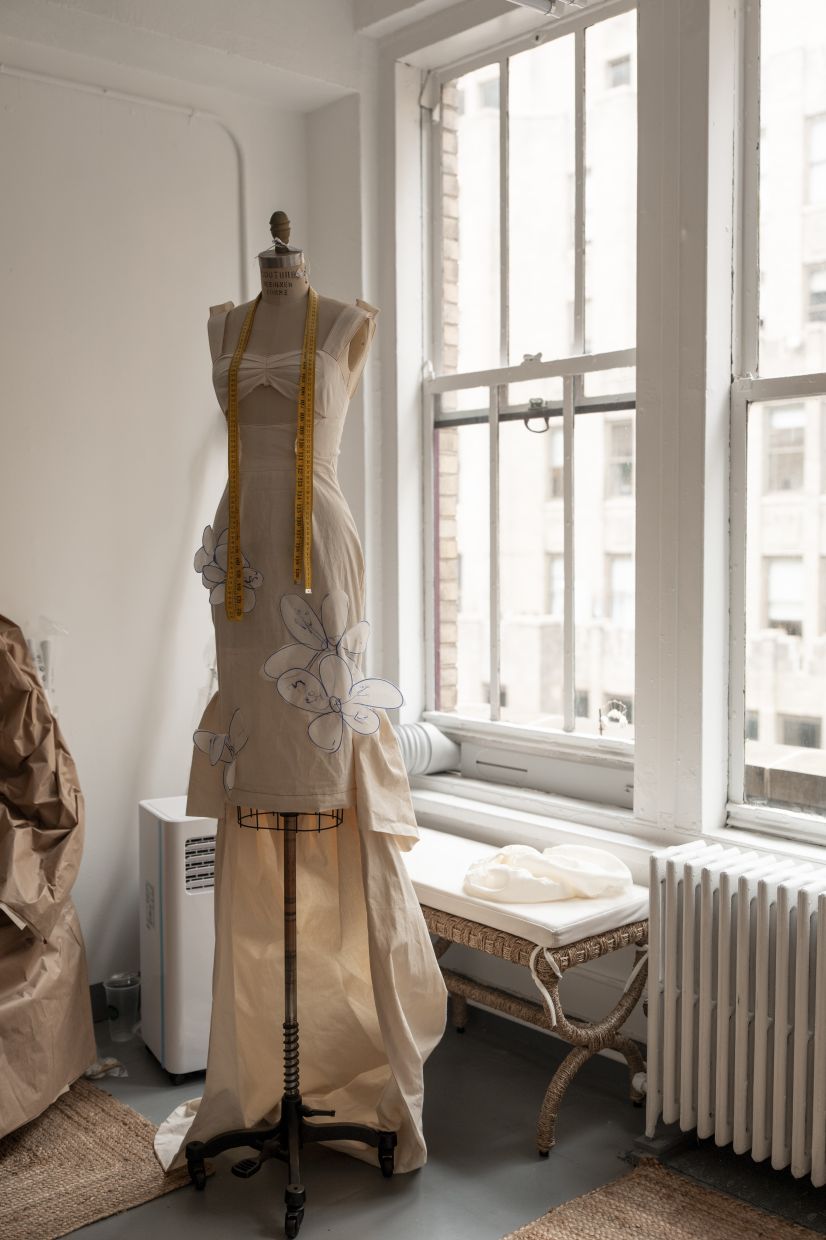
At the centre of the room was a single mannequin, an unfinished muslin clinging to it.
The completed gown, part of his Heritage collection and showing at this year’s bridal week, is powder blue and features a sweetheart neckline, a high-low skirt and cutouts.
It does not look like a traditional bridal gown, and that’s the point.
“You don’t have to follow traditions,” he said. “If you want to experience colour, we have that for you.”
The piece, in its hue, resembles the gown actress Chloe Grace Moretz wore for her wedding in August.
True to form, the primary inspirations behind “Heritage” were the “multifaceted women” of Dieujuste’s family and his Haitian legacy.
Part of the impetus for doing bridal week this year also has to do with representation.
“You rarely see any designers of colour,” Dieujuste said. “From my experience, there is not enough of us, and I think ultimately it is due to resources.”
He looks to Amsale for an example of how to navigate the bridal world as a Black-owned business.
Read more: She designs with love, for love: Nurita Harith speaks on her bridalwear journey
Contributing to romance
In addition to honouring the women in his family, crafting bridal gowns is also about finding inclusion in a cultural fantasy that Dieujuste hasn’t experienced firsthand.
“I’ve never been in a relationship,” he said. “Which is kind of weird, but I’ve always championed those who are in love and who want to celebrate love.”
Working with brides, and often their mothers and other women in their lives, is a way of contributing to the world of romance and family lineage.
“This is a garment you’re creating for someone that is going to go down in their history, and their family’s dynamic,” Dieujuste said.
“One day, their little girl is going to say, ‘Well Mom, you really did a great job on your wedding dress. I would love to wear it again.’”
The relationships his aunt had with the brides who came to her shop gave him a model for the role he wanted to play.
And even when it comes with challenges, he cherishes being part of that dynamic.
“You have to be extremely patient, because sometimes the customers are not that decisive,” he said, chuckling to himself. “There’s a lot of back and forth.”
Even so, Dieujuste said he relishes “being part of the celebration, being part of the narrative, being part of a legacy”. – ©2025 The New York Times Company
This article originally appeared in The New York Times.