How designers like Malaysia's Melinda Looi are weaving heritage into fashion


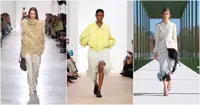
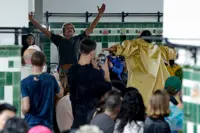
Melinda Looi thinks that by “reinventing” traditional crafts through fashion, she will be able to garner the attention of the younger generation. She is pictured here with her daughter, Maya Luebbert, at her couture show. Photo composite: Melinda Looi

Fashion is trying to change itself for the better. In attempts to move away from the exploitation of heritage, the industry is paying respect to artisans and producer communities – as well as highlighting traditional crafts.

This has happened all over the world. Dior’s Spring/Summer 2022 couture show in January, for example, shone a spotlight on Indian embroidery – of which decorated the Parisian venue.

Vast tapestries were spotted as part of the runway’s setting. They comprised a retrospective of the work of two Indian artists, Madhvi and Manu Parekh, embroidered by the women of the Chanakya School of Craft in Mumbai.

A fashion fair in Mexico last month saw designers showing off creations inspired by traditional Mexican motifs, embroidery and colours.

The event was promoted by the Mexican government to support marginalised indigenous communities.

In October, the country even managed to win an apology from US fashion house Ralph Lauren after Beatriz Gutierrez, wife of Mexico’s president Andres Manuel Lopez Obrador, accused it of plagiarising indigenous designs.

Closer to home, Singapore, Malaysia, Brunei and Thailand announced plans last week to jointly nominate the kebaya for inclusion in the Unesco (United Nations Educational, Scientific and Cultural Organisation) list of intangible cultural heritage.

All these really show that what we wear can matter in terms of preserving heritage, culture and local communities.

Read more: Ralph Lauren accused of plagiarising indigenous Mexican designs, offers apology

Designers all over the world are now more aware of the right way to pay tribute to culture and heritage. Seen in the background of the Dior couture show are tapestries woven by artisans from India. Photo: Dior

Modern artisanal touch

While some fashion designs are visually recognisable in terms of the culture that they draw from, others take a more unconventional route.

Although made traditionally, the resulting materials are modern and avant-garde.

Malaysian fashion designer Melinda Looi unveiled a couture collection in October that showcased handmade traditional materials like rattan weaving, tenun, batik and songket – but with a twist.

One songket fabric was created from a light and airy organza base. Looi says that this is something never done before. Songket is traditionally known as a heavy brocade hand-woven in silk or cotton.

The couture designs also included quirky motifs based on artworks by Looi’s daughter, Maya Luebbert. They feature extremely vivid and bright shades not seen in traditional fashion too.

In this manner, the collection represents a coming together of heritage and contemporary creativity.

“It’s fun and young,” Looi quips, adding that this is how she hopes to encourage the younger generation to appreciate heritage fabrics – or rather, traditional craftsmanship.

“I want to show that you can use the traditional ways, but to create modern works – with contemporary motifs and unconventional colours.”

Not wanting to just piggyback on culture and heritage though, Looi and her teenage daughter made sure to immerse themselves in the artisanal process. They learned the ins and outs of each craft.

The duo travelled to Sarawak in late August. There, they met with the artisans who produced fabrics for the clothes and studied the finer details of what it takes. For batik, they enrolled in classes, learning the art of hand drawing and dyeing.

For her show, Looi engaged the weavers of Sarawak to create songket that feature modern visuals. Photo: Melinda Looi

The couture collection was created with the help of Tanoti Crafts and Tun Jugah Foundation. Both these heritage brands assisted with the production of the rattan weaving, tenun and songket, as they have resources and relationship with the maker communities.

Malaysia’s National Craft Institute lent a hand by providing the needed resources in the creation of Looi’s uniquely modern batik.

According to Looi, the artisans in Sarawak were thrilled about weaving her daughter’s doodles and graffiti into fabrics. This is despite the motifs being “foreign” to them, far removed from the classic patterns they are used to.

The batik prints are also unconventional as they don’t feature familiar subjects – flora and fauna, for instance, but still adhering to the traditional way of production, that is wax-resist dyeing.

In a press conference before the runway show, Maya relates that she knew very little about such traditional crafts before going on the “fashion journey” with her mother.

She says that it was an eye-opening experience.

For Looi, this is how tradition and heritage can live on – in contemporary fashion and within a different perception of beauty.

“Fashion is art. I’m not afraid to push the boundaries to create such pieces,” she lets on.

Looi thinks she has also opened the eyes of the artisans and makers as well. When trying to create batik from silk chiffon, the instructor told her that it possibly could not be done. Yet, she managed to do it.

“I want to inspire the younger generation of designers in Malaysia too. I want to show them that it is possible to fashion modern, cool and contemporary designs using materials created from traditional means,” Looi says with pride.

Even the rattan weaving that she used showed contemporary motifs. Photo: Melinda Looi

Finding a balance

As it is, the traditional crafts industry is facing a problem in renewing its image. Heritage arts are often seen as old and irrelevant by the younger generation. This is what that needs to be changed.

Shamsul Azizi Samsudin, director of Malaysia’s National Craft Institute, admits that shaping public perception is key in keeping the industry alive.

He points out that evolving does not necessarily mean that we are not preserving heritage. It is the same way how traditional crafts will not get lost in the fashion realm – if given the right respect.

“Sharing the differences in both the fashion and heritage worlds will bring a better knowledge, understanding and appreciations in terms of creativity, skills and techniques to produce a masterpiece,” he notes.

“Culture is beauty. It is a root for everything. It is the way of life and lifestyle, which includes fashion.”

On the matter of not overstepping boundaries, he believes designers need to think long and hard about what they are trying to do.

“For instance, to simply turn a songket fabric into a swimsuit, under the name of creativity, just shows how cultural appropriation – versus appreciation – can happen,” he stresses.

“It is a lazy effort of understanding, and instead, merely using creativity to justify the means.”

Jacqueline Fong, co-founder of Tanoti Crafts, agrees. In her opinion, such perpetrators need to be called out.

“Cultural appropriation, to me, means that elements are being taken from the original source without any acknowledgement, credit or compensation to the producers of the original items,” she adds.

Fong’s advice for designers who would like to make use of heritage textiles is to consult the makers or artisans.

“Patterns are very critical in the production of heritage textiles. Unfortunately, for fashion, textiles need to be worn on the body. Hence, to produce fashion, the fabric would need to be cut up to be sewn and to create shapes and silhouettes,” she elaborates.

“It is considered offensive to the culture of some traditional textile producers if fabrics were to be cut across their patterns.”

Fong does however recognise the need for traditional crafts to find a place in fashion.

Read more: 'Legacy of our ancestors': Mexico weaves fashion policy to curb plagiarism

“The global fashion industry is valued at US$1.7tril (RM7.7tril) as of 2022. In comparison, the global handicraft industry has a market size of only US$680bil (RM3.1tril) – which is 40% of the former,” she says.

“If traditional crafts are able to successfully apply to fashion, we can expect large jumps in demand for handicrafts. It will increase the size of the handicraft sector.”

That said, her belief is that designers can benefit from using traditional crafts too.

“Firstly, by nature, textiles and other products made using traditional crafts come with a high element of craftsmanship, (now) sought after by luxury fashion and couture houses,” she explains.

“Secondly, the ability to extract provenance, as well as document ESG (environmental, social and governance) factors in such procurement, will be able to enhance the value of each fashion item.”

As seen in the Melinda Looi couture collection, both heritage and fashion can indeed complement each other. Of course, it takes understanding and respect to successfully find a middle ground to grow together.

While some people may argue that with the amalgamation of fashion, traditional crafts could possibly no longer look like what they were before, but in its essence, the skill and passion of artisans and makers will definitely live on.

Get 20% OFF The Star Digital Access

Monthly Plan

RM 13.90/month

RM 11.12/month

Billed as RM 11.12 for the 1st month, RM 13.90 thereafter.

Best Value

Annual Plan

RM 12.33/month

RM 9.87/month

Billed as RM 118.40 for the 1st year, RM 148 thereafter.

Follow us on our official WhatsApp channel for breaking news alerts and key updates!

Next In Style

Framing fashion: Bibo Aswan, the photographer shaping Malaysia's visual style
Has Taylor Swift’s wedding just outshone the Met Gala in fashion stakes?
Fashion awaits Taylor Swift's bridal look, but here's what the guests wore
The American dream, dressed: A look into 250 years of fashion and aspiration
Why letting go of a wedding dress can be among fashion’s hardest choices
Fashion sees clearly as glasses emerge as the chic accessory of the moment
The bikini at 80: Fashion is still pushing the limits of this swimwear classic
Two shirts, one outfit: Is this fashion’s smartest layering trick yet?
A shirtmaker so extraordinary that a luxury fashion house is buying the brand
Holidaying somewhere hot and humid? Stylists share their fashion essentials

Others Also Read