
We already know that Saturn’s icy moon is one of the few places in our solar system that could sustain life. But Enceladus could be even more hospitable to life than previously thought, according to new research.
A team of researchers at United States and German universities has shown in laboratory experiments that certain microorganisms could survive in the ocean hidden beneath the moon’s ice.
“Enceladus is considered one of the most promising places to search for extraterrestrial life,” said Vanessa Helmbrecht, the study’s lead author, according to a statement from Ludwig Maximilian University of Munich.
“Our experiments show that its unique geochemistry could create conditions that are even more favourable for microbial life than we had previously assumed.”
Conditions beneath the ice crust recreated
Researchers believe that a global ocean of liquid water and a deeper rocky core exist beneath the moon’s icy crust. Through experiments, the team has now explored if and how certain microorganisms could survive there.
To do so, the team recreated in the laboratory the conditions on the Saturnian moon’s ocean floor and discovered in the process that hydrogen-consuming, methane-producing archaea – so- called ancient bacteria – can cope with this inhospitable environment. It had previously been assumed that such an environment would be lethal for these anaerobic single-celled organisms.
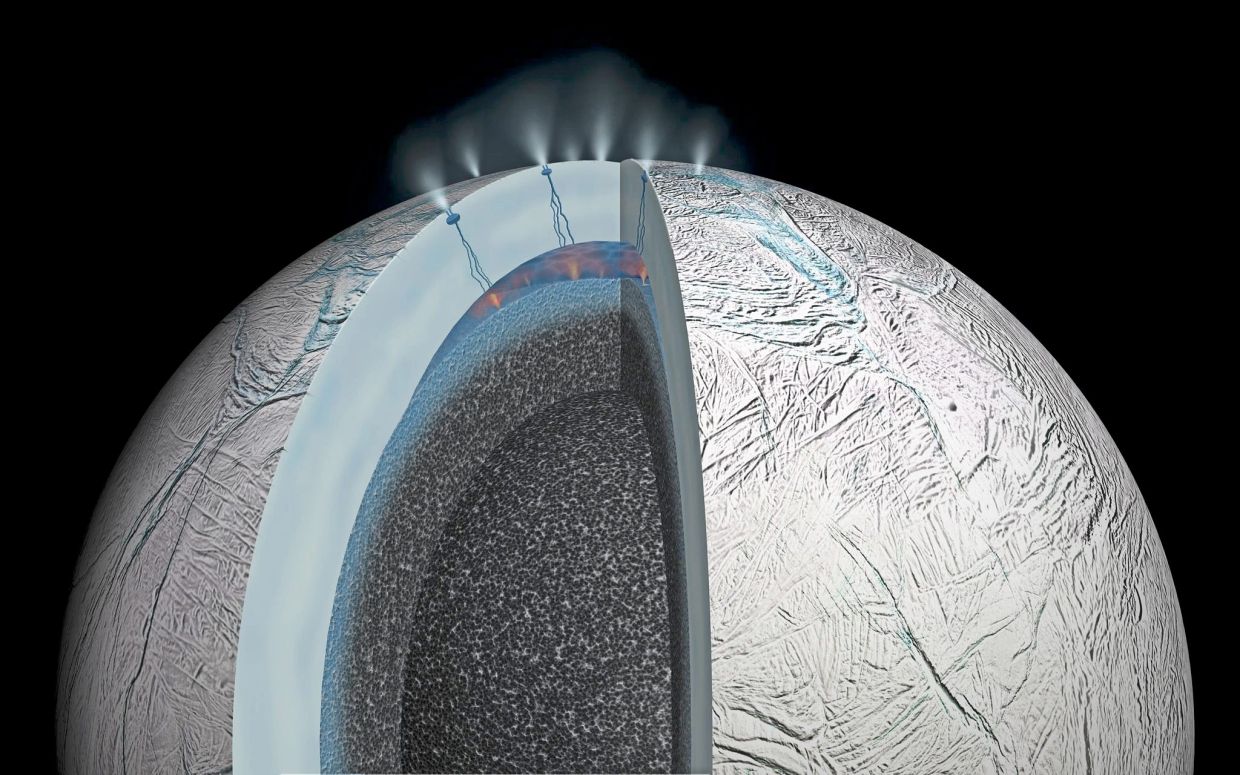
For the study, published in the journal Science Advances in September, the researchers built a special chamber to replicate conditions on Enceladus.
The oxygen concentration inside was extremely low – about 10,000 times lower than in Earth’s atmosphere. Under these conditions, they simulated both the moon’s alkaline ocean and its rocky ocean floor.
They then introduced Methanothermococcus okinawensis – an archaeon that lives in the deep sea on Earth.
To generate energy, this single-celled organism requires only the gases hydrogen (H2) and carbon dioxide (CO2), according to the researchers. This is considered one of the most primordial metabolic pathways still found in living organisms on Earth today.
Researchers surprised by results
“The results were astonishing: the organism continued to grow in the Enceladus simulation and produced methane using hydrogen generated by water-rock reactions,” the Munich university said.
One of the greatest challenges for potential life on Enceladus, it noted, is the extremely low concentration of carbon dioxide caused by the ocean’s high pH level. The team was able to show that the archaeon could adapt to this and use the tiny amounts of available CO2 with the help of its unique metabolism.
“Our study does not prove that there is life on Enceladus,” said geobiologist William Orsi, the study’s corresponding author.
“But it does show that key geochemical features there could enable one of the oldest metabolic forms of life.”
The search for life on Enceladus is set to continue: the European Space Agency (ESA) recently announced, according to the statement, that its planned 2042 mission “L4” would collect samples from the plumes ejected by geysers through the ice crust into space.
Those samples could then be analysed for microbial life. – dpa