



The wheelbarrows are piled high with buckets, sponges, brushes and cloths, balanced precariously atop rakes, spades, gloves, water bottles and snacks.
After a final check to make sure nothing has been forgotten, the group of 20 teens and young adults briskly sets off across Magdeburg's West Cemetery until they reach a path in a grassy area lined by more than 130 stone crosses.
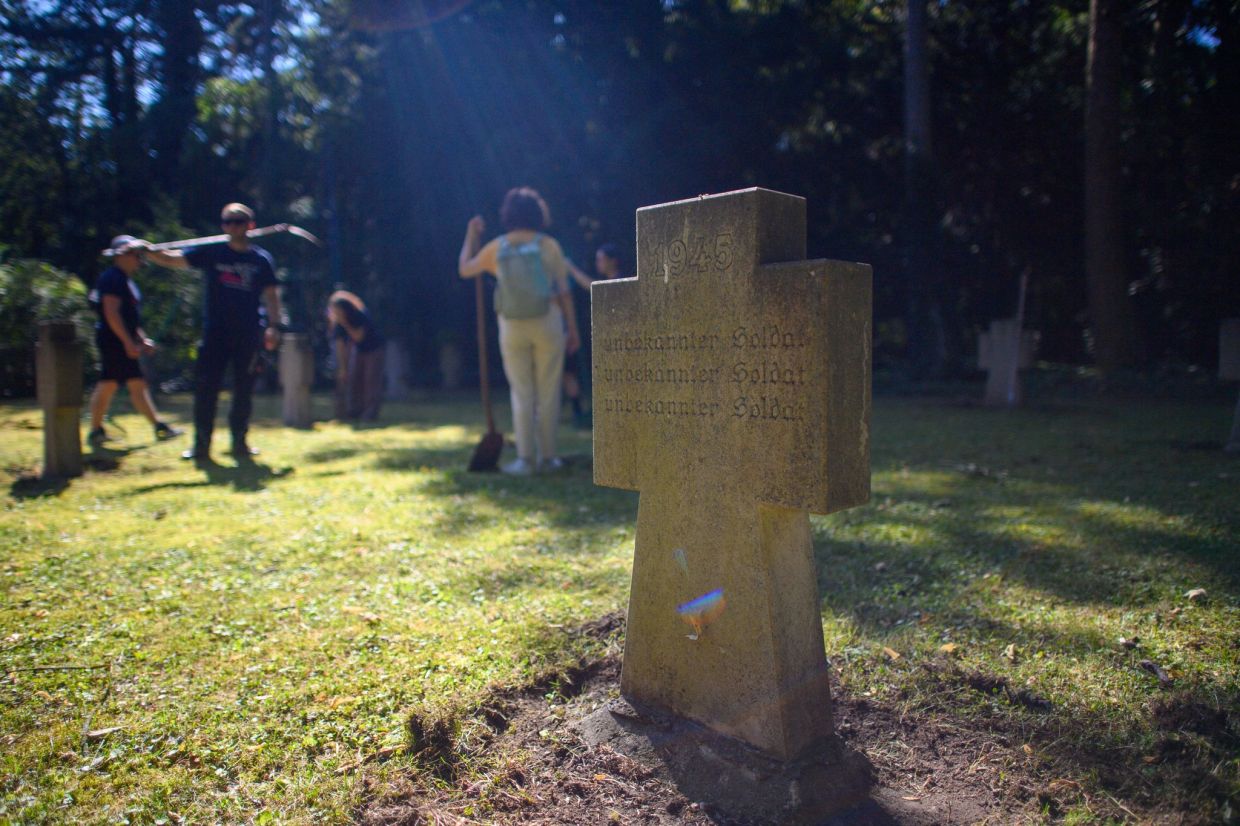
Each cross bears one or more names. There are no flowers, no photographs, no personal mementos.
Only an ageing sign beside the path offers a clue to who lies beneath: "Soldiers 1939/1945."
Following a brief introduction in English, the young group spreads out across the graveyard with their tools.
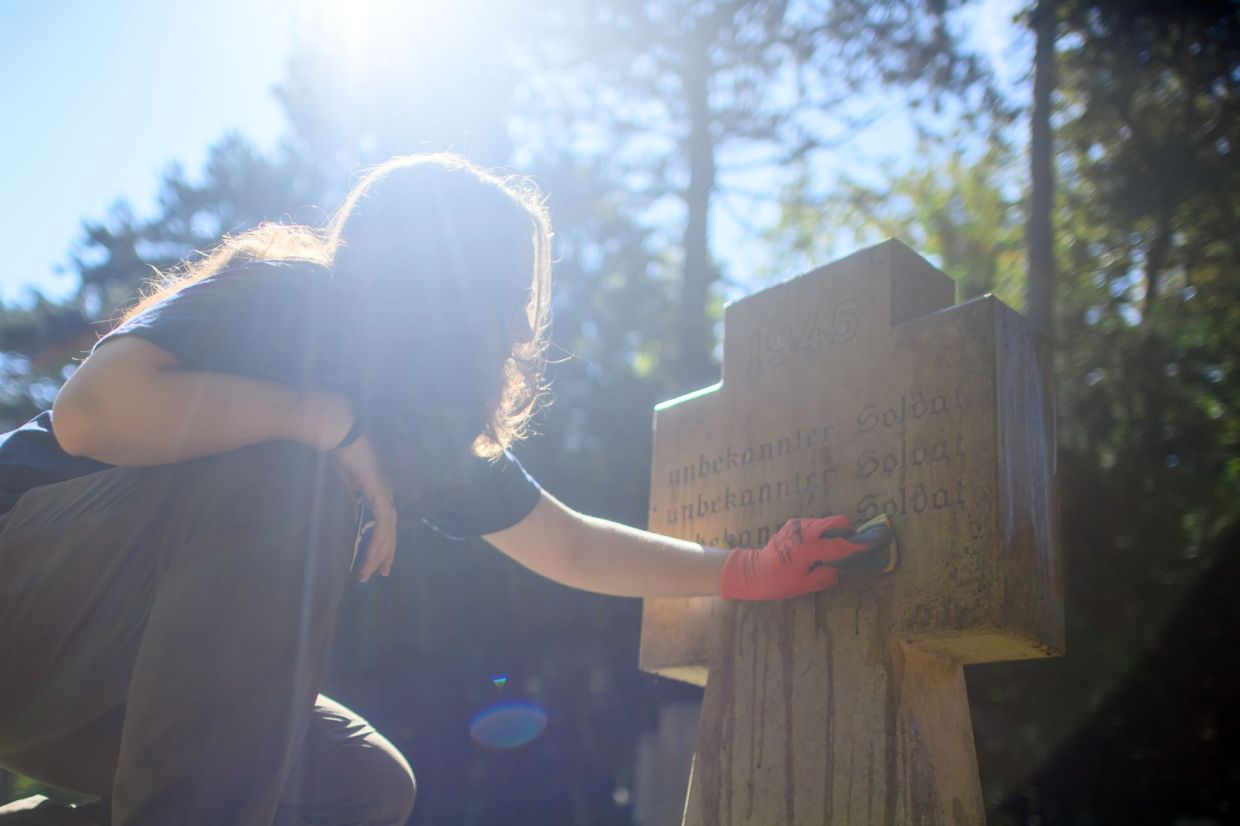
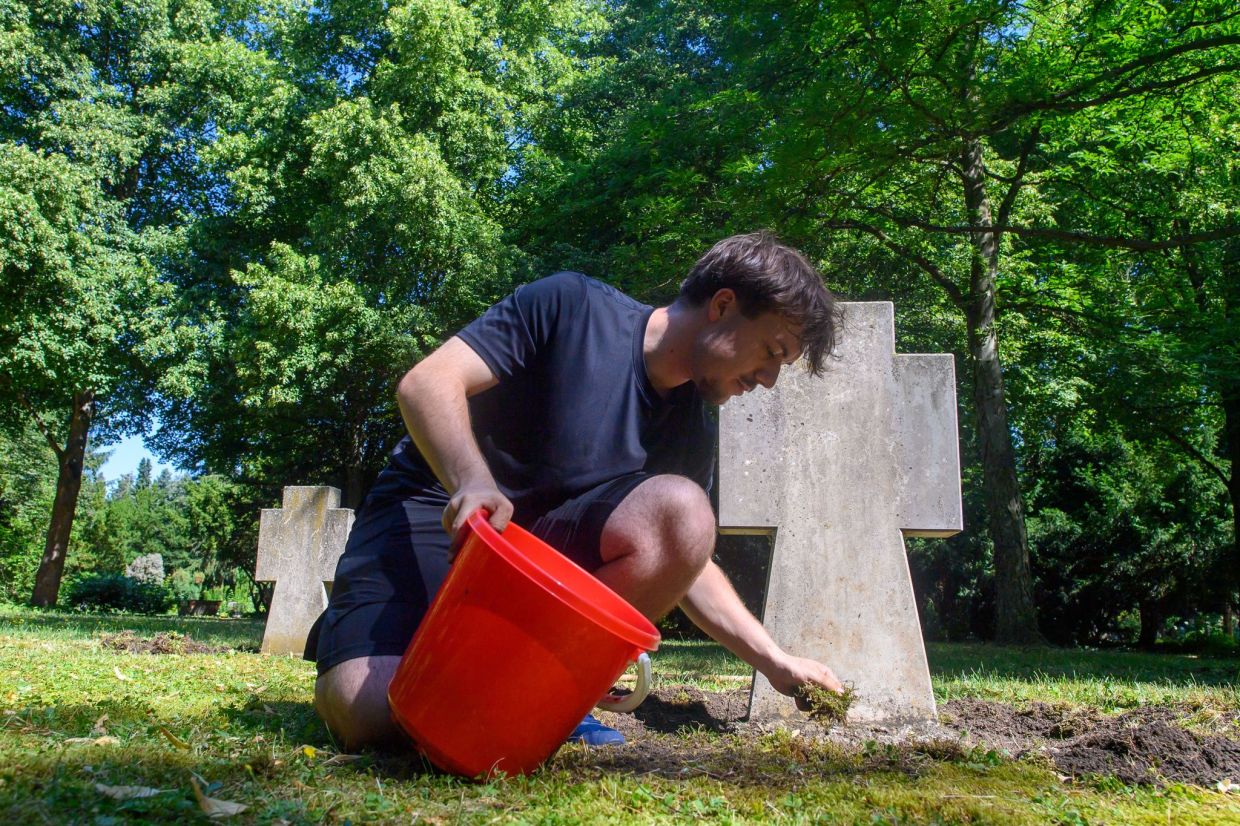
Some kneel beside the graves pulling weeds from the turf. Others scrub away years of moss and dirt, slowly revealing names carved into the weathered stone.
The work is physically demanding, yet the mood is light.
No one is on their phone; instead the youngsters are engrossed in the task at hand, some working on their own, others in teams.
What unites them all is their interest in the stories behind the graves.
Guillaume Kresdorn, a 19-year-old political science student, has travelled from Tours in France to take part in the Magdeburg International work camp, organised by the German War Graves Commission in the eastern German city.
The non-profit organisation is dedicated to the upkeep of more than 830 war grave sites in 45 countries housing about 2.8 million war dead, while also offering youth work and educational programmes, according to its website.
As part of the camp, the young people are deployed to the 62.5-hectare Magdeburg West Cemetery, to tend to the graves of war dead and victims of the Nazi regime.
Dieter Steinecke, who served as chairman of the regional branch of the commission until 2023, describes it as "peace work."
"Young people in particular need to send a clear message," says the 82-year-old.
Remembrance culture challenged by the rise of the far right
Magdeburg carries particular significance as the setting for a camp dedicated to reconciliation and active engagement with Germany's culture of remembrance.
It is the capital of Saxony-Anhalt, a German state where the far-right Alternative for Germany (AfD) party is seen as having a good chance of clinching a regional government for the first time in elections in September.
AfD officials in Saxony-Anhalt, where the regional party branch has been classified as a confirmed far-right extremist organisation, have sought to downplay the horrors of the Holocaust, pushing instead to shift the focus of remembrance on fallen German soldiers as part of what it describes as a "patriotic turning point."
'Remembering brings us together'
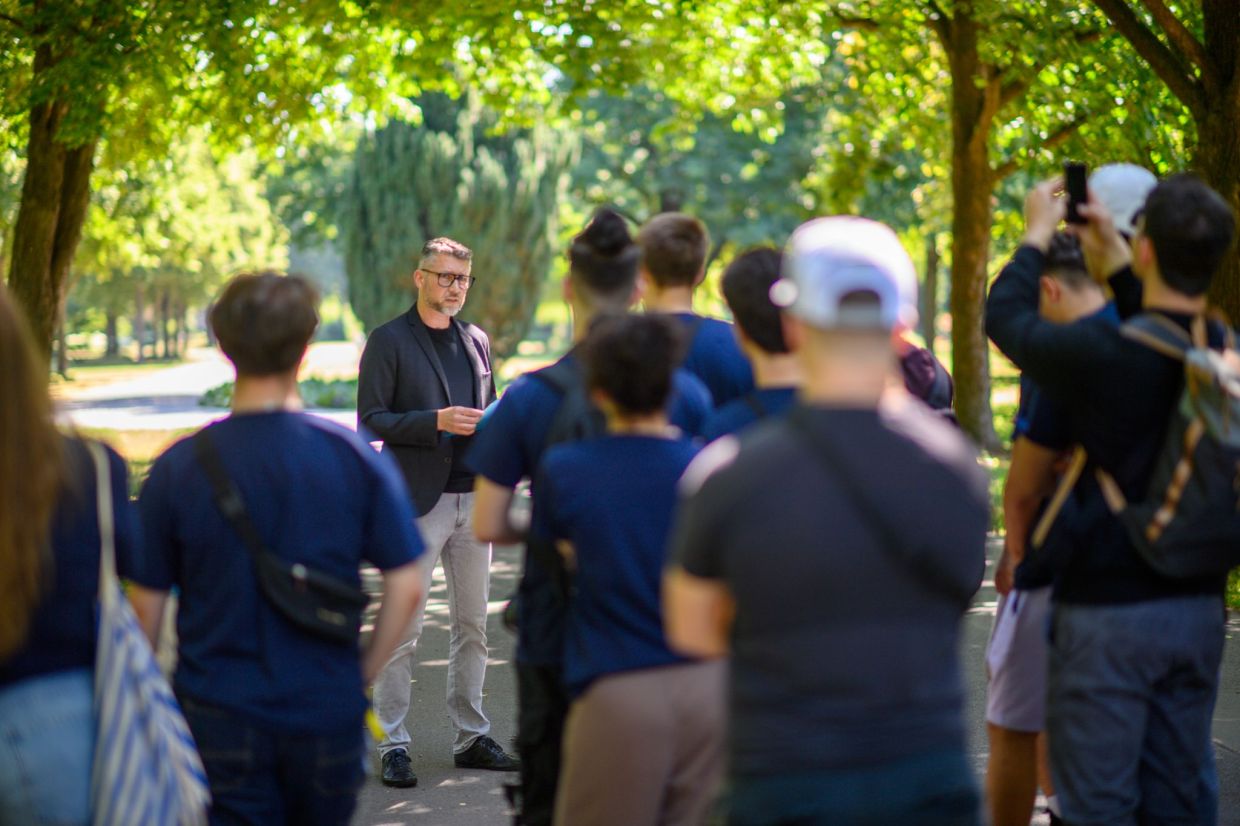
Against that backdrop, the work camp's motto - "Remembering brings us together" - takes on added significance for this group of 23 teenagers and young adults who spend about two weeks together in July.
Participants from Germany, Romania, Turkey, Hungary, France, Ukraine and Italy wear matching T-shirts emblasoned with the words: "Together for peace."
For Guillaume, the motivation is straightforward. He says that, above all, he is looking to learn something "about the World Wars and how other cities and people deal with them and think about them."
The programme extends well beyond maintaining graves. The young people also take part in discussions and excursions, including a visit to the Feldscheune Isenschnibbe memorial, which commemorates more than 1,000 concentration camp inmates from many European countries who were sent on a death march and killed by SS paramilitary troops in a barn on April 13, 1945.
Valentina Corsetti from Venice is the only Italian taking part and, at 25, one of the oldest participants.
Her mother is German; her grandfather, born in 1937, fled from the Nazis with his parents when he was a toddler.
"For me, it's a bit like researching my family history," says Corsetti. "We all know the theory about the cruelty of war, but here we're experiencing something like the reality of it."
It takes Corsetti, who studies German linguistics, around 15 minutes to clean a cross.
She carries out each stroke of the brush carefully, removing every trace of dirt and moss from the inscriptions carved into the stone.
Sometimes the graves she and the others tend to do not bear any name, but only the words "unknown soldier."
Corsetti cites the term "postmemory," used to describe the relationship of the succeeding generation to the traumas of those who came before it. "This is the past, but its impact is still felt today," she says.
'Reconciliation over the graves'
International youth exchanges and work camps have a long tradition at the German War Graves Commission.
The organisation began its work in 1953 at the military cemetery in Lommel, Belgium, which is regarded as the largest German World War II military cemetery in Western Europe outside Germany.
Its guiding principle "Reconciliation over the graves" also governs the work camps, designed to ensure that young people from as many countries as possible take part to bring together a wide range of perspectives.
In Magdeburg, applicants aged between 16 to 25 were eligible to join, says Anne Schieferdecker from the commission's Berlin office.
Each participant has to pay a fee of between €150 and €200 depending on whether they come from an EU or non-EU country.
In return, the organisation provides accommodation for two weeks in a hostel run by the European Education Center for Vocational Training and Society, while participants are responsible for making their own travel arrangements, according to Schieferdecker.
Young people urged to ask questions
In 2026, the commission has scheduled some 30 work camps and other youth work events across Europe, mostly in cooperation with partner organisations, Schieferdecker says.
Magdeburg has hosted a camp on several occasions before.
For regional chairman Andreas Arnsfeld, this reflects the city's history, having been extensively destroyed in 1631 during the Thirty Years’ War and in 1945 during World War II.
"Cemeteries are not just places of remembrance; they are also places of learning," says Arnsfeld. "They help us to understand history and to take responsibility for the future."
"I urged the young people: Make the most of this time. Ask questions, listen to one another and learn from one another." – dpa
