
During a trip to the zoo with his mother, a biology student came across a strange-looking ant, roaming around between the elephants, koalas and tigers.
"The two worker ants were slightly slimmer and darker, with behaviours that set them apart from native species," he recalled, according to the University of Hohenheim.
It was the first confirmed sighting of the Asian needle ant in Germany. Researchers fear it will not be the last after earlier finds in Europe and North America.
Severe pain and risk of allergic shock
When researchers came across an entire colony of the Asian needle ant in a neighbouring park shortly afterwards, one thing was clear: the introduced species has not only made it to Europe, but it is surviving and spreading – and that could become a problem for people, insects and ecosystems.
According to experts, the needle ant’s stings are not only painful, they can also trigger allergic shock – similar to a wasp sting – and, in extreme cases, death.
"The insects are classified by the European Union as particularly problematic because of their potential to cause damage and their potentially allergy-triggering stings," experts at the Senckenberg Society for Nature Research in Frankfurt said. The species was upgraded to the European Union’s highest risk category last summer.
Officials in the United States are equally concerned about the ant's spread after it has been reported in at least 19 states, mostly on the US east coast. The ant has not yet been reported in Canada.
"Stings are often reported to result in intense pain at the site of the sting that comes and goes over the course of several hours. Some people experience pain away from the sting site," the US Department of Agriculture says.
According to the USDA, common symptoms of a severe allergic reaction, or anaphylaxis, which can be triggered by the Asian needle ant, include:
- Skin reactions, including hives, itching and flushed or pale skin
- Low blood pressure
- Constriction of the airway, wheezing, difficulty breathing,
- Swollen tongue or throat
- Weak and rapid pulse
- Nausea, vomiting or diarrhoea
- Dizziness or fainting
- Psychological symptoms, such as a feeling of impending doom
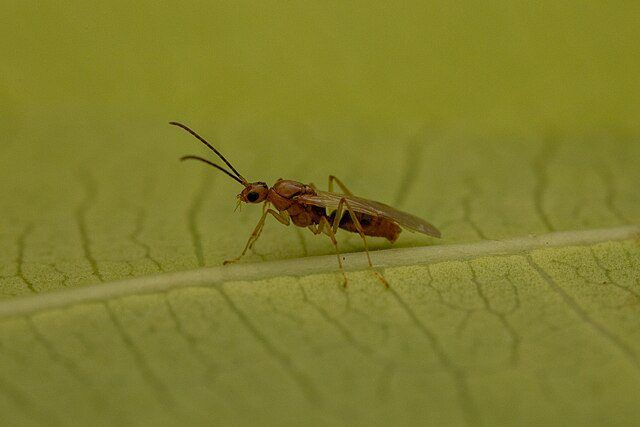
The discovery of the colony in the southern German city of Stuttgart is the first confirmed record of the Asian needle ant (Brachyponera chinensis) in Germany, the scientists said – and it is unlikely to be the last.
"We were able to discover a complete colony of the Asian needle ant in the park, including offspring," said Brendon Boudinot from the Senckenberg Research Institute and Natural History Museum in Frankfurt.
"This shows that this is not just a matter of individual introduced animals, but very likely a local population capable of overwintering."Boudinot is the lead author of a study on the first confirmed sighting in Germany, which has now been published in the scientific journal Zootaxa.
One of the co-authors is Stuttgart biology student Max Hartel who, according to the University of Hohenheim, had already discovered and identified a specimen of the Asian needle ant at Stuttgart’s Wilhelma zoo shortly beforehand.
"It was a chance find," said David Grunicke, who had previously provided the first evidence of an established population of this species in Europe at Lake Como in Italy. The ant found at the Wilhelma was probably a specimen from the colony in the park, he said.
Not the first invasive ant
The Asian needle ant originally comes from East Asia. It was first discovered in the south-eastern United States in 1932, according to the university. Since then, it has displaced native ant species in several states there. Allergic reactions similar to wasp stings are also known from the US.
In Europe, a single ant of this species was found in Naples in 2020. Further finds later followed in Italy, including the population at Lake Como.
To identify the ant species, researchers compare external characteristics such as body shape, surface structure and eyes.
The Asian needle ant is only one of many invasive ant species seen expanding around the world.
In North America, the European fire ant and tropical stinging ant are spreading, while in parts of Europe, the red imported fire ant - one of the world's most invasive species – is said to be damaging agriculture and causing fatal stings.
Most recently, another introduced ant species, Tapinoma magnum, made headlines in Europe after spreading in the millions in many regions, chewing through power cables, knocking out internet connections and invading cars, dishwashers and children’s bedrooms.
Chewing through parks and gardens
Invasive ants cause significant damage worldwide. They can affect public green spaces and private gardens, attack livestock and protected species and alter entire habitats. They are not harmless to people either – their stings can trigger severe allergic reactions, including life-threatening shock. The animals are often spread unnoticed, for example via the international plant trade, in containers or in luggage.
Rising temperatures linked to climate change also facilitate the spread of these species. The altered climatic conditions make it easier for them to establish themselves in new regions and multiply rapidly.
Researchers suspect the Asian needle ant was introduced in plants. "Urban areas are often at the centre of the establishment of non-native species," said Maura Haas-Renninger from the State Museum of Natural History Stuttgart.
"They increasingly arrive here as stowaways, for example in potted plants or other imported goods, and can often establish themselves particularly well." – dpa
Pullout quote: They increasingly arrive here as stowaways, for example in potted plants or other imported goods, and can often establish themselves particularly well. Maura Haas-Renninger