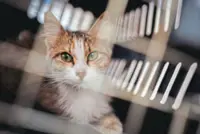
Owning a cat offers many health benefits, including reduced stress and emotional support, and new research suggests our feline friends might also offer clues to better treat certain cancers.
That's according to a new study published recently in the journal Science, which investigated cancers in cats and found significant parallels with how the disease plays out in humans.
Previous studies had highlighted similar links between dogs and humans, but little research focused on cats, said co-author Louise van der Weyden, a scientist at the British Wellcome Sanger Institute.
Cats, just like dogs, provide "a great model for us," she said, because they share an environment with humans that includes similar pollution, such as second-hand smoke.
"They develop other illnesses that we do when you get cancer," Van der Weyden said, explaining that cancer can be accompanied by ailments like diabetes or heart disease. Not infrequently, she said, the "animals will have that too."
With this principle as their guide, the international research team analysed cancerous tumor samples from nearly 500 domestic cats across five countries.
They covered 13 types of cancer, including brain, breast, lung and skin.
Since cancers develop from genetic mutations, researchers probed the DNA of cat tumor cells for markers already known in human medicine.
Several similarities emerged, especially when it comes to breast cancer.
In more than half of the feline mammary tumors analysed, the gene FBXW7, which has already been identified in humans, was found to have mutated.
This type of mutation is not common in women with breast cancer, but when it does occur it's particularly aggressive, Van der Weyden said.
It's similarly aggressive in cats.
"It's a really good model for what you see in humans, in terms of the biology of it," said Van der Weyden.
The researcher said that for women who are impacted by this type of mutation, the discovery is "great" because it could pave the way for new treatments.
Carrying out human clinical trials is difficult given the small number of affected patients.
But because so many cats suffer this mutation, targeted treatments could be more broadly tested on them in veterinary clinics.
Van der Weyden added with a smile that she personally would be more inclined to "take a drug based on it working in cats" rather than in mice.
Win-win
Encouraged by this parallel, Swiss researchers conducted additional experiments on these samples and discovered that two chemotherapy treatments appeared very effective against tumors with this particular mutation.
The results must be confirmed with further research. But they could quickly have benefits for both women and cats, as these drugs are already approved for human and veterinary use, Van der Weyden said.
Prof Harikrishna Nakshatri, who studies breast cancer at Indiana University, called the results "fascinating" and said the data could help scientists gain better understanding of how cancer develops.
Specifically, Nakshatri said, the results could benefit our understanding of how genes interact with environmental factors, which are often considered prime suspects of triggering the disease.
For Van der Weyden, the findings could result in a "win-win" for humans and our beloved pets.
"We're genomically so similar, the tumors we develop are so similar," she said. "What you learn in one species can be used to help the other." – AFP