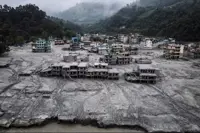
Heat waves and wildfires, torrential rain and flooding – extreme weather events are on the rise in many parts of the world. Residential buildings can't be expected to withstand the forces of nature if they're not well adapted to the vagaries of the local climate.That makes climate-appropriate home construction more important than ever. What does it entail? Here are some questions and answers:
What exactly is "climate-appropriate" construction?
Secondly, our homes need to be adapted to climate change.
In other words, climate-appropriate construction means planning buildings able to stand up to current and future climate changes, and building them in as climate-friendly a way as possible.
Is this a new idea?
"Climate-adapted construction is basically as old as mankind itself. Weather and climate have always determined where and how to build," says Markus Hennecke, executive board member of the Bavarian Chamber of Civil Engineers.
This is why houses in the mountains look different than those on coasts, and houses on the Mediterranean from those in the Far North. Constantly adapting to climate changes such as stronger winds, heavier snowfalls and rising temperatures isn't new either.
"But now there's a third dimension, namely resource-efficient construction," Hennecke says. "This means constructing and operating buildings that cause as little greenhouse gas emissions as possible. It's a new challenge."
"It involves comprehensive planning: Architects, energy consultants, building physicists and landscapers have to work closely together from an early stage," says Steinfeldt.
They've got to "take the lifespan of the building and its components, as well as local conditions into account".
How should individuals best approach construction planning?
"Clients who attach great importance to climate-appropriate construction need to be active themselves. They can't just book a climate package as an add-on when planning a house," says architect Andreas Kohler, a consultant for the Berlin-based Builder Alliance (BSB).
Ideally, they should hire an architect or planner who specialises in this area, then "go directly with the specialist to the property and draw conclusions", says Kohler.
For example, if you want to build near a river or on a hillside, you've at least got to make sure that the basement is waterproof against pressure. Houses on hillsides are also often exposed to strong wind suction nowadays, so they have to be designed to withstand it.
The building's orientation is important as well. If it's exposed to sunlight for many hours of the day, there'll be lower heating costs in the winter, but measures to mitigate solar radiation in the summer will be required, such as awnings or other forms of heat protection.
"The client should discuss these things with the architect before detailed construction planning begins," Kohler says.
Are there construction materials that are particularly climate-friendly?
"It's environmentally more sustainable to use renewable and natural materials, for example by substituting gypsum plasterboard with clay building boards."
Steinfeldt says, "As for insulation, there are ecological alternatives to plastic, such as hemp or cellulose. These natural materials often provide a more pleasant room climate, store carbon dioxide during their lifespan and can be recycled more easily later."
If you are building a home, what else should you take into consideration?
This requires exceptional insulation, airtight windows and a ventilation system that brings in fresh air without heat loss.
If heating does prove necessary, it should be produced using renewable energy sources if possible, for instance a heat pump or solar thermal systems. Solar panels can produce electricity, and what's not used immediately can be stored.
What are the advantages of having a climate-friendly house built for you?
"You benefit from the use of natural materials, low energy consumption and a healthy indoor climate," says Kohler, adding that it also gives you a good feeling knowing your house is well equipped for both the present and the future.
"There's a financial benefit too," says Handwerk. "Climate-friendly houses with low energy consumption have a higher long-term value than conventionally built ones do." – dpa