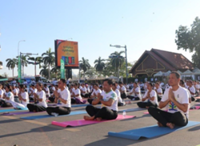
Malanin Bee curves her spine like a stretching cat as she lets out a maniacal, forced laugh.
The quick-fire pattern of manufactured giggles – “oh, hoo hoo hoo, eeh, ha ha ha” – soon ripples into genuine laughter, and she giddily kicks her feet.
She’s practising what she calls Laughaste, a hilarious yoga routine she created that is a descendant of “laughter clubs” that emerged in India in the 1990s. It feels awkward at first, but you fake it till you make it, she said.
“It’s about allowing yourself to be OK with being awkward,” said Bee, a Los Angeles comedian and speaker. “Then you’re going to find some form of silliness within that is going to allow you to laugh involuntarily.”
The laughter clubs were based on the common-sense notion that laughter relieves stress. But a good laugh is also good for your heart, immune system and many other health benefits, said Dr Michael Miller, a cardiologist and medical professor at the University of Pennsylvania.
“Like we say, exercise at least three to five days a week,” Dr Miller said. “Belly laugh at least two to five days a week.”
Although luminaries from the ancient Greeks to Freud have opined on the roots and implications of laughter, the modern study of laughter – gelotology – began emerging in the 1960s.
Stanford University psychologist William F. Fry, one of gelotology’s founders, drew blood samples from himself while watching Laurel And Hardy. He discovered that laughter increased the number of immune-boosting blood cells.
In 1995, Dr Madan Kataria, a physician in Mumbai, got wind of the emerging research as editor of a health magazine while researching an article on stress management. To combat his own stress, he started the first daily laughter club in a park. It ballooned from a handful of participants to more than 150 within a month, he said.
After the group quickly ran out of jokes, Dr Kataria created exercises that activated the diaphragm, and he incorporated yogic breathing exercises, light stretchesand deliberately silly sounds and movements.
“We were faking in the beginning and within seconds, everybody was in stitches,” Dr Kataria said.
The benefits of laughing
Dr Miller began studying laughter in the 1990s. Showing funny movies to study participants, he found that laughter produces endorphins in the brain that promote beneficial chemicals in the blood vessels.
Nitric oxide, for example, causes blood vessels to dilate, which lowers blood pressure, inflammation and cholesterol.
The combination reduces the risk for a heart attack, he said, and the endorphins are natural pain killers.
“When you’ve had a really good laugh, you feel very relaxed and light,” said Dr Miller, who is also chief of medicine at the Philadelphia Veterans Administration, where he is implementing a laughter therapy programme. “It’s like you’ve taken pain medication.”
Forced laughter – or simulated mirth, in academia – may even be more beneficial than spontaneous laughter, said Jenny Rosendhal, a senior researcher of medical psychology at Jena University in Germany.

Rosendhal completed a meta-analysis of 45 laughter studies, among other research, and found that laughter-inducing therapies decreased glucose levels, the stress hormone cortisol and chronic pain. They also improved mobility and overall mood, especially in older populations.
Because humour is subjective, it is hard to measure. That’s why much of the more recent research has focused on laughter yoga and similar programmes that provoke sustained bouts of laughter during 30- to 45-minute sessions, Rosendhal said.
Laughter yoga is particularly effective for people who might not feel like laughing, such as those struggling with depression or cancer patients, she said. With simulated laughter, the physiological mechanisms are the same, such as additional inhaling, exhaling and muscle activity that also improves mood.
“The well-being comes through the back door,” she said. “You start with an exercise, and then the spontaneous laughter comes later because it’s funny to see people laughing.”

Laugh for no reason
During a recent video call, Dr Kataria said the trick is to learn to laugh for no reason. He and others in laughing yoga classes around the world have created hundreds of exercises that help.
The simplest: Get together with another person, look in each other’s eyes and repeat the sound “ha” for a full minute. Or try the “breathe in and laugh”. Bring your hands to your chest on a deep inhale, hold your breath for three seconds, and burst out laughing on the exhale while extending your hands forward.
In laughing yoga classes, people may pretend to greet each other like aliens, crawl around like their favourite animals, or tap their temple as if a light bulb went off, exclaiming, “Aha! ha ha ha!”

Dr Kataria suggested bringing laughter into your daily life, even at things that might not seem funny. Demonstrating “credit card bill laughter”, he held out his hand as if looking at a statement, and burst into a roiling, infectious laughter. For inspiration, you could log into one of the three dozen free online American laughter clubs recognised by Laughter Yoga International.
“Really, it’s not about forcing yourself to laugh,” he said. “It’s like activating your laughter muscles, getting rid of your mental inhibitions and shyness. Then the real laughing is childlike laughing, unconditional laughing.” – AP