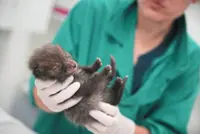
Few creatures are as closely linked to being spooky as bats.
With their large ears, sharp teeth and eerie midnight flights, they have long fuelled fears of bloodsucking vampires and carriers of disease.
In films, they frequently symbolise disaster and evil – from the 2023 horror The Last Voyage of the Demeter, where a bat-winged Dracula terrorises a ship at sea, to the recently-remade vampire classic Nosferatu, whose vampire teeth evoke a bat's fangs.
But are these creatures really as terrifying as they appear on screen?
"Bats are nocturnal, so we usually only glimpse them briefly, and their lives seem mysterious," says Marcus Stiglegger, a film studies lecturer in Mainz. In cinema, their leathery wings and pointed teeth create an eerie visual shorthand.
"The less we know about the real animals, the more effective the symbol becomes," he says.
Bats have long been associated with vampires. The most famous is Dracula, from Bram Stoker's 1897 novel, though legends linking the undead to bats date back to the early 18th century.
Forensic scientist Mark Benecke notes that misinterpretations of corpses helped fuel these myths.
In folklore, the souls of the dead were believed to flutter, while vampires lingered between worlds, shunning sunlight – "always flitting back and forth, circling much like bats," says the president of the Transylvanian Society of Dracula, an organization dedicated to studying vampire lore.
Threatened, not dangerous
In reality, bats in Europe pose little threat to humans, says the Nature and Biodiversity Conservation Union (NABU).
They rarely transmit diseases; only rabies can be passed by rare bites, and bats are never aggressive on their own.
European bats do not drink blood – only three species in Central America feed on mammal or bird blood, and even then without killing their hosts.

Meanwhile, bats themselves face serious threats. According to the International Union for Conservation of Nature (IUCN), of the 1,336 bat species assessed globally, 25 are critically endangered and 87 are considered threatened.
The IUCN states that bats, among the world's most endangered animals, face "unprecedented threats" from habitat loss, hunting, climate change, invasive species and diseases.
In some regions, it says, entire local populations have vanished following mysterious mass die-offs.
A little fear is good for you
Communication scientist Daniel Possler from the Media University in Hanover explains that bats in films still frighten many viewers because they are intuitively perceived as real.
People initially feel fear and only afterwards remember that what they are seeing is fiction, he notes.Beyond the storyline, filmmakers rely on stylistic devices such as unsettling music or dramatic camera angles to intensify emotions, Possler adds.
Fear is a vivid example of such intuitive reactions, according to Possler. "Studies show that most people react involuntarily with fear to stimuli such as darkness, the sound of screams, depictions of distorted, angry faces, or even certain animals such as snakes or spiders," he says.
Horror directors make deliberate use of these triggers to evoke strong feelings. "Many people are entertained by the fear and anxiety that horror and thriller films generate – they enjoy the emotional thrill," says Possler.
If viewers manage to cope with the negative emotions, he adds, "positive feelings such as pride or a sense of mastery can follow." – By ALINA SCHMIDT/dpa