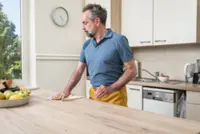
Expert tips on decluttering your home during the stay-home order


By Agency
Now that we are at home, decluttering experts say we have an opportunity to take action and feel better about the stuff we have. Photo: dpa

In a recent decluttering webinar hosted by professional 
organiser Fay Wolf, people all over the country signed on to Zoom to
 get how-to tips while sequestered at home due to the coronavirus.

”There’s room in your life to do something right now, ” said Wolf, 
 author of New Order: A Decluttering Handbook for Creative Folks (and
 Everyone Else).

“Now that we are at home we are faced with our
stuff. But we have an opportunity to take action and feel better.”


People on the webinar confessed to feeling fearful, sad and jittery
 as they shared free guided-meditation apps and journalling strategies
 as well as their recent decluttering victories.

 They are not alone.


On March 18, Goodwill Southern California closed its stores and
 donation centres in response to the escalating Covid-19 pandemic. By
 March 24, many of the centres were so overwhelmed by drop-offs that 
the nonprofit appealed to Los Angeles residents to stop.


”As much as we love to accept donations, we can’t take them right
 now, ” said Marla Eby with the US nonprofit Goodwill. “People are 
dropping things off, and it is becoming a health hazard, especially 
in the rain. We are asking people to organise their things at home 
and have them ready when we reopen.”

Grouping items by category helps you to get rid of stuff. Photo: AFP


Professional organiser Marla Stone, author of The Clutter Remedy: A 
Guide to Getting Organized for Those Who Love Their Stuff, isn’t
 surprised by the “corona cleaning.”

“March is normally the month 
people clean out their garage regardless of the sequestering, ” said
Stone. “We’re like the bears that come out of hibernation.”


Most professional organisers have their own method. For Marie Kondo, 
it’s the Kon Mari Method. Wolf likes to use sorting bins labelled 
”donate, ” “trash, ” “recycle, ” “shred” and “other rooms.”


Stone, a former psychotherapist, focuses on how people feel about
 their stuff. “I help them make good decisions, ” she said.

“That’s the 
most important thing. There is a huge push to get rid of stuff. When 
I go into a home I tell them, ‘You don’t have to get rid of 
anything.’ As soon as I tell people that, they start heave-hoing 
their stuff out of the garage.”


In a recent interview, Stone offered tips on how to get organised
 while you’re self-isolating:


Don't focus on getting rid of stuff
- Focus on making good decisions.


- Ask yourself: Is it useful? Does it serve a purpose? Is it 
sentimental? How sentimental?


- Do I love it? If it’s something you love and it makes you happy, 
then it’s a keeper.


- Take a moment and think 10 years ahead. Will this serve you 10 
years from now? Will you still love it? Can you see your kids using 
it? This thinking is better than throwing away all of your stuff in a
 whirlwind.


Categorise your stuff


- Putting things away and being organised are not the same thing.


- Grouping items by category helps you to get rid of stuff. Stone
 said the main reason her clients remain disorganised is because they 
don’t do this.


- Fine-tune your categories. That way there is order. Organise your
 books. Contain items in the bathroom in zip top bags. Put electrical
 cords in a bin. That way, you can see what you have and realise that 
you don’t need the objects.


- Focus on what you actually use. How many blenders do you have? How 
many dishes? Have they been sitting there for 16 years? If you have 
space and are sentimental about them, keep them; otherwise, get rid
 of them.


You only want items you use daily, weekly or monthly in your 
kitchen cabinets, closets and bathroom cabinets. Photo: TNS
You only want items you use daily, weekly or monthly in your 
kitchen cabinets, closets and bathroom cabinets. Photo: TNS


Use clear bins


- Clear bins are important for storage. When things are in boxes and
 bags, you don’t know what’s in them.


The garage


- The garage is the most important space to have organised. Stone
 usually suggests it as a place to start.


- Categorise and use clear and concise criteria. Ask yourself: Will I
 use this, and if so, how often? Is it serving a purpose? Is it 
sentimental?


- If it’s something like camping gear and you don’t camp, ask
 yourself, “What’s this item doing in my real estate?” If that answer 
is nothing, pass it forward.


Interior spaces

- You only want items you use daily, weekly or monthly in your 
kitchen cabinets, closets and bathroom cabinets.


- If there are things, such as Christmas platters, that you use only
 a couple of times a year, put them in a bin and store them away from
 your everyday items.


Home office


- What do you use daily? Weekly? Monthly? Put what you don’t use in
 the closet. What if you don’t have a closet? Then you don’t have
 space for all this stuff.


-Organise important papers when you finish organising your office.
 You can’t categorise paper in a cluttered environment.


Think green


- Don’t put items that can be used in a trash can, dumpster or a junk 
truck. Think about individuals and organisations that might be able
 to use them.


- Consider using free e-waste and toxic waste disposal centres.


Organise important papers when you finish organising your home office.
 Photo: TNS
Organise important papers when you finish organising your home office.
 Photo: TNS

Where to donate now

- If your local donation centre is closed, you can list things for 
free on Facebook Marketplace, the Nextdoor app or local online
 groups.


- Leave the item on your driveway or porch for pickup. Or place it on 
the sidewalk with a sign marked “free.”


- Donate to family, friends and neighbours. Stone developed 
membership sales group pages on Facebook so she could donate directly 
to people.


Selling your stuff

- You can sell any item you don’t want and make a profit using social
 media sales and online resources.


- Free online advertising helps you avoid shipping and returns.
 Companies such as Venmo and PayPal make it safe to accept and pay
 money, protecting both sellers and buyers.


- Make sure you communicate clearly about what you are selling, 
including any damage, scratches, discolouration or odours.


- If you’re a buyer, do your research and make sure it’s not an 
impulse purchase. Be careful when picking up an item.


- Try trading groups online where people barter for the things they
 want.

Get 20% OFF The Star Digital Access

Monthly Plan

RM 13.90/month

RM 11.12/month

Billed as RM 11.12 for the 1st month, RM 13.90 thereafter.

Best Value

Annual Plan

RM 12.33/month

RM 9.87/month

Billed as RM 118.40 for the 1st year, RM 148 thereafter.

Follow us on our official WhatsApp channel for breaking news alerts and key updates!

Next In Living

How to still have fun without overspending: Tips from financial experts
Big Smile, No Teeth: Here’s a Faustian deal for you
Tips for adopting frightened dogs
This scampi risotto recipe flies you straight to coastal Croatia
Why do our brains malfunction in high-pressure situations?
Dog Talk: The dog who found her bark
The juiciest grilled chicken breast starts with these 4 tips
40yo Malaysian terrace house transforms into tropical home infused with light and nature
Heart And Soul: The devastating loss of a pet
Fish sleep a lot like us, and they even nap

Others Also Read