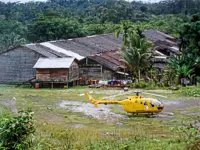
The Flying Doctor Service (FDS) was started in Sarawak – our largest state, which has a land area almost equal to that of Peninsular Malaysia – in 1973 and Sabah in 1976.
The objectives of the FDS are twofold.
One is to provide healthcare to residents in remote areas where access by road or river transportation are impossible or difficult, or where the low population numbers make it unviable for permanent services to exist.
The other objective is to provide healthcare to those who experience a medical emergency and require urgent transportation to care in a hospital, and also for transfer between healthcare facilities.
The FDS in Sarawak covers more than 90 localities, especially in the divisions of Kapit, Miri and Limbang, where transportation access is limited.
The range of services provided by the FDS include:
- Treatment and follow-up for non-communicable diseases (NCDs) like diabetes and hypertension (high blood pressure)
- Maternal and child care, including vaccination, antenatal and postnatal care
- Health screening
- Basic acute and emergency treatments
- Basic surgical treatment and management
- Blood-taking for tests, and
- Basic portable ultrasound examination.
The duration of stay of each FDS team, which usually comprises a Medical Officer, an Assistant Medical Officer and two or three nurses, at each locality depends on the number of cases and the weather at the particular point of time.
The effective functioning of the FDS is contingent on quality standards of clinical care and aviation infrastructures that emphasise safety and consistency, and are patient focused.
Standards
There are various standards for FDS services.
The Aeromedical Society of Australasia (ASA) has standards for aeromedical services and the World Health Organization (WHO) has guidance for medical evacuation (medevac) in emergencies.
The ASA standards cover the following:
- Capability and governance: This includes a capability statement, organisational governance and clinical governance
- Clinical capability: This covers the medical director, clinical personnel, medical passengers, continuing aeromedical/clinical education and clinical documentation
- Partnering with consumers: This includes consumer engagement, confidentiality of patient information and informed consent to treatment
- Safety, quality and risk management: This covers health and safety, human factors and crew resource management, safety management systems, risk management and quality assurance, complaint management, and reportable events management
- Service operation: This includes operational information, operational management and dispatch, aircraft operations, the chief pilot, pilot in command/captain, co-pilots, helicopter aircrew members, helicopter rescue crew members and winch operator
- Service equipment: This includes availability for tasking, preparedness and activation, and medical equipment, including certification, stretchers, suction, monitoring equipment, medical power and medical gases
- Service communications: This covers communications, response to incidents, coordination of critical incidents/patient transfer services, communications back-up systems and resources
- Aircraft landing areas
- Uniform standard
- Fire-fighting equipment on board aircraft.
The WHO guidance covers the following situations:
- Activation of the response and coordination mechanism, which covers integration of the medevac coordination function, mapping the system - coordination partners and key contacts, establishment of medevac transit points or hubs, request for assistance, assessment of available medevac capacities and capabilities, medevac process flow, information management requirements, and agreement on communication pathway and platform
- Decision-making, including prioritisation and dependency
- Repatriation
- Approval for transfer
- Agreement and informed consent
- Safety and security, including team health and welfare
- Civil-military coordination
- Information management and documentation
- Transfer of care
- Financial considerations.
- Clinical decision-making
- Team capabilities and service provision
- Scenario/case-specific transports, which includes additional considerations for highly infectious diseases; burns care; chemical, biological, radiological, nuclear and explosive/hazmat (CBRNe), paediatric and neonatal critical cases, and extracorporeal life support (ECLS) transport
- Quality indicators.
- Power and fuel
- Warehouse management
- Pharmacy supply chain and medical stock management
- Communications
- Transportation asset and fleet
- Site assessment, selection and planning
- Mobilisation and demobilisation.
- Water supply
- Hygiene
- Infection prevention and control
- Environmental cleaning
- Waste management
- Sanitation
- Dead body management.
- Human movement across borders, including customs and immigration procedures
- Considerations for air medevac, including air traffic control and airspace restriction
- Medical documentation and information exchange, including security and privacy
- Transport of hazardous waste materials.
Although this columnist could not find standards or guidance for the FDS in the public domain, he believes that there are standard operating procedures (SOPs) at each healthcare facility that provides the FDS.
Long Lellang crash
The Long Lellang helicopter crash involving a FDS team that occurred earlier this month (September 2026) shocked the nation.
The Health Minister stated at a press conference that the FDS would continue so as to provide universal health coverage, only to announce the next day that there would be a temporary suspension of the FDS in Sarawak pending a review.
There has been, at the time of writing, no announcement of when the FDS will resume.
The Health Minister informed the media that the FDS air services were outsourced to private contractors.
This was unlike the situation in the early years of the FDS when the air services were provided by the Armed Forces.
The crash led to much angst, and even anger, in the medical and nursing professions, which were not assuaged by the tone and lack of empathy in the Health Minister’s press conferences.
This was reflected in social media postings calling for an independent review of the crash and the Health Minister’s resignation, as well as stories from healthcare providers involved in previous FDS missions about some of the challenges they encountered.
Going forward
It is moot to be reminded of the Health Ministry’s mission “to ensure a high quality health system that is customer-centred, equitable, affordable, efficient, technologically appropriate, environmentally adaptable and innovative with emphasis on professionalism, caring and teamwork value, respect for human dignity and community participation”.
That there is a need for the formulation and immediate implementation of standards for the FDS is a given.
After all, the Health Ministry has legislated quality standards for private hospitals and clinics since 2006, the objective of which was to ensure safety for patients using these facilities.
Surely patients in the remote areas of Malaysia cannot and should not be treated any differently from patients who seek healthcare in the private sector.
A life is a life, no matter what a person’s station in life is.
A safe FDS is urgently needed.
Dr Milton Lum is a past president of the Federation of Private Medical Practitioners Associations and the Malaysian Medical Association. For more information, email starhealth@thestar.com.my. The views expressed do not represent that of organisations that the writer is associated with. The information provided is for educational and communication purposes only, and it should not be construed as personal medical advice. Informa-tion published in this article is not intended to replace, supplant or augment a consultation with a health professional regarding the reader’s own medical care. The Star disclaims all responsibility for any losses, damage to property or personal injury suffered directly or indirectly from reliance on such information.