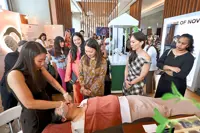
The autopsy suite at UMMC: once the forensic entomology team (left) has collected their specimen, the forensic pathology team (right) takes over for the inspection and dissection. — Photos: AZHAR MAHFOF/The Star
“I have a case tomorrow morning, but it’s a partially decomposed body, can you make it?”
Forensic pathologist Dr Shatishraj Jothee sent me this late night text a fortnight ago (mid-January 2026), in response to my request to see how a post-mortem is carried out.
Photographer Azhar Mahfof and I have been waiting for a “fresh” body to arrive, but the timing wasn’t suitable until this case came along.
“Ok, we’ll be there,” I responded.
And so we found ourselves once again in Dr Shatishraj’s workplace: the mortuary at Universiti Malaya Medical Centre (UMMC), Kuala Lumpur.
The body of a man had arrived the previous night.
He had been living alone and had no known family.
The police had broken his door down and discovered him dead in his landed property after the neighbours detected a stench and called them.
The body was then sent to UMMC in an ambulance.
The investigating officer had ordered a post-mortem to rule out foul play.
As per guidelines, the procedure has to be carried out within a practicable time, i.e. between 24-48 hours of arrival at the hospital.
Careful examination
When we arrive, Dr Shatishraj is attired in his personal protective equipment (PPE) and Wellington boots.
He tells us: “Our entomologist is inside the autopsy suite collecting bug samples, so we’ll wait till the team finishes their work.
“Let me show you the toilets, just in case you need to run out.”
Yes, it’s common, even for healthcare workers, to throw up at the sight and smell of a decaying corpse.
Excited, Azhar preps his gear.
My initial intention is to observe from the gallery above the autopsy suite, but alas, the room is changed at the last minute due to plumbing issues.
In this present suite, there is no gallery, so I watch through the glass door for the first few minutes.
My stomach begins to churn slightly at the sight of the greenish-greyish-blackish body, and I whip out my trusty peppermint essential oil to sniff as the odour permeates the air.
Once the entomology team has collected their specimens, the body is washed to remove dust, sand, etc.
The forensic pathology team then enters the room.
Dr Shatishraj begins by doing a gross external examination (with the naked eye) of every part of the putrefied body to record any visible signs or identifying marks of the potential cause of death, e.g. tattoos, scars, stab wounds, bruises, etc.
Then he makes a “Y”-shaped incision from the neck to the umbilicus with a PM40 blade to expose the internal tissues and organs for examination.
The single-use blade has to be super-sharp to cut through the joints, and sometimes, more than one PM40 is required for a post-mortem.
Together with his team, they remove the organs one by one.
Each organ is weighed, measured and checked for any abnormalities (bleeding, swelling, tumours, fractures, deformations, etc) layer by layer.
Then a small block of each organ is sliced off for microscopy examination before the rest of it is placed back in the body.
The liver and kidney blocks are sent to the Chemistry Department for toxicology tests.
In a decomposed body, bacteria eats up blood cells, so only tissue samples can be sent.
Azhar seems unperturbed by the sight, and along with two other photographers – one each from UMMC and the police – furiously clicks away to obtain visuals.
With soiled hands, Dr Shatishraj beckons me to come in, as he is about to saw the head open.
Be brave, I remind myself, and enter in my work clothes!
The stench is bearable – it’s not as bad as when the mortuary refrigerators are opened.
Making an incision across the scalp, Dr Shatishraj peels back the skin to expose the skull.
Using an oscillating saw, he removes the top of the skull to access the brain and a greyish-whitish substance gushes out.
I remain calm, but Azhar blinks his eyes in horror and shakes his head.
Dr Shatishraj says: “The brain matter is naturally soft and mushy, so when there is no blood, it turns porridge-like.
“The pancreas and brain matter are the first to decompose, and as you can see, the brain matter is already liquefied, so I’m checking for clots.
“I also check the base of skull, neck, etc.’
Nothing abnormal is detected.
A heart attack
From examining the heart, Dr Shatishraj finds a significant build-up of scar tissue (fibrosis) in the heart muscle.
He is confident that the cause of death is ischaemic heart disease, which he later writes in the death certificate.
He points out: “If there is a thickening of the coronary artery, it may be due to a lot of factors: plaque build-up, cholesterol deposits, high blood pressure, diabetes, etc.
“We can’t tell with the naked eye if there is an infection (unless there is pus) or what kind of tumour, if any – histology will give us more information.
“The doctor will decide if the gross finding is good enough to conclude the cause of death.”
However, the liver and kidney tissue samples are still sent to the Chemistry Department.
“In this case, I’m confident the toxicology report will not change the findings.
“If we are unsure, we write ‘pending laboratory analysis’ as the cause of death, and as long as there is no objection from the police, the body can be released to the family.
“Once the findings are revealed, then we alter the cause of death in the death certificate,” says Dr Shatishraj.
Before the incisions are sutured, fillers such as cotton linen are placed in the orifices to absorb the fluid.
He explains that: “Although we stitch up, the fluid can still seep out.”
The body is washed and cleaned to remove any fluid or bloodstains, dried, shrouded, placed in a black body bag (for police cases), and wheeled back into the refrigerator.
Leaving his team to finish up, Dr Shatishraj steps out to scrub himself.
It has taken slightly over four hours to complete this post-mortem.
Meeting death alone
Dr Shatishraj shares: “Almost 10-20% of our cases are badly decomposed.
“A lot of people in urban areas are now living alone in apartments, without family or friends, so we tend to get more decomposed bodies.
“The remains are only found after the smell becomes unbearable to neighbours.”
In fact, he adds that they’ve had cases where only skeletal remains were found in condominiums.
“By this time, there is no more smell.
“We then have to do a biological profiling of the skeletal remains to estimate the age, sex, stature and race – although most of them are of Asian descent – before passing the information to the police,” he explains.
Sadly, UMMC’s forensic pathology team is also seeing an increasing number of people falling to their deaths by jumping off high buildings, causing the limbs to be severed and organs splattered.
Dr Shatishraj says: “The body is disfigured and we try our best to reconstruct it back after the post-mortem before releasing it to the family.”
At UMMC, there is no fee to store the body at the mortuary.
At press time, no one has come forward to claim this body and steps are still being taken to trace his family members.
If the police are unsuccessful by six months, permission is sought from the hospital director to release the unclaimed body to the relevant agencies, i.e. state religious authorities for Muslims and non-governmental organisations for non-Muslims, for funeral rites.
This is where entrepreneurs like Tan Kar Chun come in to help.
Final send-off
When he gets a call to collect an unclaimed body, Tan drives over to do his bit, with assistance from his charitable friends who are happy to chip in to cover the funeral costs.
Depending on whether the deceased is an Indian or Chinese, he accords them a proper funeral according to their religion.
“If the person is an Indian, we liaise with a Hindu priest to conduct the last rites; if Chinese, we get a Buddhist monk.
“If we don’t know, then it’s a Buddhist funeral.
“A basic funeral is roughly RM3,600 and I collaborate with a few memorial parks to keep the ashes in the columbarium,” he shares.
Tan, who owns a funeral service company, has been doing this for almost a decade.
Yearly, he collects over 100 unclaimed bodies from mortuaries all over the Klang Valley.
He also helps families who cannot afford to perform the last rites.
He attends every funeral ceremony to ensure everything is in order.
The ashes, kept in urns and labelled with numbers if the identity is unknown, are kept “forever”, as there have been instances where family members have come searching for the remains years later.
Tan says: “It costs money to maintain the urns, but the memorial parks bear the cost.
“Should the family member trace the urn, I surrender all the documentation to them and it’s up to them to do what they want thereafter.”
He deems this job a blessing from the dearly departed.
“It gives me a lot of fulfilment.
“I sometimes dream of unknown people and they suddenly become a ball of light.
“I take it as a good sign as my business is flourishing,” he says, laughing.