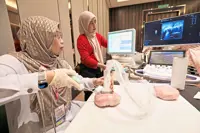
Cancer remains one of the leading causes of death worldwide, however, advancements in science continue to bring hope through better treatment options.
One such option is photodynamic therapy (PDT), a promising and less invasive treatment that uses light, a special drug and oxygen molecules to target and destroy cancer cells.
PDT is a type of cancer treatment that combines a special drug called a “photosensitiser” with light to destroy cancer cells.
The drug becomes active when exposed to a specific type of light, usually from a laser or LED (light-emitting diodes), and reacts with oxygen in the body. This reaction produces substances that kill cancer cells, disrupt nearby blood vessels and trigger a local immune response.
Unlike treatments such as chemotherapy or radiation, PDT is very precise, targeting only the cancer cells while sparing most healthy tissue.
It’s especially useful for cancers close to the skin’s surface or inside body cavities where light can reach.
PDT is also less painful than surgery, leaves minimal scarring and has fewer side effects.
Some photosensitisers have already been approved for treating certain pre-cancerous conditions and cancers in the United States and Europe.
Availability of PDT locally
In Malaysia, the use of PDT is gradually increasing as awareness of its benefits grows.
Since it is a minimally invasive healthcare technology, PDT is gaining attention as an alternative or complementary treatment to traditional therapies.
Although PDT isn’t intended to replace surgery, chemotherapy or radiation, it’s a valuable option for certain patients.
Experts believe that improvements in technology, such as better photosensitisers, will help expand the use of PDT.
However, more research is needed to fully establish its advantages over traditional treatments and its cost-effectiveness within Malaysia’s healthcare system.
Healthcare providers and institutions are also working to make PDT more affordable and accessible, while educating patients about its benefits and limitations.
Is PDT effective?
PDT has been proven to work well for various cancers, including skin cancer, oesophageal cancer, lung cancer, bladder cancer, biliary tract cancer and head and neck cancers.
It’s particularly helpful for managing symptoms in advanced or recurring cases that can’t be cured.
For skin cancer, PDT offers an added benefit: it leaves the skin looking better after treatment compared to surgery or other options.
In some cases, PDT has also been found to improve survival rates and quality of life.
Side effects, such as light sensitivity, pain, redness, or itching, are usually mild and manageable.
Among PDT's uniqueness:
> Minimally-invasive: Helps avoid the need for major surgery, leading to faster recovery times and less discomfort.
> Precise targeting: The treatment focuses on cancer cells without harming most healthy tissues.
> Fewer side effects: Unlike chemotherapy, PDT doesn’t cause nausea, hair loss, or other widespread side effects.
> Repeatable treatment: PDT can be safely repeated in the same area, unlike radiation therapy.
Challenges and future directions
While PDT has many advantages, it also has some limitations.
The treatment only works for cancers that can be reached by light, which means it’s not suitable for all types of cancer.
Additionally, the photosensitising drugs used in PDT can make the skin and eyes sensitive to light for some time after treatment, requiring precautions like avoiding sunlight.
Looking ahead, researchers are working on developing more effective drugs and better ways to deliver light to tumours, which could make PDT even more effective.
Worldwide, efforts are being made to make PDT more affordable and available to patients.
In short, PDT is an innovative treatment for certain types of cancer.
It offers a less invasive and more targeted approach compared to traditional options. As awareness grows and technology improves, PDT has the potential to play a substantial role in cancer care.
While challenges remain, the future of PDT is bright, bringing hope to cancer patients everywhere.
Dr Lee Tze Yan is a senior lecturer and researcher in the field of biomedical science at the Institute of Medical Science Technology, Universiti Kuala Lumpur, Dr Nur Aininie Yusoh is a postdoctoral fellow in the Department of Radiology, West China Hospital, Sichuan University, Chengdu, China, and Dr Loo Yan Shan holds a PhD in nanomedicine from Universiti Putra Malaysia, and is currently a research assistant in Monash University Malaysia. The information provided is for educational and communication purposes only, and should not be considered as medical advice. The Star does not give any warranty on accuracy, completeness, functionality, usefulness or other assurances as to the content appearing in this article. The Star disclaims all responsibility for any losses, damage to property or personal injury suffered directly or indirectly from reliance on such information.
Already a subscriber? Log in
Get 20% OFF The Star Digital Access
Cancel anytime. Ad-free. Unlimited access with perks.