
Children receive most of their vaccine shots at a very young age.
This is because they are most vulnerable to infection during infancy, so they have to receive most of their immunisation shots as early as possible during that stage of life.
Infectious diseases such as tuberculosis, polio, diphtheria, measles and pneumococcal disease, can be life-threatening to infants.
In fact, such diseases were a significant factor in the high rates of infant deaths in the past.
This strategy of giving as many vaccines as early in life as possible is followed around the world in order to prevent such deaths.
However, it doesn’t mean that a child’s immune system is fully developed once they start to walk and talk.
After infancy, the next stage of child development is early childhood – a crucial phase of life when children start to explore the world on their own.
This is the time when they will take their first step, say their first sentence, make their first friend, attend their first class in preschool and experience many other firsts in life.
Typically, a child in the early childhood stage is called a toddler when they are one to three years old, and a preschooler at four to six years old.
Still vulnerable
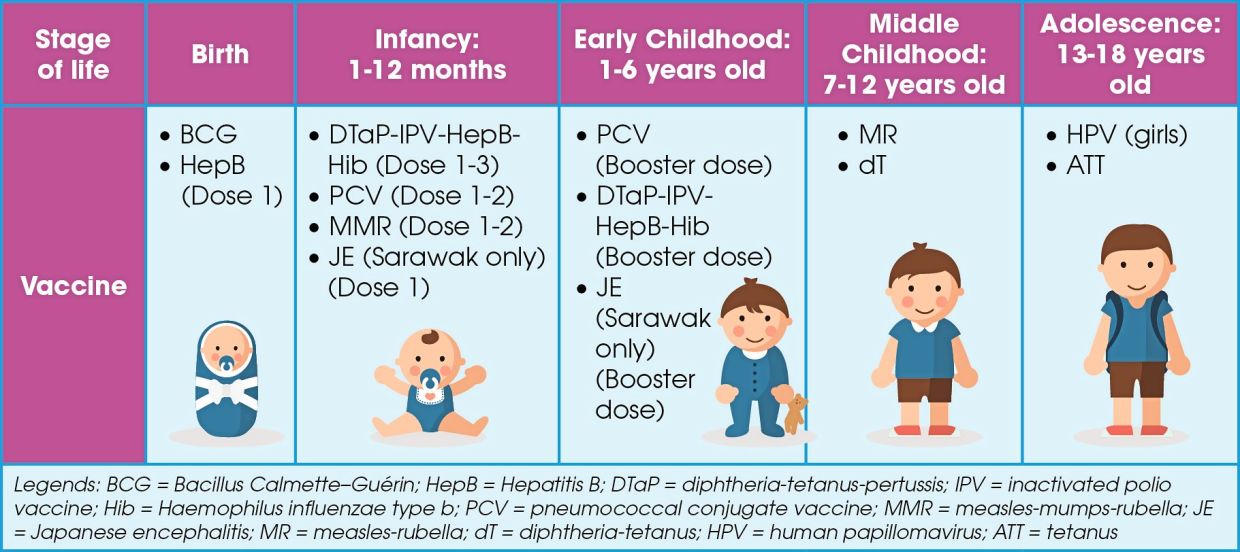
By the time a child reaches one year of age, they would have received at least nine out of the total 14 vaccine shots (or more for girls, and children in Sarawak/Sabah) as scheduled in the National Immunisation Programme (NIP).
They will continue to receive the remaining shots during their childhood and adolescence (see the next Positive Parenting column in a fortnight for more on this).
Young children who have received their vaccine shots during infancy are protected against the diseases covered by the vaccines.
However, it doesn’t mean that toddlers and preschoolers are free from danger.
Children still have to complete their doses of the pneumococcal conjugate vaccine (PCV), diptheria-tetanus-pertussis (DTaP)-inactivated polio virus (IPV)-hepatitis B (HepB)-Haemophilus influenzae type B (Hib) vaccine and Japanese encephalitis (JE) vaccine after the age of one year to ensure full protection against the diseases.
Apart from that, it is important for toddlers and preschoolers to receive and complete vaccination as children below five years old are also categorised as high-risk groups vulnerable to infectious diseases due to their still immature immune system.
Exposed to others
Early childhood is also the age when most children first go to the daycare centre, preschool and kindergarten.
Close proximity with other children, caregivers and teachers at these places exposes them to possible infections.
At these ages, children are also very curious to explore their surroundings and this tendency may put them in danger of picking up infections.
Another reason for toddlers and preschoolers to get vaccinated is to provide a layer of indirect protection for other high-risk populations in their household.
These can include infants, the elderly and people with chronic diseases or suppressed immune systems.
Parents should also note that some daycare centres, kindergartens and preschools may require children to be fully vaccinated according to the NIP in order to be enrolled in their establishments.
A note on the PCV
The PCV has finally been included in the NIP starting in 2020 and this is such welcome progress.
The downside is that it is currently only provided for free for children who are born in 2020 or later.
There are children who are born a little earlier who are currently still under five years of age and also need to be protected against pneumococcal infection.
Hence, pneumococcal catch-up vaccination for this group of children is recommended.
The World Health Organization (WHO) states that catch-up vaccination should be applied when introducing PCV in the NIP if possible.
This is to accelerate its preventive impact in children aged between one to five years old.
Consult a paediatrician to learn more about pneumococcal catch-up vaccination for your toddler or preschooler.
Datuk Dr Zulkifli Ismail is a consultant paediatrician and paediatric cardiologist. This article is courtesy of the Malaysian Paediatric Association’s Positive Parenting programme in collaboration with expert partners. For further information, please email starhealth@thestar.com.my. The information provided is for educational and communication purposes only, and it should not be construed as personal medical advice. Information published in this article is not intended to replace, supplant or augment a consultation with a health professional regarding the reader’s own medical care. The Star does not give any warranty on accuracy, completeness, functionality, usefulness or other assurances as to the content appearing in this column. The Star disclaims all responsibility for any losses, damage to property or personal injury suffered directly or indirectly from reliance on such information.
Already a subscriber? Log in
Get 20% OFF The Star Digital Access
Cancel anytime. Ad-free. Unlimited access with perks.