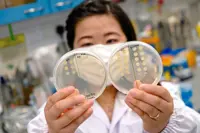
Scientists at Nanyang Technological University (NTU), Singapore, have developed a synthetic peptide that can make multidrug-resistant bacteria sensitive to antibiotics again when used together with traditional antibiotics.
This offers hope for the prospect of a combination treatment strategy to tackle certain antibiotic-resistant infections.
On its own, the synthetic antimicrobial peptide can also kill bacteria that have grown resistant to antibiotics.
Every year, an estimated 700,000 people globally die of antibiotic-resistant diseases, according to the World Health Organization (WHO).
The international health agency says that in the absence of new therapeutics, infections caused by resistant superbugs could kill an additional 10 million people each year worldwide by 2050, surpassing cancer.
Antibiotic resistance arises in bacteria when they can recognise and prevent drugs that would otherwise kill them from passing through their cell wall.
This threat is accelerated by the developing Covid-19 pandemic, with patients admitted to hospitals often receiving antibiotics to keep secondary bacterial infections in check, thus increasing the opportunity for resistant pathogens to emerge and spread.
The NTU team, led by Singapore Centre for Environmental Life Sciences Engineering (SCELSE) principal investigator Associate Professor Kimberly Kline and Centre of Antimicrobial Bioengineering director Prof Mary Chan, developed the antimicrobial peptide known as CSM5-K5.
This peptide comprises repeated units of chitosan – a sugar found in crustacean shells that bears structural resemblance to the bacterial cell wall – and repeated units of the amino acid lysine.
The scientists believe that chitosan’s structural similarity to the bacterial cell wall helps the peptide interact with and embed itself in it, causing defects in the wall and membrane that eventually kill the bacteria.
How it works

Antimicrobial peptides, which carry a positive electric charge, typically work by binding to the negatively-charged bacterial membranes, disrupting the membrane and causing the bacteria to eventually die.
The more positively charged a peptide is, the more efficient it is in binding to bacteria, and thus killing them.
However, the peptide’s toxicity to the host also increases in line with the peptide’s positive charge – it damages the host organism’s cells just as it kills bacteria.
As a result, engineered antimicrobial peptides to date have met with limited success, explains Assoc Prof Kline, who is also from the NTU School of Biological Sciences.
CSM5-K5 is able to cluster together to form nanoparticles when it is applied to bacteria biofilms, which are slimy coats of bacteria that can cling onto surfaces such as living tissues or medical devices in hospitals, and are difficult for traditional antibiotics to penetrate.
This clustering results in a more concentrated disruptive effect on the bacterial cell wall, compared to the activity of single chains of peptides, meaning that it has high antibacterial activity, but does not cause undue damage to healthy cells.
To examine CSM5-K5’s efficacy on its own, the scientists developed separate biofilms comprising methicillin-resistant Staphylococcus aureus (MRSA), a highly virulent multidrug-resistant strain of Escherichia coli (MDR E. Coli) and vancomycin-resistant Enterococcus faecalis (VRE).
In lab experiments, CSM5-K5 killed over 99% of the biofilm bacteria after four hours of treatment.
In infected wounds on mice, the peptide killed more than 90% of the bacteria.
When CSM5-K5 was used with conventional antibiotics, the researchers found that the combination led to a further reduction in the bacteria in both lab-formed biofilms and infected wounds in mice, compared to when only CSM5-K5 was used.
This suggests that the peptide made the bacteria sensitive to drugs they would otherwise be resistant to.
More importantly, the team found that the three strains of bacteria studied developed little to no resistance against CSM5-K5.
While MRSA did develop low-level resistance against CSM5-K5, this actually made the bacteria more sensitive to the antibiotic it was otherwise resistant to.
The amount of antibiotics used in this combination therapy was also at a concentration lower than what is commonly prescribed.
Says Assoc Prof Kline: “Our findings show that our antimicrobial peptide is effective, whether used alone or in combination with conventional antibiotics, to fight multidrug-resistant bacteria.
“Its potency improves when used with antibiotics, restoring the bacteria’s sensitivity to drugs again.
“More importantly, we found that the bacteria we tested developed little to no resistance against our peptide, making it an effective and feasible addition to antibiotics as a viable combination treatment strategy as the world grapples with rising antibiotic resistance.”
Prof Chan adds: “While efforts are focussed on dealing with the Covid-19 pandemic, we should also remember that antibiotic resistance continues to be a growing problem, where secondary bacterial infections that develop in patients could complicate matters, posing a threat in the healthcare settings.
“For instance, viral respiratory infections could allow bacteria to enter the lungs more easily, leading to bacterial pneumonia, which is commonly associated with Covid-19.”
She also says: “Developing new drugs alone is no longer sufficient to fight difficult-to-treat bacterial infections, as bacteria continue to evolve and outsmart antibiotics.
“It is important to look at innovative ways to tackle difficult-to-treat bacterial infections associated with antibiotic resistance and biofilms, such as tackling the bacteria’s defence mechanisms.
“A more effective and economic method to fight bacteria is through a combination therapy approach like ours.”
The next step forward for the team is to explore how such a combination therapy approach can be used for rare diseases or wound dressing.
The research was funded by NTU, the Singapore National Research Foundation and Singapore’s Education and Health Ministries.
The results were published in May (2020) in the journal ACS Infectious Diseases.
Already a subscriber? Log in
Get 20% OFF The Star Digital Access
Cancel anytime. Ad-free. Unlimited access with perks.