
London's museum scene is in a slump. The number of visitors to the Tate Modern and National Gallery in 2025 was down 26% and 31%, respectively, from 2019. In the last three months of 2025, visits to state-funded museums in England (all of them free since 2001) fell more than 8% from 2019.
Museums themselves cite varying reasons, including a decline in international travellers, despite tourism bouncing back after Covid-19, and fewer visitors in their teens and 20s arriving from the European Union after Brexit.
An independent 2025 report, Curating Connection, highlighted streaming services, immersive pop-ups, virtual art experiences and “creator-led storytelling” on TikTok and YouTube as threats to the museum sector.
“For younger audiences especially, the ‘cultural fix’ increasingly happens outside traditional institutions,” the report concluded.
But a wave of London venues – from a revamped London Museum, to two new outposts of the V&A, to a Museum of Youth Culture dedicated entirely to the experiences of teenagers – is aiming to grab the attention of museumgoers once more.
Museum of Youth Culture co-founder Jamie Brett acknowledges the challenge: “Museums are under real pressure to refresh and rethink collections. We have to create something that actually requires a bricks-and-mortar visit, something worth coming out for.”
The Museum of Youth Culture is set to open in Camden Town in June after a series of pop-up shows.
Drawing on a collection of more than 150,000 items (the majority of which are photos, but there are also rave flyers, T-shirts, Sony Walkman players and a Raleigh Chopper bike), it will showcase teenage subcultures in Britain from the 1920s on.
The museum recently put a call out on Instagram looking for people to share lies they told their parents as teenagers. Brett says the best replies will go on the walls.
“It’s important we act like a museum and have a serious archive – but we want to do the rest of it completely differently,” he says.
That means having a record store in the building and “having much quicker exhibition turnarounds, sometimes just a month or shorter. We’re going to be responsive to trends.”
Brett doesn’t see social media as a threat: “What’s exciting is building a museum that isn’t competing with social media but is inspired by its flair for storytelling.”
On a much larger scale, with almost 50 times the amount of floor space, the vast London Museum is the new home of the Museum of London, which closed in December 2022 after 46 years.
It is being built half a mile from its old London Wall site within the Victorian meat and 1960s poultry markets at West Smithfield. It will be free and is aiming to attract two million visitors a year – an almost threefold increase on the 706,219 visits to its former site in 2019.
The London Museum’s director, Sharon Ament, says that when the first stage of the £437mil (approximately RM2.3bil) project opens in the autumn, visitors will be able to see the untitled Banksy artwork from summer 2024 that turned a City of London police sentry box into a fish tank full of piranhas.
The museum will also house a segment of the “fatberg”, a 130-tonne mass of grease, wet wipes and other waste, which famously clogged up London’s sewers in 2017 and which Ament describes as “a grotesque and wonderful thing”. Call it London’s newest landmark.
For Ament, innovation extends beyond adding eye-grabbing artefacts to the museum itself. A new venue is an “opportunity to do things differently,” she says.
Ament wants the museum to reflect the bustling nature of the British capital’s streets and its nightlife.
She has broached a partnership with nearby club Fabric and is exploring the late-night opening of a revived Victorian hot-chocolate shop on the site.
“We want it to be literally 24 hours, maybe once a month,” she says. “We just need to work out how to do that without going bankrupt.”
The museum’s attractions include a large glass window in the basement so visitors can watch trains as they enter and exit Farringdon station nearby. Another will be the museum’s nine entrances – an inheritance from its history as a working market – which will create a streetlike “flow” through the museum.
Among the new venues, the first to welcome visitors is the V&A East Museum, a £135mil (RM722mil) yellow-brick temple to creativity that opened in April with a permanent themed exhibition, Why We Make, and the temporary show The Music Is Black: A British Story, which takes visitors on an audio tour through the history of Black music in Britain.
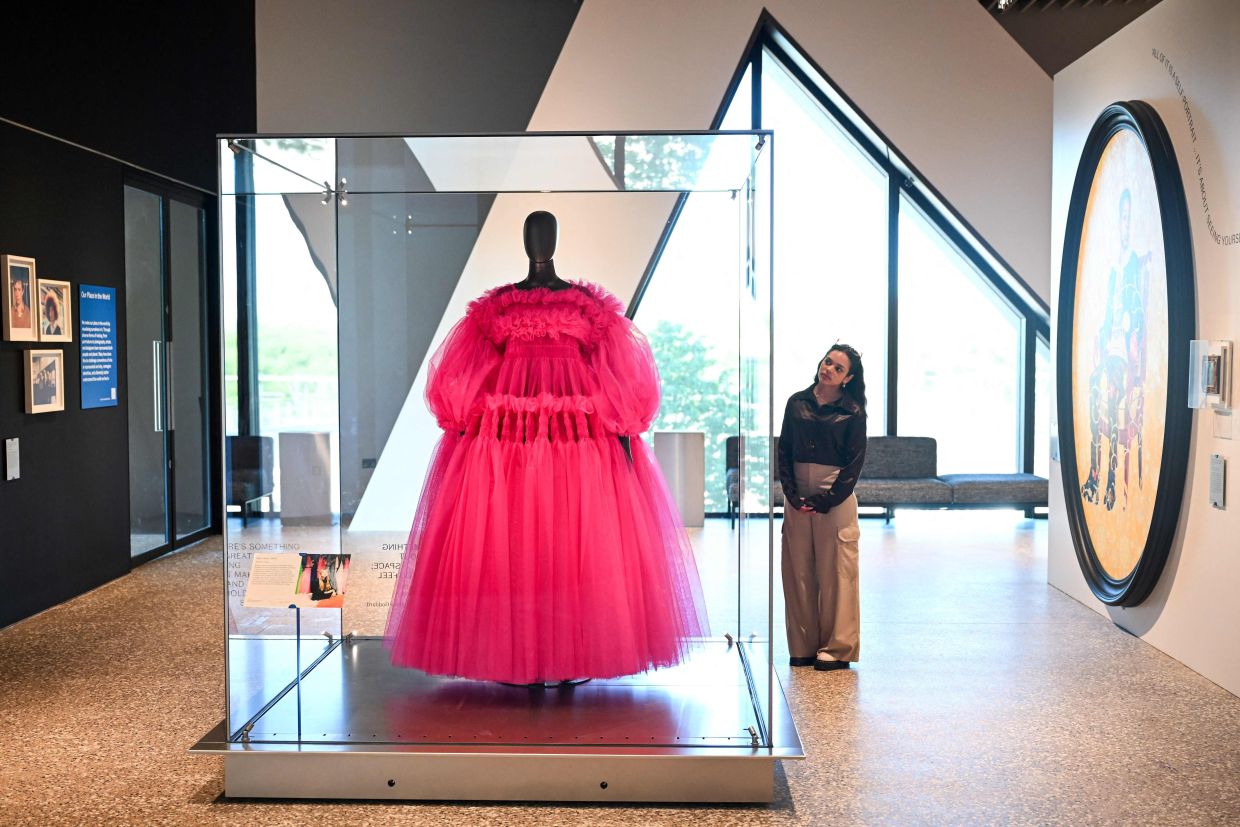
The emphasis on music and fashion reflects the museum’s desire to engage Gen Z visitors, according to V&A East director Gus Casely-Hayford. There are costumes on display by Vivienne Westwood and Alexander McQueen. Prominently positioned at the entrance to the Why We Make show is the bright pink “Daria” dress by London fashion designer Molly Goddard, made famous by its large volume of material (60m of nylon tulle) and for being worn by Beyonce.
On opening day, Theo Keschner, 22, soon to be a student at the London College of Fashion next door, was hooked by the focus on fashion.
“You can tell they’ve thought about what someone my age is talking about,” he said. “It’s more noticeable than, say, the National Gallery.”
Casely-Hayford visited more than 100 local schools to hear from students what they wanted.
“They were honest,” he says. “They were frustrated by museums. They wanted respect. They wanted us to tell their stories in ways that reflected their priorities.”
One outcome is that the museum has a strong focus on local stories: A cabinet dedicated to the 19th century designer William Morris emphasises his connection to his birthplace, the east London area of Walthamstow.
One audio exhibit allows visitors to listen to the memories of Tom Hunter, a photographer who documented social change in nearby Hackney in the 1990s.
The V&A East Museum follows the success of the V&A East Storehouse, its £65mil (RM348mil) sister venue half a mile away in Hackney Wick, which opened in May 2025. The storage warehouse is a peep-behind-the-curtains experience that displays items, sometimes without descriptive labels, from the collection of the storied Victoria & Albert Museum.
One minute you’re looking at an Olympic torch from 2012, the next you’re eyeing a sleek 1960s chair. You can also order items from the archive – say, a 12-string guitar from the David Bowie collection – for a private audience.
The V&A East Storehouse’s first seven months saw 416,300 visitors, beating its target of 250,000 a year. (For comparison, the original V&A in South Kensington welcomed 3.3 million visitors in 2025.)
“We want to be a place of refuge and reflection for many – particularly young people,” says Casely-Hayford about V&A East Museum.
The V&A’s own research on the first six months of V&A East Storehouse is promising: More than 31% of visitors were age 16 to 35, and more than 45% of British audiences were from minority ethnic groups.
Those shaping London’s new venues can be encouraged by some successes by established museums amidst the general slump in post-Covid attendance.
In 2025, London’s Natural History Museum broke the all-time record for annual footfall to a museum in Britain, with more than 7.1 million visits across the year.
It attributes this to a strategy of regularly opening new spaces within the museum.
Last year’s boost in visits came partly, according to the museum, from the launch of a new permanent gallery, Fixing Our Broken Planet, dedicated to the global climate emergency. (It charts the impact of humans on the natural world and suggests how we can act to solve environmental challenges.)
Since June 2025, visitors to the Natural History Museum can also pay (£20, RM107 for an adult) to attend a 50-minute cinematic experience, Our Story With David Attenborough, which runs until August. It attracted more than 133,000 visitors in 2025.
The scale will be different at the Museum of Youth Culture. So will the subject matter: more DIY culture than dinosaurs. But the aim is similar.
“We really want to break the traditional museum mould,” says Brett.
“We want to give people a real reason to come out, to hang out, to reminisce with friends, to see themselves on the walls – and to feel like they actually belong in the space.” – Bloomberg