Salt is essential to life – it flavours our food, seasons our sweat from hard work, and lingers in our tears of joy or sorrow. An ancient Chinese proverb from the Southern Song dynasty (1127-1279) lists salt among the seven daily necessities, alongside firewood, rice, oil, soy sauce, vinegar, and tea.
Inspired by this traditional wisdom, contemporary artist Cheng Yen Pheng’s fourth solo exhibition, Salt Of The Land, at Wei-Ling Gallery in Kuala Lumpur (through Nov 8), pays humble tribute to life’s essentials – with salt as a quiet symbol of continuity.
“I wanted to find an English equivalent to the saying and came across the phrase ‘salt of the Earth’, which is used to refer to someone who is honest and upstanding,” says Cheng, 43, at a recent interview at the gallery.
“But as my solo exhibition focuses more on the relationship between people and the land, I decided to name it Salt Of The Land instead,” she adds.
This new show, with its earthy feel, comprises 10 works, much of which were made from naturally-sourced items that Cheng fashioned into materials by hand, such as mulberry paper, banana stem paper, mud bricks, and even acacia bark.
“Salt Of The Land is about being humble and down to the ground. That’s why in these works, you’ll find ordinary items from everyday life, such as spoons, chickens and pyjamas,” says Cheng.
“When I visited my godfather in Baram, Sarawak, I was struck by how deeply the indigenous communities are connected to the land – it’s family to them. Through these works, I wanted to show how closely we, too, are bound to it.”
Soil and toil
Originally from Penang, Cheng now lives in the quiet town of Batu Arang, Selangor, with her 10-year-old daughter and a host of animals. Behind their wooden kampung house, she tends a garden that nourishes both her table and her art.
Trained as a painter, Cheng tells us that what started off as a way to avoid the expensive costs of art materials has since evolved into a signature part of her practice, starting with mulberry paper, which is made from the fibre of the mulberry trees that grow in abundance around her home.
Her ideals bore fruit when Cheng’s commitment to handmade materials earned her the UOB Painting of the Year (Malaysia) 2019 award in the Established Artist category for Tug Of War: My Homeland, crafted from coarse grass roots, mulberry pulp, thread, and wood.
“Honestly, I started making my own materials out of necessity. All of my money was going towards raising my family, so I didn’t have any money leftover to buy art supplies. So I thought to myself, ‘Why not make my own materials?’,” she says.
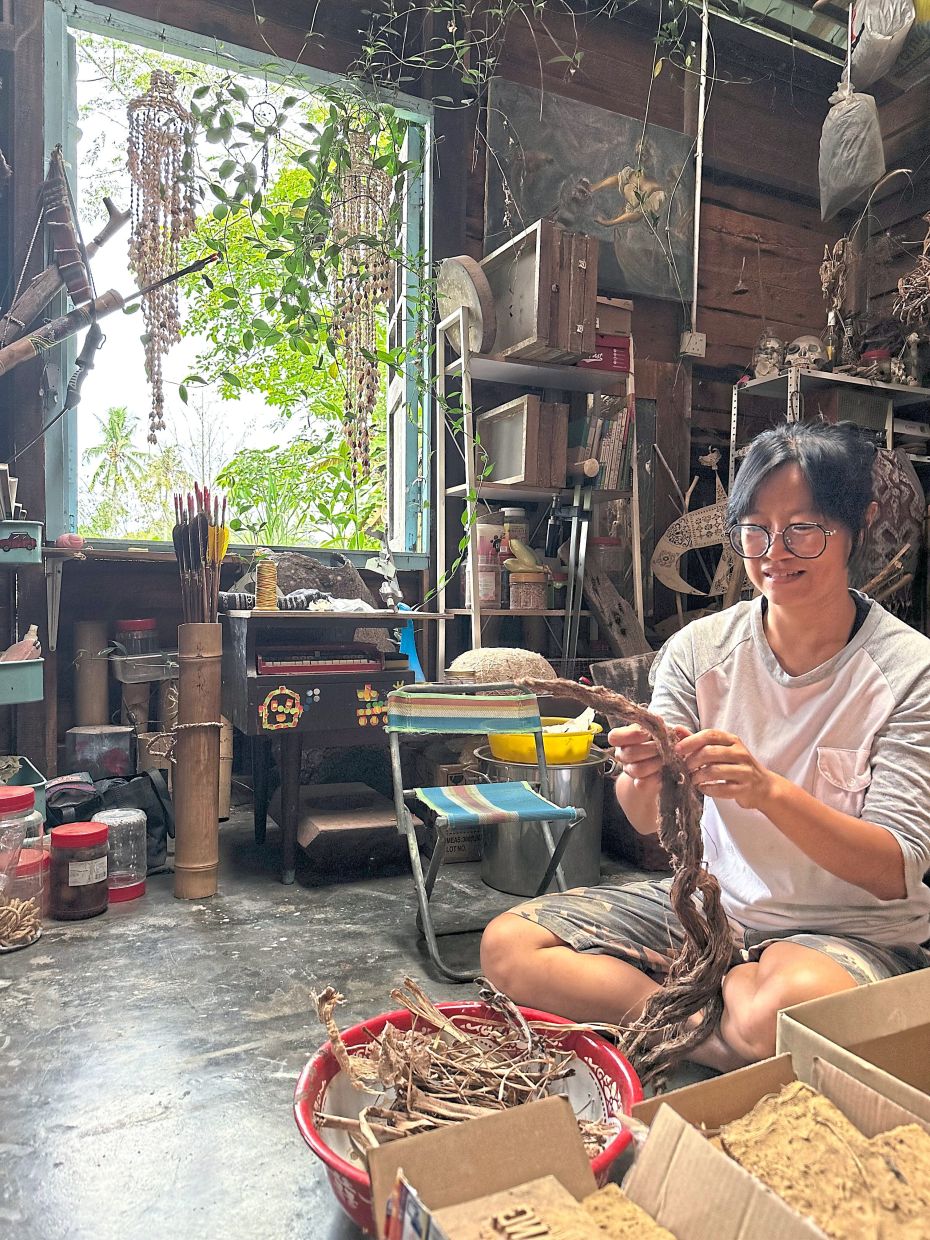
With patience and care, Cheng harnesses the four classical elements – water, fire, earth, and air – in her home studio, using traditional craft techniques to preserve artisanal knowledge and cultural memory while infusing her works with a contemporary touch.
She soaks mulberry or banana pulp for handmade paper, burns wormwood to ash for purification, mixes soil with plant fibre for bricks, and lets air dry paper and lift feathers. Though it now seems methodical, Cheng admits it took much trial and error – with a few happy accidents along the way.
“I added wormwood ash to the paper because I had read that wormwood was traditionally used as a natural insect repellent, but I discovered that after burning the wormwood, the resulting smoke had driven away the insects and pests out of my house as well!” she says with a laugh.
Close to the heart
With her handmade materials, Cheng stitches heartfelt memories and stories into her art.
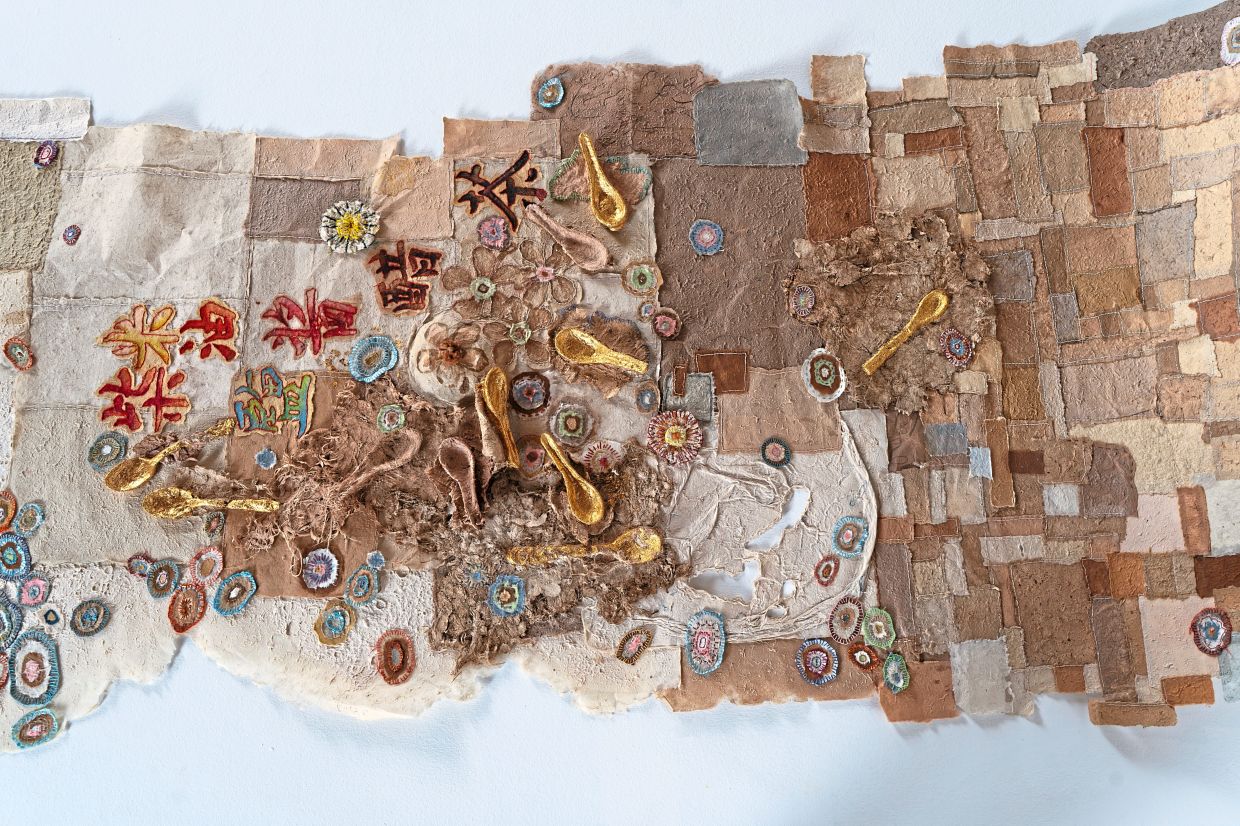
In Salt Of The Land, which shares the same title as the exhibition, the base of the work is made up of many small pieces of handmade paper that Cheng sewed together by hand, while spoons covered in gold leaf denote the spirit of togetherness that comes from sharing a communal meal.
“Firewood, rice, oil, salt, soy sauce, vinegar, tea – the simplest yet truest parts of life. The work we put into our day to day is like salt: ordinary, but it’s what gives life its flavour. This piece is a tribute to all who labour, and to everyone striving to keep order in their daily lives,” says Cheng, who personally transported much of the exhibition material to the gallery and laid it out herself.
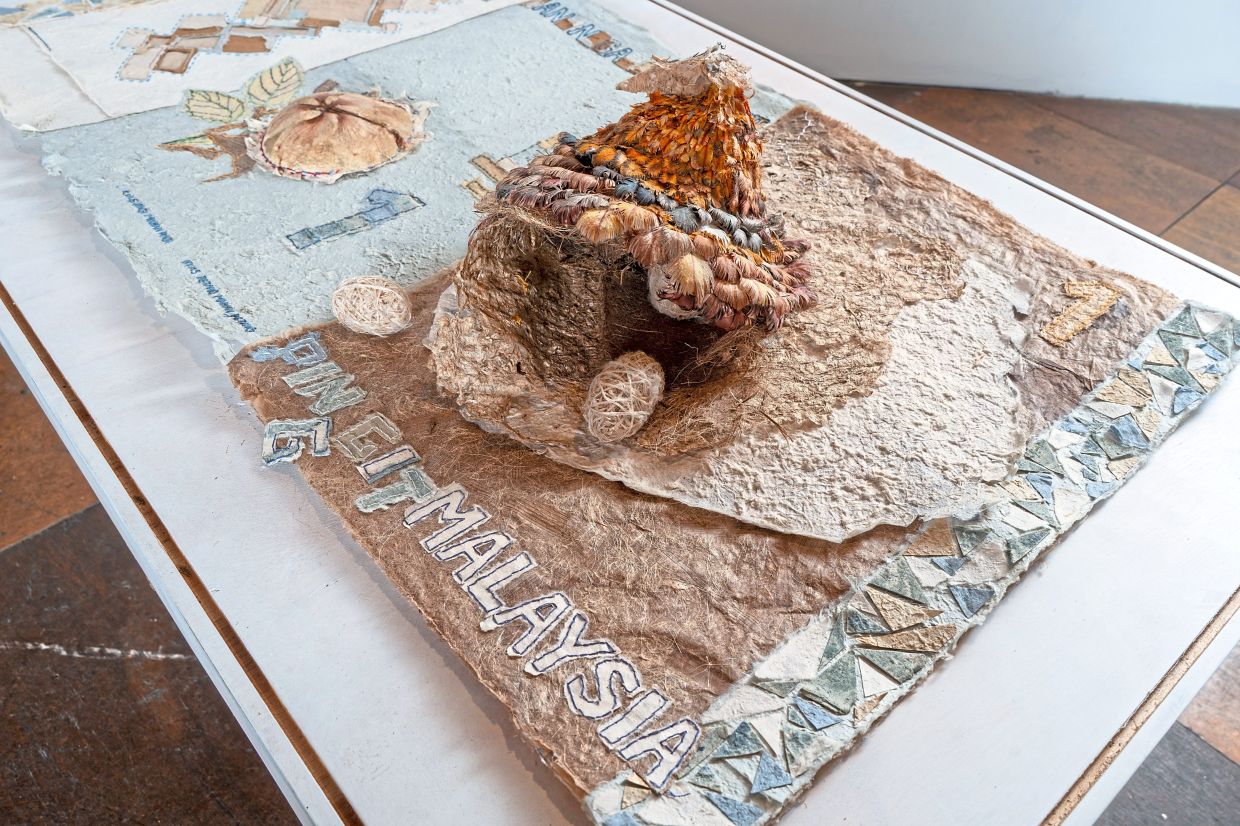
As you walk around the gallery space, you may notice a repeating motif among the works – the chicken. You see it in One Ringgit Chicken, inspired by the colloquial phrase for something cheap or insignificant.
At the centre of the piece is a chicken made from “feathers” of paper, coloured in with pencil and ink, curled at the ends as a finishing flourish.
“Here, the chicken is a metaphor for survival and the unnoticed labour that sustains a home. When value is measured only in money, how much is life’s labour and laughter still worth?” questions Cheng.
There’s also Feather Mother, Feather Home, where small chicks peek out from beneath the hen.
“After the lockdown, I began raising chickens for eggs, the most basic source of protein in our family. From five to more than thirty, they became part of our domestic world. One remarkable hen even bred four or five generations, and her daily walks with her chicks became our quiet joy.
“In this work, the mother hen embodies the cycle of care and domestic labour. Her body is a house, her feathers are its walls, a shelter of tenderness and endurance that sustains everyday life,” says Cheng.
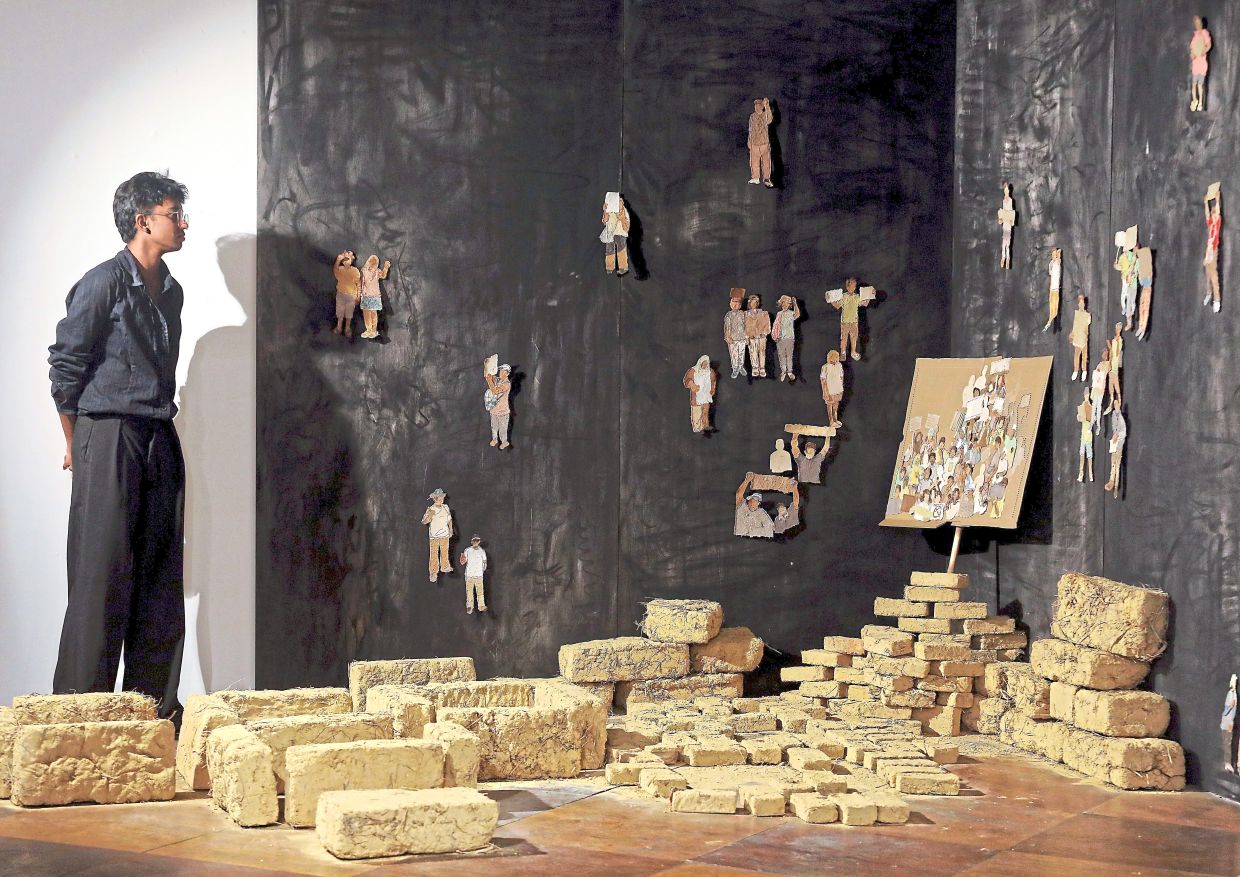
The installation Feathers On The Floor, But We Stand Firm And Tall is a poignant one – its walls are coated in black charcoal and its floor is covered with mud bricks made from red clay, sand and plant fibres, stacked haphazardly.
On the walls, figures of Batu Arang residents stand in protest against a proposed mega incinerator – among them Cheng and her daughter, active voices in the movement.
“Over the past two years, my life has been deeply influenced by community movements. Regardless of how systems change, people should never forget their right to democracy and self-determination. It is not a gift granted from above, but a voice reclaimed brick by brick, from the soil itself.
“To fight for our right to democracy and self-determination is an inseparable part of life. Amidst the disorder and fragments of everyday struggle, there is still collective strength, a fragile unity, yet steadfast as a wall built from many hands,” concludes Cheng.
Salt Of The Land runs at Wei-Ling Gallery, Brickfields, Kuala Lumpur, until Nov 8. Open Tuesday-Friday (10am-6pm) and Saturday (10am-5pm). For appointments, call 03-2260 1106. More info: weiling-gallery.com.