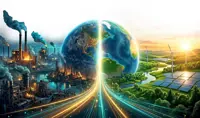
2026 has been a tumultuous year for the global climate, as Mother Earth faces one of the most intense El Nino events in human history.
The collapse of Himalayan glaciers, which triggered a severe inland tsunami in Nepal and the surrounding areas on Aug 26 this year, serves as a warning that the world faces severe climate consequences if nothing is done.
In his book, “The Energy Transition Conundrum,” Datuk Kenneth Pereira brings these competing demands into a single discussion.
The book connects climate science and economic history with energy security, politics and finance. Its value lies in explaining not just the ambition behind the transition, but also the practical difficulties of delivering it.
Thirst for power
The world has relied on fossil fuels because they have driven economic growth. Historical evidence suggests that whether it was coal, oil, gas, or nuclear, the world needs them in abundance to maintain economic momentum.
Industrialisation and rising electricity demand have further increased fossil fuel demand. In contrast, population growth, demand for air travel, sea vessels for transporting goods, and explosive demand for automobiles have left the world thirsty for energy.
The quest for energy supplies and reserves has led to countless wars and oil crises, which, up to today, have resulted in the loss of millions of lives and livelihoods, too.
According to the author, fossil fuels delivered more than 80% of global primary energy demand (600 exajoules) in 2025. Yet, energy demand is still expected to rise by between 30% and 75% by 2050.
However, while renewable energy is expected to grow the fastest, non-fossil fuel sources are projected only to reach 29% to 34% of total primary energy supply by 2050.
Overall, electricity supply is expected to be central to the energy transition, while energy demand is expected to rise substantially by 2050, even as non-fossil sources expand.
In addition, rising energy demand also raises emissions and climate-change concerns. The challenge, therefore, is not simply to replace existing energy supplies, but to meet rising demand while reducing emissions and addressing climate change.
War and politics
The author has written extensively about how war and politics affect energy issues. He argues that while nations are committed to the net-zero target by 2050, the Russian invasion of Ukraine has shifted their energy priorities.
Energy security has now become Europe’s top priority, while sustainability has taken a back seat.
While the war in Ukraine helped fast-track energy-transition efforts, the immediate shift was emergency diversification (liquefied natural gas or LNG, storage and alternative sources and suppliers) and reduced energy demand.
As a result, climate considerations took a back seat as economic resilience took precedence.
The war in Iran, which led to the closure of the Strait of Hormuz, pushed nations to accelerate energy-transition initiatives to reduce dependence on oil from the conflict zone.
Hence, nations now face not only the costs of climate risks, but also the need to mitigate energy security threats, both of which can be costly.
It remains uncertain how countries ensure that climate-change adaptation and mitigation, coupled with energy security imperatives, are funded appropriately.
This is an important distinction. Assessing the energy transition only against emissions targets may overlook affordability, reliability and resilience.
The book’s treatment of war, geopolitics and finance helps explain why governments cannot solely remain committed to climate objectives while ignoring immediate energy security priorities.
Energy security
Concerns about energy sources have also led nations to prioritise energy security, defined as a reliable, affordable and resilient energy supply needed to keep a nation’s economy, society and essential services functioning at all times. According to the author, energy security deserves the same standing as national economic and defence strategies.
Importantly, the discussion extends beyond electricity. Transport fuels, industrial requirements and household consumption all make up the national energy demand mix.
The Paris climate conference in 2015 also highlighted the difficulty of achieving rapid decarbonisation while keeping energy costs low, ensuring abundant supply and maintaining financial viability and political acceptability in an uncertain world where energy security is increasingly under threat.
Current status
According to the author, post-Paris, funding commitments have been insufficient to meet climate goals.
While the European Union (EU), the United States, China and even India have pledged to reduce carbon emissions by varying percentages, global pledges and policies still fall far short of the Paris agreement’s targets.
A central issue is the “ambition gap” – the distance between climate objectives and the pledges, policies and implementation needed to fulfil them. The discussion considers whether the scale of the task was underestimated, substitutes were overpromised and supporting systems were underbuilt.
The book also examines the effects of anti-fossil-fuel campaigning, subsequent policy reversals and inadequate long-term investment.
It raises important questions about the energy transition, placing it within the realities of capital allocation and implementation.
The cost of emissions
The economic assessment goes beyond the cost of building a cleaner energy system. The author considers the historical costs or emissions and estimates the future bill if net-zero targets are missed.
He also examines the benefits historically associated with emissions-producing economic growth, weighing them against the benefits of accelerated decarbonisation and the risks of an energy shortfall.
This gives the discussion valuable balance, as the costs of climate damage, the consequences of delayed action and the economic risks of an inadequately supplied energy system need to be considered together.
Financing
The biggest issue in tackling climate change and incentivising the transition to more sustainable energy sources is financing. In fact, the author observes that the primary fuel of a successful energy transition is not solar, nuclear or wind energy, but adequate and appropriate funding.
In the EU, financing for the green agenda comes from multiple channels – budgets, green bonds, transition funds, carbon pricing and traditional lending institutions. In summary, funding will come from everyone, in layers.
Developing economies often lack the resources to invest in clean energy and protect their communities.
While wealthier nations may be better equipped to meet these funding needs, others struggle, creating a “climate funding gap.” This makes it even harder for the world to move to a safer climate pathway.
Overall, the book’s strength lies in its broad, interconnected perspective. Students and general readers gain a foundation spanning science, history, and economics.
Policymakers encounter
the tensions among climate ambition, national resilience and limited funding. Corporate players responsible for sustainability gain context for considering energy costs, investment decisions and emissions obligations.
By bringing these issues together, the author makes the energy conundrum easier to understand and the debate more relevant to those expected to act on it.
Next week, the focus will be on the author’s views on climate-change funding and whether they address the current dilemma.
Already a subscriber? Log in
Get 20% OFF The Star Digital Access
Cancel anytime. Ad-free. Unlimited access with perks.