
BY now, most investors would have familiarised themselves with the concept of the Madani Economy since the launch last week by Prime Minister Datuk Seri Anwar Ibrahim.
Anchored on seven key objectives, the Madani Economy blueprint can be said to be a holistic assessment of where we are and where we intend to go over the next 10 years to get our mojo back as we had lagged behind other economies in the region.
Hence, the Madani Economy can be said to be the master plan while the National Energy Transition Roadmap (NETR) Part 1, which was launched last week, as well as the New Industrial Master Plan 2030 (NIMP2030), to be launched at the end of this month, are the building blocks that will take us where we want to be in 10 years and beyond.
Top 30 globally
One of the key objectives of the Madani Economy is to make Malaysia among the Top 30 economies globally within the next decade.
Based on World Bank data, we are probably ranked 36 globally based on last year’s nominal gross domestic product (GDP) value of RM1.79 trillion and the greenback and ringgit exchange rate then.
Hence, it is not only the size of the economy but also the exchange rate that will determine our global ranking, and as we know, the weakness of the ringgit too has caused us to slip lower and lower.
If the ringgit was at about RM3.75 to the dollar, Malaysia would already be ranked among the top 30 globally, just behind Thailand, but well ahead of Vietnam and Singapore.
Ringgit aside, the Prime Minister had laid out broad reform agendas in the form of “raising the ceiling” and “raising the floor” and addressing key concerns among the various stakeholders.
The key structural roadblock will be having the political will to do the right thing, which is not only about restructuring our over-dependence on subsidies but also raising wages progressively, introducing tax reforms, including new taxes, improving our education standards, and making Malaysia an attractive choice of investment destination for foreign investors.
Off the mark
Among the key targets that were laid out last week under the Madani Economy was to achieve a fiscal deficit target of 3% or better in 10 years.
Ironically, under the 12th Malaysia Plan, Malaysia’s target was to hit a 3% to 3.5% budget deficit target by the end of 2025.
Hence, it is rather surprising when one of the Madani Economy’s objectives was “kicked down the road” with a 3% target or lower within 10 years.
A more optimistic target would have been to achieve at least a balance if not a surplus budget in 10 years instead.
Having said that, the key in any government finances is about boosting government revenue and reducing expenditure and this leads to the much-delayed tax reforms – in the form of higher tax rates, new taxes as well as the removal of some of the reliefs provided to individuals or corporates to ensure we have higher collection.
The introduction of the long-awaited Fiscal Responsibility Act also can help the government’s finances to be better managed and governed.
Exponential wage growth?
Firstly, wages must commensurate with productivity gains to ensure that we do generate economic value with higher wages.
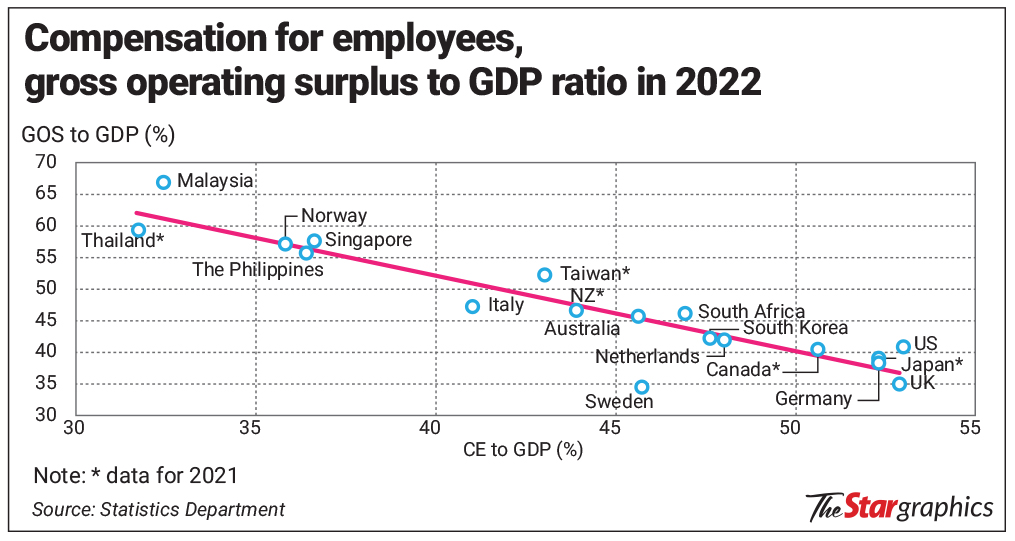
Yes, Malaysia’s current compensation for employees (CE) to GDP ratio of just 32.4% is simply unacceptable, but at the same time, we must ensure we are able to implement the much-talked-about “progressive wage model” that will lift income for the people.
If our economy is going to double in 10 years (based on 6% plus growth as envisaged in the Madani Economy), our income will need to expand nearly three times to enable us to achieve the 45% CE to GDP ratio – a daunting task under the current scenario whereby any discussion on higher wages is quickly shot down by employers, especially via the Malaysian Employers Federation.
Hence, we need a concerted effort to raise wages at different levels and this includes a decent minimum wage, higher entry-level wages for our graduates, and higher income overall.
The current Gross Operating Surplus (GOS) enjoyed by businesses at 67% is simply insane, while the government’s tax revenue net of subsidies (T-S) as a percentage of GDP at just 0.6% is ridiculously low.
Businesses ought to have a lower operating surplus by at least 15 to 20 percentage points and this should be reallocated in the form of higher CE and T-S.
Based on data provided by the Statistics Department and as seen in the accompanying chart, Malaysia’s current CE and GOS to GDP ratio is an outlier which basically shows Malaysia needs not only lay out the plan forward to normalise the current imbalance shared between employees and businesses, but to have concrete fiscal reforms that will generate higher revenue for the government via higher taxes and lower subsidies.
Based on the best-fit line, the mean values sit at 45% and 46% for CE and GOS respectively, while the T-S value is at 9%.
Madani Economy – the way forward
With comprehensive targets set, the work to achieve the seven bold objectives is just getting started and the government has already hit the ground running with the launch of NETR (Part 1) last week and this will be followed by the launch of NIMP2030 later this month.
Obviously, there will be more to come in terms of broad and specific incentives, but the most important is to get both the public sector (perhaps via the government- linked companies and government-linked investment companies) and the private sector to participate in the national agenda to take the country to the next level.
Enough of the rhetoric, let us get moving. Malaysia needs to win back its mojo and return to the path where this nation belongs and not be hijacked by political expediency.
Pankaj C. Kumar is a long-time investment analyst. The views expressed here are the writer’s own.
Already a subscriber? Log in
Get 20% OFF The Star Digital Access
Cancel anytime. Ad-free. Unlimited access with perks.